AlRukban Mohammed, AlRuthia Yazed, Almasaoud Majed, Al-Owairdhi Mohammad, Alsouan Anwar, Alrabiah Abdullah, Alshaikh Abdulrahman, Alsuhaibani Adel, Aleidan Alan
Department of Family Medicine, College of Medicine, King Saud University, Riyadh, Saudi Arabia.
Department of Clinical Pharmacy, College of Pharmacy, King Saud University, Riyadh, Saudi Arabia.
Risk Manag Healthc Policy. 2020 Dec 8;13:2899-2907. doi: 10.2147/RMHP.S278404. eCollection 2020.
The aim of this study was to explore community pharmacists' views toward the antibiotics dispensing law that was enforced in May 2018 and bans the sale of antibiotics without a prescription in community pharmacy settings in Saudi Arabia. Moreover, the potential impact of the law enforcement on the sales of oral antibiotics in Saudi Arabia was also explored.
A questionnaire-based cross-sectional study was conducted between September 2019 and March 2020 in Riyadh, Saudi Arabia. A multistage sampling technique was used to recruit community pharmacists from different districts. Pharmacists who consented to participate and reported practicing prior to the law enforcement were interviewed about their views of the law using a 14-item newly developed questionnaire. The annual sales of oral antibiotics for the years of 2017, 2018, and 2019 were retrieved from the Saudi Food and Drug Authority (SFDA) database.
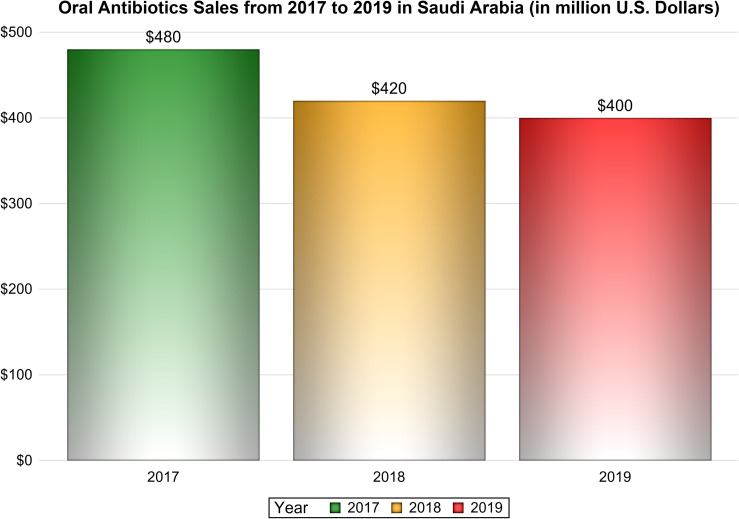
Two hundred and eighty six pharmacists consented to participate and met the inclusion criteria. After the law enforcement, approximately 51% of the participants reported that the percentage of patients seeking antibiotics without a prescription is less than 25%. Moreover, the majority (87.41%) reported a drop in the sales of antibiotics. Additionally, about 90% of the participants believed that the rate of inappropriate use of antibiotics will decrease as a result of the law enforcement. About 41% of the participants reported that the law has negatively impacted their pharmacies' profits. The sales of oral antibiotics have seen a 16.6% drop in the year of 2019 as compared to 2017.
The antibiotics dispensing law is favorably perceived among community pharmacists in Saudi Arabia despite some concerns about its impact on their sales. Exploring different business models that delink the profits from the volume of antibiotics sales is necessary for this vital industry to thrive.
本研究旨在探讨社区药剂师对2018年5月实施的抗生素配药法的看法,该法律禁止在沙特阿拉伯的社区药房无处方销售抗生素。此外,还探讨了执法对沙特阿拉伯口服抗生素销售的潜在影响。
2019年9月至2020年3月在沙特阿拉伯利雅得进行了一项基于问卷的横断面研究。采用多阶段抽样技术从不同地区招募社区药剂师。同意参与并报告在执法前执业的药剂师使用一份新开发的包含14个条目的问卷接受有关他们对该法律看法的访谈。从沙特食品药品管理局(SFDA)数据库中检索2017年、2018年和2019年口服抗生素的年销售额。
286名药剂师同意参与并符合纳入标准。执法后,约51%的参与者报告说,无处方寻求抗生素的患者比例低于25%。此外,大多数(87.41%)报告抗生素销售额下降。此外,约90%的参与者认为执法将导致抗生素不当使用的比率下降。约41%的参与者报告说,该法律对其药房的利润产生了负面影响。与2017年相比,2019年口服抗生素的销售额下降了16.6%。
尽管沙特阿拉伯的社区药剂师对该抗生素配药法对其销售的影响存在一些担忧,但他们对该法律的看法是积极的。对于这个重要行业的蓬勃发展来说,探索将利润与抗生素销售量脱钩的不同商业模式是必要的。