Adelaide Medical School, The University of Adelaide, Adelaide, SA, Australia.
School of Public Health, The University of Adelaide, Adelaide, SA, Australia.
Front Public Health. 2020 Dec 1;8:595943. doi: 10.3389/fpubh.2020.595943. eCollection 2020.
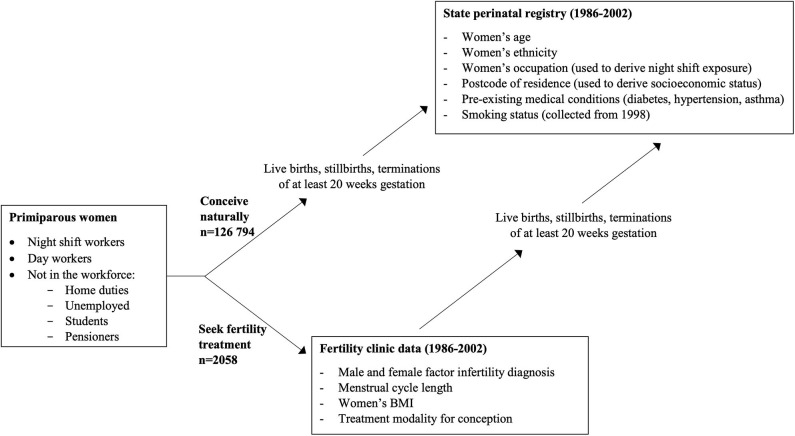
Asynchrony in circadian processes alters many physiological systems, including female reproduction. Thus, there are possible reproductive consequences of night shift work for women including menstrual irregularity, endometriosis, and prolonged time to conception. This study examined whether women who worked night shift were more likely than those who did not to require fertility treatment to conceive a first birth, whether they had specific infertility diagnoses, and if such relationships were age-specific. In a retrospective data linkage study of 128,852 primiparous women, fertility treatment data were linked to the state perinatal registry for South Australia (1986-2002). Potential exposure to night shift work was assessed using a job-exposure matrix. First, the association between night shift work and fertility treatment was assessed among (1) all women, then (2) women in paid employment, using logistic regression. Interactions between age and shift work status were also examined. Secondly, among women who conceived with fertility treatment, we assessed associations between night shift work and type of infertility diagnosis. Potential confounders were considered in all analyses. Among women ≤35 years, night shift workers were more likely to require fertility treatment (all: OR = 1.40, 95% CI 1.19-1.64; in paid employment: OR = 1.27, 95% CI 1.08-1.50). There were no associations among women >35 years. Ethnicity, socioeconomic status and smoking did not affect these results. Among women who underwent fertility treatment, night shift workers were more likely than day workers to have menstrual irregularity (OR = 1.42, 95% CI 1.05-1.91) or endometriosis (OR = 1.34, 95% CI 1.00-1.80). Night shift work may contribute to increased need for fertility treatment in younger women. This increased risk may reflect young women's vulnerability in terms of poor tolerance of night shift work, and/or lack of control and choice about shift schedule.
昼夜节律过程的不同步会改变许多生理系统,包括女性生殖系统。因此,女性倒班工作可能会对生殖系统产生影响,包括月经不规律、子宫内膜异位症和妊娠时间延长。本研究旨在探讨夜班工作的女性是否比不从事夜班工作的女性更有可能需要接受生育治疗才能首次怀孕,以及她们是否有特定的不孕诊断,如果存在这种关系,是否与年龄有关。
在一项对 128852 名初产妇的回顾性数据链接研究中,生育治疗数据与南澳大利亚州围产期登记处(1986-2002 年)相关联。夜班工作的潜在暴露情况通过工作暴露矩阵进行评估。首先,在(1)所有女性和(2)有薪就业的女性中,使用逻辑回归评估夜班工作与生育治疗之间的关联。还检查了年龄和轮班工作状态之间的相互作用。其次,在接受生育治疗后怀孕的女性中,我们评估了夜班工作与不孕诊断类型之间的关联。在所有分析中都考虑了潜在的混杂因素。
在≤35 岁的女性中,夜班工作者更有可能需要接受生育治疗(全部:OR=1.40,95%CI1.19-1.64;有薪就业:OR=1.27,95%CI1.08-1.50)。而在>35 岁的女性中,没有关联。种族、社会经济地位和吸烟并没有影响这些结果。在接受生育治疗的女性中,夜班工作者比白班工作者更有可能出现月经不规律(OR=1.42,95%CI1.05-1.91)或子宫内膜异位症(OR=1.34,95%CI1.00-1.80)。
夜班工作可能导致年轻女性更需要接受生育治疗。这种风险增加可能反映了年轻女性对夜班工作的较差耐受性和/或对轮班时间表缺乏控制和选择方面的脆弱性。