Department of Epidemiology, Johns Hopkins Bloomberg School of Public Health, Baltimore, MD, USA.
Welch Center for Prevention, Epidemiology and Clinical Research, Johns Hopkins University, Baltimore, MD, USA.
BJOG. 2021 Jul;128(8):1293-1303. doi: 10.1111/1471-0528.16633. Epub 2021 Feb 1.
Caesarean section (CS) interrupts mother-to-newborn microbial transfer at birth. Beyond the neonatal period, the impact of CS on offspring gut microbiota and their short-chain fatty acids (SCFAs) remains unclear. Here, we examine birth delivery mode (CS versus vaginal delivery) with the infant gut microbiota and faecal SCFAs measured 3 and 12 months after birth.
Longitudinal study.
North Carolina.
In 2013-15, we enrolled pregnant women and followed up their offspring for 12 months. We asked a subset of participants, enrolled over a 3-month period, to provide faecal samples at the 3- and 12-month follow-up visits.
We sequenced the 16S rRNA V4 region with Illumina MiSeq and quantified SCFA concentrations using gas chromatography. We examined delivery mode with differential abundance of microbiota amplicon sequence variants (ASVs) using beta-binomial regression and faecal SCFAs using linear regression. We adjusted models for confounders.
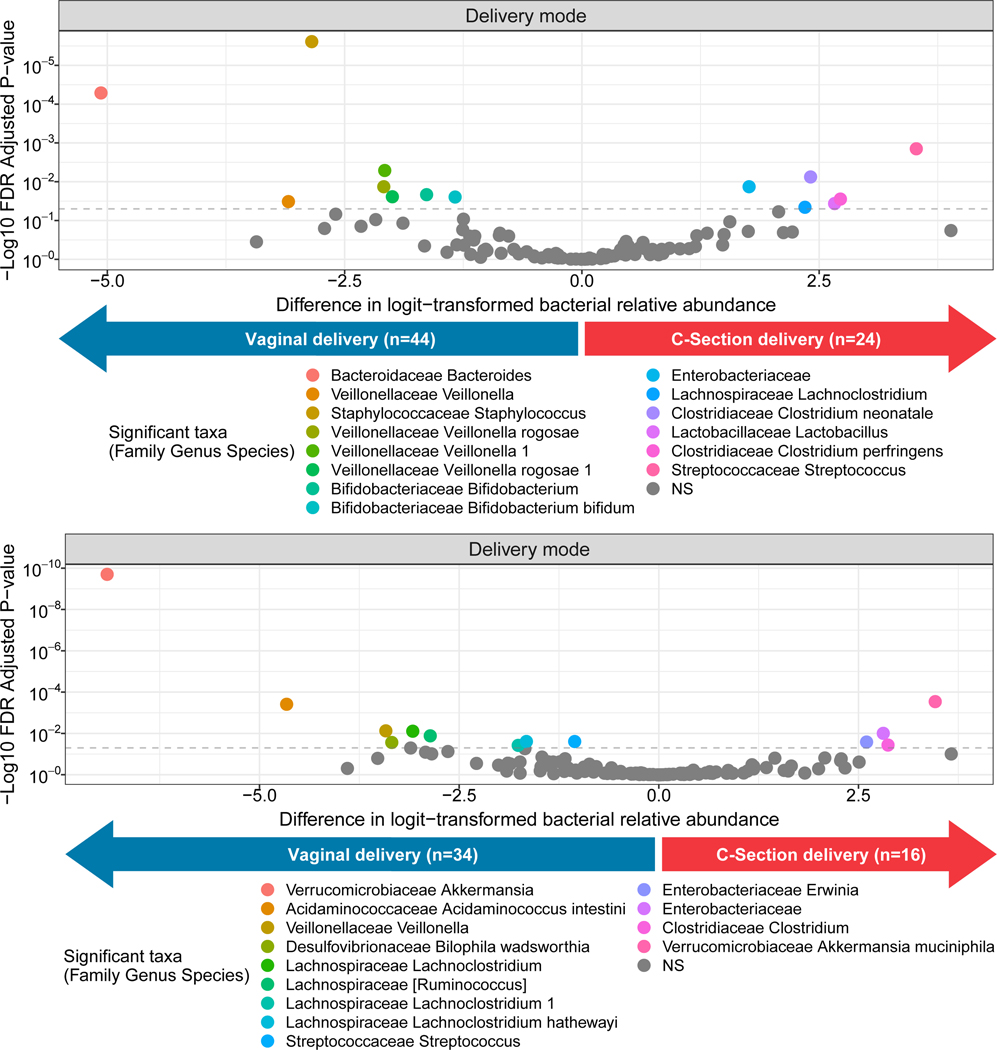
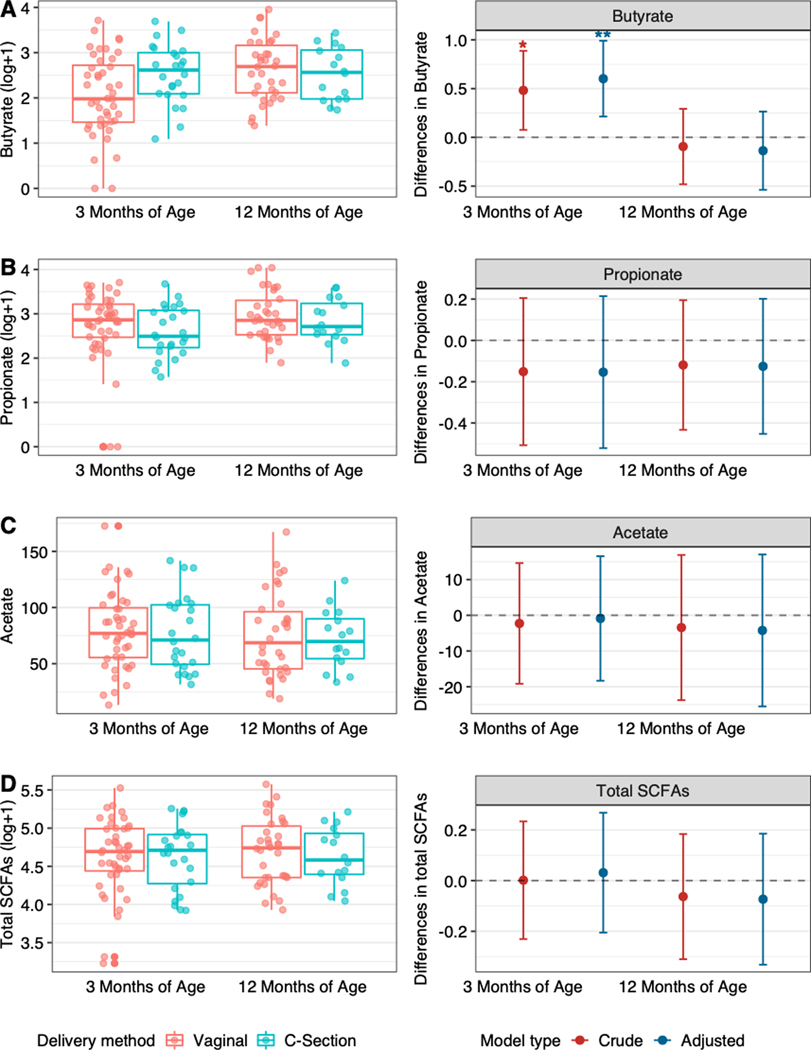
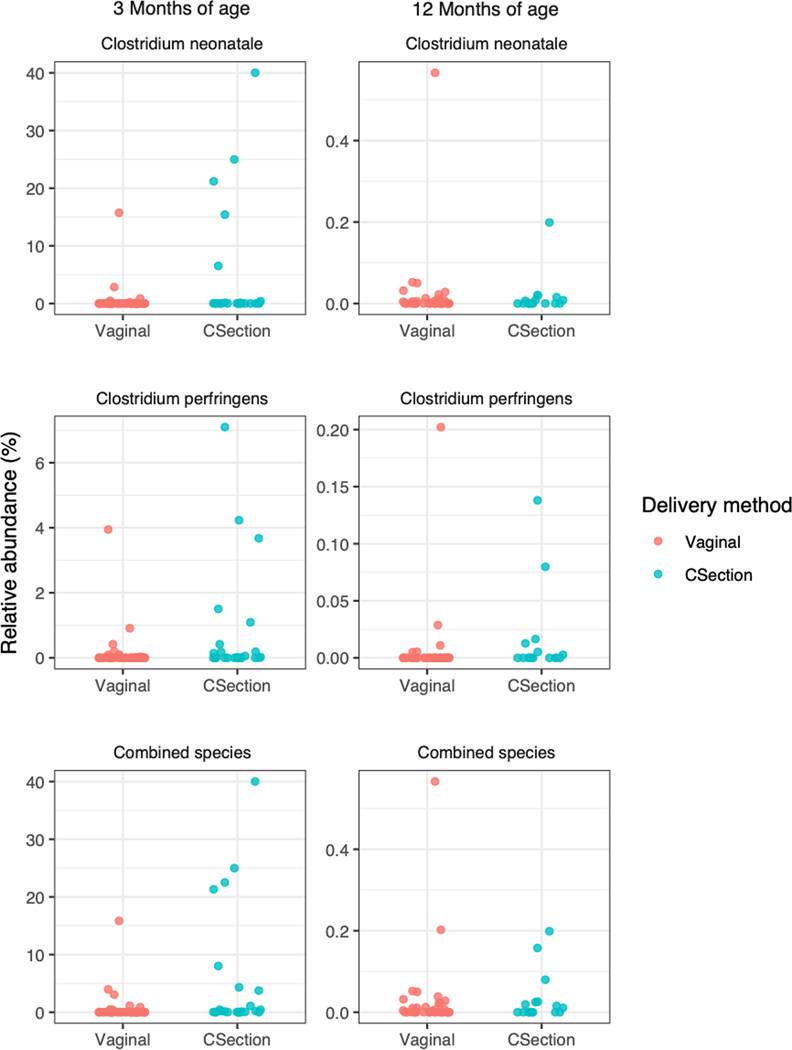
Of the 70 infants in our sample, 25 (36%) were delivered by CS. Compared with vaginal delivery, CS was associated with differential abundance of 14 infant bacterial ASVs at 3 months and 13 ASVs at 12 months (all FDR P < 0.05). Of note, CS infants had a higher abundance of the potential pathobionts Clostridium neonatale (P = 0.04) and Clostridium perfringens (P = 0.04) and a lower abundance of potentially beneficial Bifidobacterium and Bacteroides spp. (both P < 0.05) at 3 months. Other ASVs were differentially abundant at 12 months. Infants delivered by CS also had higher faecal butyrate concentration at 3 months (P < 0.005) but not at 12 months.
Caesarean section was associated with increased butyrate excretion, decreased Bifidobacterium and Bacteroides spp., and more colonisation of the infant gut by pathobionts at 3 months of age. CS was also associated with altered gut microbiota composition, but not faecal SCFAs, at 12 months.
Caesarean section delivery was associated with increased butyrate excretion, decreased Bifidobacterium, and increased colonisation of the infant gut by pathobionts at 3 months of age.
剖宫产术(CS)会在分娩时中断母婴间的微生物转移。在新生儿期之后,CS 对后代肠道微生物群及其短链脂肪酸(SCFA)的影响仍不清楚。在这里,我们研究了分娩方式(CS 与阴道分娩)与婴儿肠道微生物群的关系,并在出生后 3 个月和 12 个月测量粪便中的 SCFA。
纵向研究。
北卡罗来纳州。
2013-15 年,我们招募了孕妇,并对其后代进行了 12 个月的随访。我们邀请了一部分参与者(在 3 个月的时间内招募)在 3 个月和 12 个月的随访时提供粪便样本。
我们使用 Illumina MiSeq 对 16S rRNA V4 区进行测序,并使用气相色谱法定量 SCFA 浓度。我们使用 beta-binomial 回归分析微生物扩增子序列变体(ASV)的差异丰度,并使用线性回归分析粪便 SCFA。我们调整了模型以控制混杂因素。
在我们的样本中,70 名婴儿中有 25 名(36%)是剖宫产分娩。与阴道分娩相比,CS 与 3 个月时 14 种婴儿细菌 ASV 的差异丰度和 12 个月时 13 种 ASV 的差异丰度相关(所有 FDR P < 0.05)。值得注意的是,CS 婴儿的潜在病原体梭状芽胞杆菌属(Clostridium neonatale)(P = 0.04)和产气荚膜梭菌(Clostridium perfringens)(P = 0.04)的丰度更高,而潜在有益的双歧杆菌属(Bifidobacterium)和拟杆菌属(Bacteroides)的丰度更低(均 P < 0.05)在 3 个月时。其他 ASV 在 12 个月时丰度不同。CS 分娩的婴儿在 3 个月时粪便丁酸浓度也更高(P < 0.005),但在 12 个月时则不然。
CS 与 3 个月时的丁酸排泄增加、双歧杆菌和拟杆菌属减少以及婴儿肠道中更多的病原体定植有关。CS 还与 12 个月时的肠道微生物群组成改变有关,但与粪便 SCFA 无关。
剖宫产分娩与 3 个月时丁酸排泄增加、双歧杆菌减少以及婴儿肠道中更多的病原体定植有关。