CRESS, Obstetrical Perinatal and Paediatric Epidemiology Research Team, EPOPe, INSERM, INRA, Universite de Paris, Paris, France.
Centre for Maternal and Child Health Research, School of Health Sciences, City, University of London, London, UK.
BJOG. 2021 Aug;128(9):1444-1453. doi: 10.1111/1471-0528.16634. Epub 2021 Feb 1.
Robson's Ten Group Classification System (TGCS) creates clinically relevant sub-groups for monitoring caesarean birth rates. This study assesses whether this classification can be derived from routine data in Europe and uses it to analyse national caesarean rates.
Observational study using routine data.
Twenty-seven EU member states plus Iceland, Norway, Switzerland and the UK.
All births at ≥22 weeks of gestational age in 2015.
National statistical offices and medical birth registers derived numbers of caesarean births in TGCS groups.
Overall caesarean rate, prevalence and caesarean rates in each of the TGCS groups.
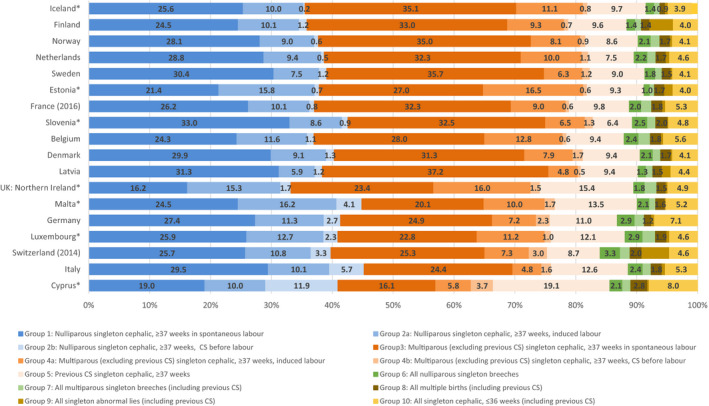
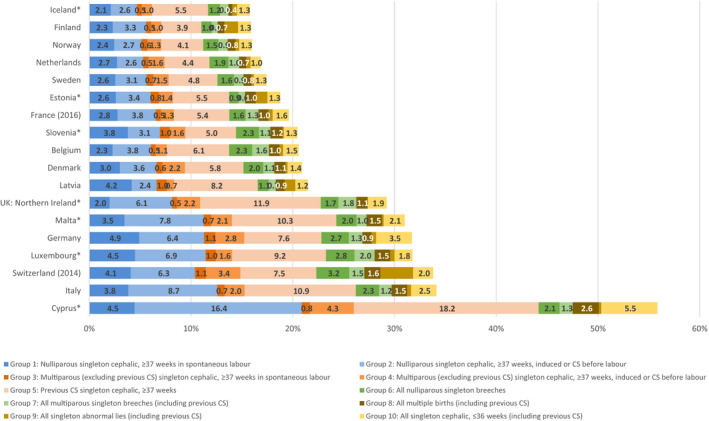
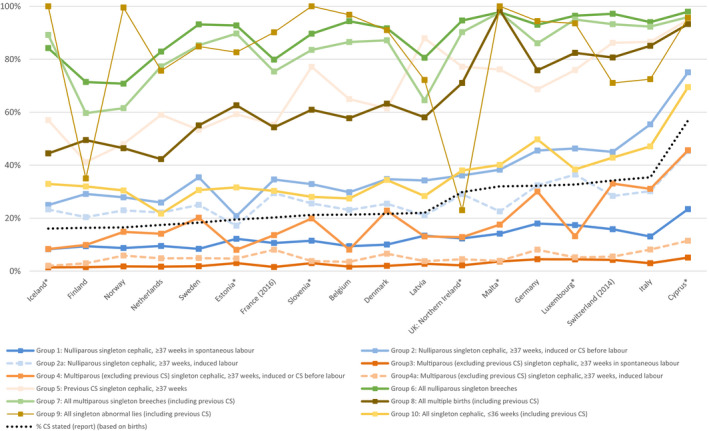
Of 31 countries, 18 were able to provide data on the TGCS groups, with UK data available only from Northern Ireland. Caesarean birth rates ranged from 16.1 to 56.9%. Countries providing TGCS data had lower caesarean rates than countries without data (25.8% versus 32.9%, P = 0.04). Countries with higher caesarean rates tended to have higher rates in all TGCS groups. Substantial heterogeneity was observed, however, especially for groups 5 (previous caesarean section), 6, 7 (nulliparous/multiparous breech) and 10 (singleton cephalic preterm). The differences in percentages of abnormal lies, group 9, illustrate potential misclassification arising from unstandardised definitions.
Although further validation of data quality is needed, using TGCS in Europe provides valuable comparator and baseline data for benchmarking and surveillance. Higher caesarean rates in countries unable to construct the TGCS suggest that effective routine information systems may be an indicator of a country's investment in implementing evidence-based caesarean policies.
Many European countries can provide Robson's Ten-Group Classification to improve caesarean rate comparisons.
罗布森的十组分类系统(TGCS)为监测剖宫产率创建了具有临床相关性的亚组。本研究评估了该分类系统是否可以从欧洲的常规数据中得出,并使用该系统分析国家剖宫产率。
使用常规数据的观察性研究。
27 个欧盟成员国加上冰岛、挪威、瑞士和英国。
2015 年所有妊娠 22 周以上的分娩。
国家统计部门和医疗出生登记处根据 TGCS 组得出剖宫产分娩数量。
总体剖宫产率、流行率和 TGCS 组中的剖宫产率。
在 31 个国家中,有 18 个国家能够提供 TGCS 组的数据,英国的数据仅来自北爱尔兰。剖宫产率范围为 16.1%至 56.9%。提供 TGCS 数据的国家的剖宫产率低于没有数据的国家(25.8%比 32.9%,P=0.04)。剖宫产率较高的国家在所有 TGCS 组中也倾向于有较高的剖宫产率。然而,观察到了很大的异质性,特别是在第 5 组(既往剖宫产)、第 6 组、第 7 组(无并发症/并发症臀位)和第 10 组(单胎头位早产)。第 9 组异常胎位的百分比差异说明了由于定义不标准化而导致的潜在分类错误。
尽管需要进一步验证数据质量,但在欧洲使用 TGCS 为基准测试和监测提供了有价值的比较器和基线数据。无法构建 TGCS 的国家剖宫产率较高表明,有效的常规信息系统可能是一个国家在实施基于证据的剖宫产政策方面投资的指标。
许多欧洲国家可以提供罗布森的十组分类,以改善剖宫产率的比较。