University of Antioquia, Faculty of Nursing, Medellin, Colombia; Sinú University Elías Bechara Zainúm, Nursing Program, Cartagena, Colombia.
Cooperative University of Colombia, Faculty of Medicine, Medellin, Colombia; University of Antioquia, School of Microbiology, Medellin, Colombia.
J Pediatr (Rio J). 2021 Sep-Oct;97(5):478-489. doi: 10.1016/j.jped.2020.10.013. Epub 2020 Dec 17.
To meta-analyze health-related quality of life in pediatric patients with chronic kidney disease in comparison to healthy patients according to the dimensions of the PedsQL instrument.
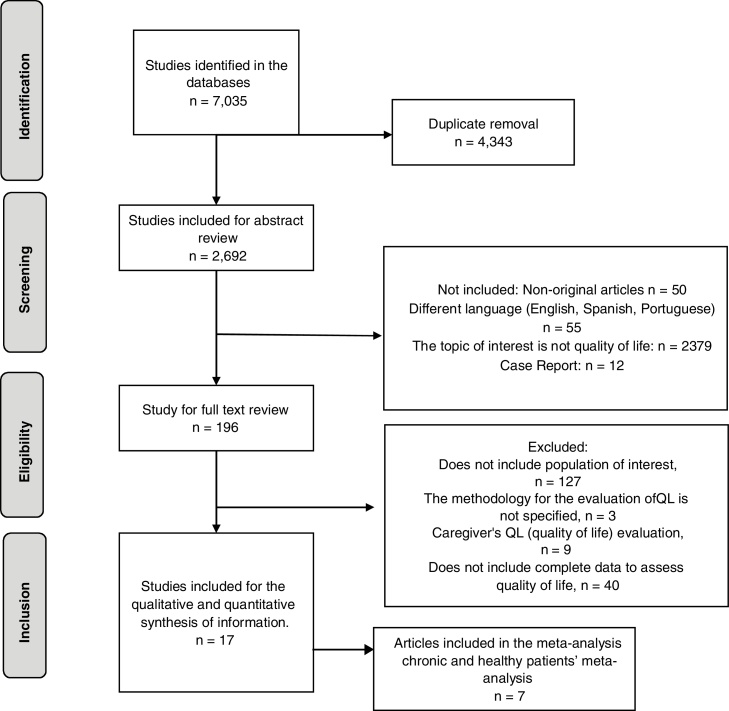
A systematic review was performed with meta-analysis for the mean difference in each of the health-related quality of life dimensions. The authors searched for ten scientific databases including PubMed, Scopus, SciELO, Science Direct, ProQuest, Google Scholar. Reproducibility by the Kappa index was evaluated, and Dersimonian and Laird's tests, RI coefficient, Begg statistic, Forest Plot, and sensitivity analysis were carried out.
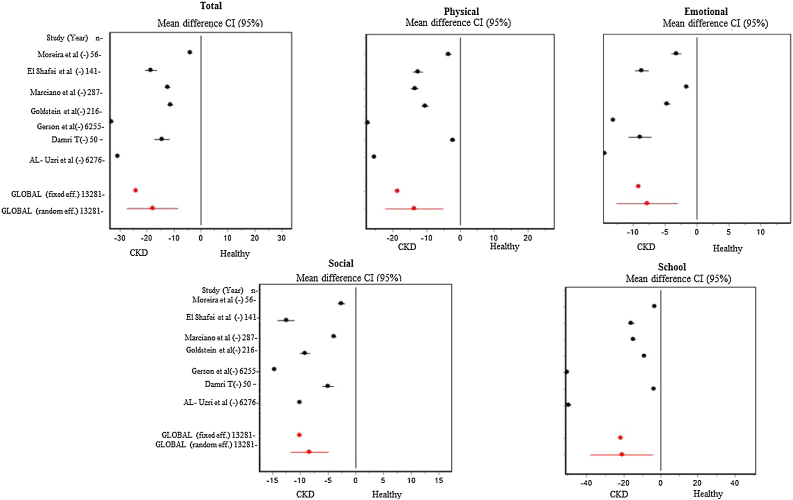
17 investigations were included in the qualitative synthesis and 7 in the quantitative synthesis with a population of 1214 of both healthy and sick pediatric patients with 3-5 chronic kidney disease stages. The health-related quality of life in pediatric chronic kidney disease patients presented lower scores in all the evaluated dimensions: in the physical dimension the difference is of 13.6 points, in the emotional dimension 7.8, in the social dimension 8.2, in the school dimension 20.8, with the total difference being 17.7 points.
The findings of this study show that pediatric patients have lower health-related quality of life in all the evaluated dimensions, with the "school" dimension being the most affected and the "emotional" one the least. In this sense, we suggest monitoring the health-related quality of life of pediatric patients with chronic kidney disease so that interventions can be oriented to strengthen the affected dimensions, including adjustments to daily life and prevention of complications related to the disease.
根据 PedsQL 工具的维度,对患有慢性肾脏疾病的儿科患者与健康患者的健康相关生活质量进行荟萃分析。
对每个健康相关生活质量维度的平均差异进行了系统评价和荟萃分析。作者在 10 个科学数据库中进行了搜索,包括 PubMed、Scopus、SciELO、Science Direct、ProQuest、Google Scholar。通过 Kappa 指数评估了可重复性,并进行了 Dersimonian 和 Laird 检验、RI 系数、Begg 统计量、森林图和敏感性分析。
17 项研究被纳入定性综合分析,7 项研究被纳入定量综合分析,共有 1214 名健康和患病的儿科患者,患有 3-5 期慢性肾脏疾病。儿科慢性肾脏疾病患者的健康相关生活质量在所有评估维度中均呈现较低的评分:身体维度差异为 13.6 分,情感维度为 7.8 分,社会维度为 8.2 分,学校维度为 20.8 分,总差异为 17.7 分。
本研究结果表明,儿科患者在所有评估维度的健康相关生活质量均较低,其中“学校”维度受影响最大,“情感”维度受影响最小。在这方面,我们建议监测患有慢性肾脏疾病的儿科患者的健康相关生活质量,以便可以针对受影响的维度进行干预,包括对日常生活进行调整和预防与疾病相关的并发症。