Guerra Patrick A
Department of Biological Sciences, College of Arts and Sciences, University of Cincinnati, Cincinnati, OH, United States.
Front Behav Neurosci. 2020 Dec 3;14:600737. doi: 10.3389/fnbeh.2020.600737. eCollection 2020.
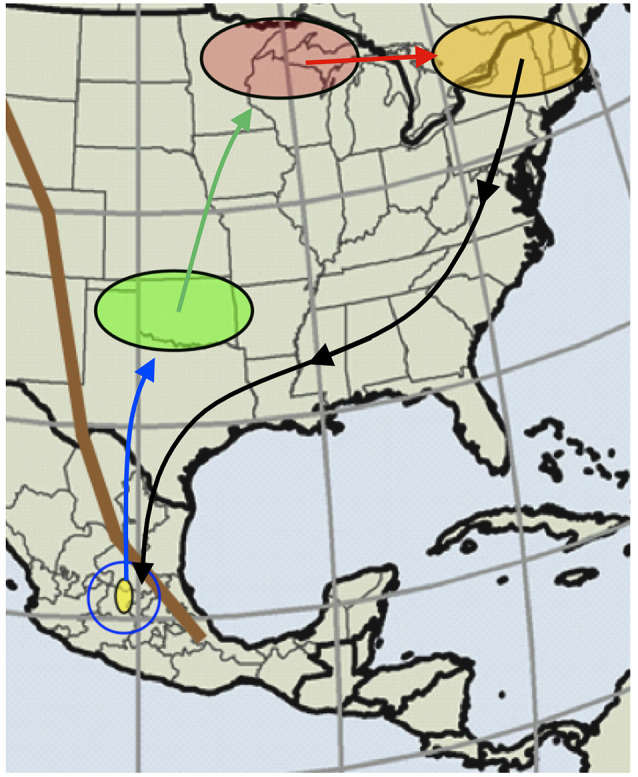
The awe-inspiring annual migration of monarch butterflies () is an iconic example of long-distance migratory phenomena in which environmental sensory cues help drive successful migration. In this mini-review article, I begin by describing how studies on monarch migration can provide us with generalizable information on how sensory cues can mediate key aspects of animal movement. I describe how environmental sensory cues can trigger the development and progression of the monarch migration, as well as inform sensory-based movement mechanisms in order to travel to and reach their goal destination, despite monarchs being on their maiden voyage. I also describe how sensory cues can trigger season-appropriate changes in migratory direction during the annual cycle. I conclude this mini-review article by discussing how contemporary environmental challenges threaten the persistence of the monarch migration. Environmental challenges such as climate change and shifting land use can significantly alter the sensory environments that monarchs migrate through, as well as degrade or eliminate the sources of sensory cues that are necessary for successful migration.
帝王蝶令人惊叹的年度迁徙是远距离迁徙现象的一个标志性例子,其中环境感官线索有助于推动成功的迁徙。在这篇小型综述文章中,我首先描述了关于帝王蝶迁徙的研究如何能为我们提供关于感官线索如何介导动物运动关键方面的可推广信息。我描述了环境感官线索如何触发帝王蝶迁徙的发育和进程,以及为基于感官的运动机制提供信息,以便它们在首次迁徙时就能前往并到达目标目的地。我还描述了感官线索如何在年度周期中触发迁徙方向的季节性适当变化。在这篇小型综述文章的结尾,我讨论了当代环境挑战如何威胁帝王蝶迁徙的持续性。诸如气候变化和土地利用变化等环境挑战会显著改变帝王蝶迁徙所经过的感官环境,以及退化或消除成功迁徙所需的感官线索来源。