Centre for Vision Research, Department of Ophthalmology (Westmead Hospital), the Westmead Institute for Medical Research, University of Sydney, NSW, Australia.
Retina Associates, Sydney, NSW, Australia.
Transl Vis Sci Technol. 2020 Dec 4;9(13):6. doi: 10.1167/tvst.9.13.6. eCollection 2020 Dec.
Topical carbonic anhydrase inhibitors (CAIs) can influence retinal fluid distribution, but their role in treating central serous chorioretinopathy (CSCR) has not been studied. We examined the efficacy of a topical CAI (dorzolamide) in treating chronic CSCR.
Prospective, nonrandomized, controlled intervention study of patients with chronic CSCR of at least 3 months duration. Observed controls ( = 15) were recruited consecutively from 2016 to 2017; treated cases ( = 18) were recruited from 2018 to 2019. Controls were observed without active intervention, whereas treated cases were treated with topical dorzolamide for 3 months. The study end points were change in central macular thickness (CMT), change in best corrected visual acuity (BCVA), and proportion of eyes achieving complete resolution of subretinal fluid (SRF). All end points were at 3 months.
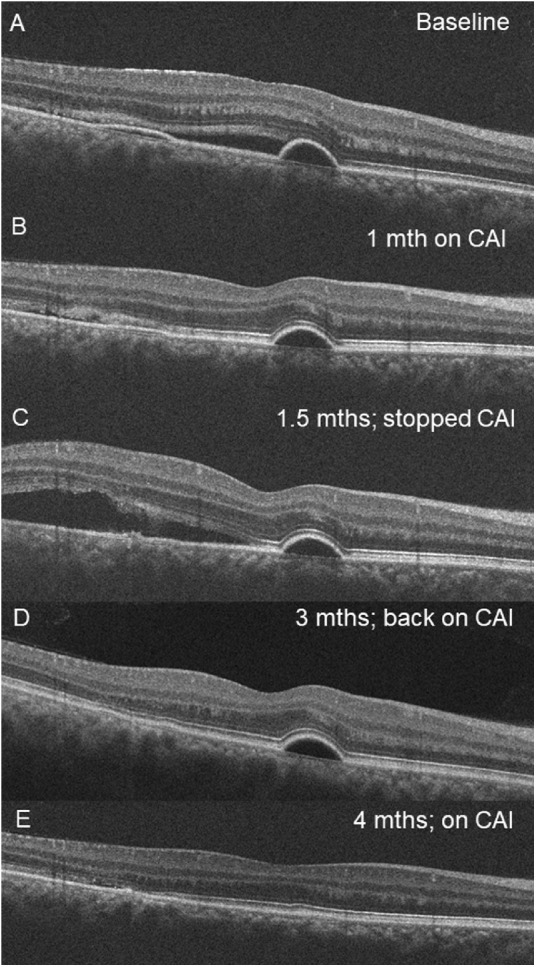
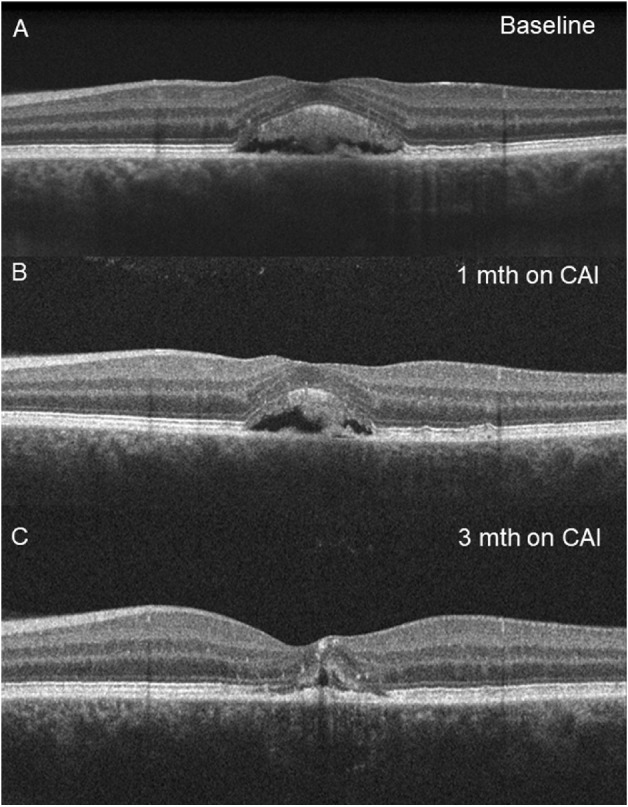
Treated patients who received topical CAI had greater reduction in CMT (-145.6 µm, 95% confidence interval [CI] -170.5 to -120.7) compared to observed controls (-45.1 µm, 95% CI -65.3 to -25.1) at the main study end point of 3 months ( = 0.015). A higher proportion of treated patients achieved complete resolution of SRF compared to observed controls (77.8% vs. 40.0%, = 0.04) at 3 months. However, change in BCVA at 3 months was similar in both groups ( = 0.12).
Topical CAI resulted in more rapid reduction of CMT compared to observation. These results, if confirmed in other studies, suggest topical CAI may be a viable treatment option for patients with chronic CSCR.
Topical CAI is used to treat a number of retinal disorders, and may be a novel treatment option for chronic CSCR.
局部碳酸酐酶抑制剂(CAI)可影响视网膜液分布,但它们在治疗中心性浆液性脉络膜视网膜病变(CSCR)中的作用尚未得到研究。我们检查了局部 CAI(多佐胺)治疗慢性 CSCR 的疗效。
对至少 3 个月慢性 CSCR 患者进行前瞻性、非随机、对照干预研究。观察对照组(n=15)于 2016 年至 2017 年连续招募;治疗组(n=18)于 2018 年至 2019 年招募。对照组未进行积极干预,而治疗组则用局部多佐胺治疗 3 个月。研究终点为中央黄斑厚度(CMT)变化、最佳矫正视力(BCVA)变化和完全消退视网膜下液(SRF)的眼比例。所有终点均在 3 个月时评估。
接受局部 CAI 治疗的患者在 3 个月的主要研究终点时 CMT 降低(-145.6 µm,95%置信区间 [CI] -170.5 至 -120.7)明显大于观察对照组(-45.1 µm,95% CI -65.3 至 -25.1)( = 0.015)。与观察对照组相比(77.8% vs. 40.0%, = 0.04),在 3 个月时,更多接受治疗的患者完全消退了 SRF。然而,两组间 3 个月时 BCVA 的变化相似( = 0.12)。
与观察相比,局部 CAI 可使 CMT 更快降低。如果在其他研究中得到证实,这些结果表明局部 CAI 可能是慢性 CSCR 患者的一种可行治疗选择。
杨学祥