Wang Yanling, Tao Bo, Li Jiaying, Mao Xiaoqun, He Wei, Chen Qinbiao
Department of Stomatology, Henan Province Hospital of Traditional Chinese Medicine, Zhengzhou, China.
Department of Orthopedics, Tianjin Medical University General Hospital, Tianjin, China.
Front Oncol. 2020 Dec 2;10:543591. doi: 10.3389/fonc.2020.543591. eCollection 2020.
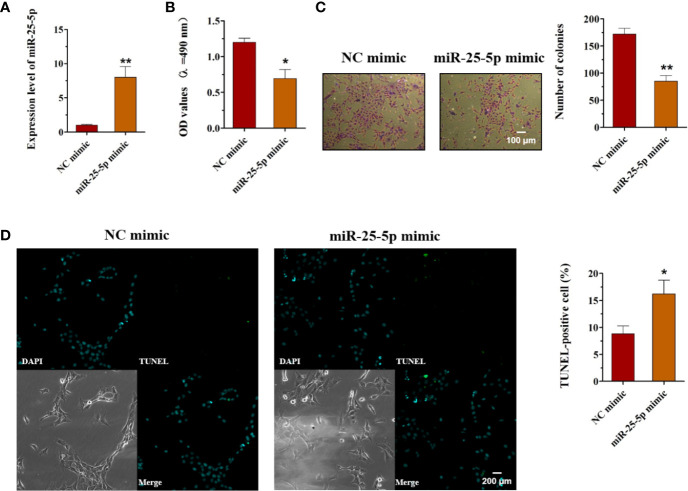
Melatonin exerts anti-cancer roles in various types of cancers. However, to the best of our knowledge, its role in oral squamous cell carcinoma (OSCC) is unknown. The present study aimed to investigate the role of melatonin and its underlying mechanism in OSCC. MTT, colony formation, wound healing, and transwell invasion assays proved that melatonin played anti-tumor effects in OSCC cells by inhibiting cell viability, proliferation, migration, and invasion in a concentration-dependent manner. The RT-qPCR analysis showed that miR-25-5p was significantly upregulated after melatonin treatment. Further, miR-25-5p might be involved in melatonin-induced inhibitory effects on the biological behavior of OSCC. The expression of miR-25-5p was decreased in tumor tissues and OSCC cells detected by RT-qPCR. MTT assay, colony formation assay, and TUNEL staining indicated miR-25-5p overexpression inhibited OSCC cell viability, proliferation, and induced OSCC cell apoptosis. Furthermore, wound healing, transwell invasion assay, and animal experiments suggested that miR-25-5p might exert suppressive effects on the migration, invasion, and tumor formation of OSCC cells, while miR-25-5p knockdown exhibited the opposite effects in OSCC cells. Bioinformatics analysis, western blot analysis, and luciferase reporter assay suggested that neural precursor cell expressed developmentally downregulated protein 9 (NEDD9) was proved to be a putative target for miR-25-5p. The role of NEDD9 in inhibiting OSCC cell proliferation, invasion, and migration was verified with NEDD9 siRNA transfection. Thus, melatonin exerted anti-proliferative, anti-invasive, and anti-migrative effects on OSCC miR-25-5p/NEDD9 pathway. Melatonin could be applied as a potential novel drug on treating OSCC.
褪黑素在多种癌症中发挥抗癌作用。然而,据我们所知,其在口腔鳞状细胞癌(OSCC)中的作用尚不清楚。本研究旨在探讨褪黑素在OSCC中的作用及其潜在机制。MTT、集落形成、伤口愈合和Transwell侵袭实验证明,褪黑素通过浓度依赖性地抑制细胞活力、增殖、迁移和侵袭,在OSCC细胞中发挥抗肿瘤作用。RT-qPCR分析表明,褪黑素处理后miR-25-5p显著上调。此外,miR-25-5p可能参与了褪黑素对OSCC生物学行为的抑制作用。通过RT-qPCR检测发现,肿瘤组织和OSCC细胞中miR-25-5p的表达降低。MTT实验、集落形成实验和TUNEL染色表明,miR-25-5p过表达抑制OSCC细胞活力、增殖并诱导OSCC细胞凋亡。此外,伤口愈合实验、Transwell侵袭实验和动物实验表明,miR-25-5p可能对OSCC细胞的迁移、侵袭和肿瘤形成发挥抑制作用,而敲低miR-25-5p在OSCC细胞中表现出相反的效果。生物信息学分析、蛋白质免疫印迹分析和荧光素酶报告基因实验表明,神经前体细胞表达下调发育蛋白9(NEDD9)被证明是miR-25-5p的一个假定靶点。通过NEDD9 siRNA转染验证了NEDD9在抑制OSCC细胞增殖、侵袭和迁移中的作用。因此,褪黑素通过miR-25-5p/NEDD9通路对OSCC发挥抗增殖、抗侵袭和抗迁移作用。褪黑素可作为一种潜在的新型药物用于治疗OSCC。