Lin Zhen, Meng Xianyi, Wen Jinming, Corral José María, Andreev Darja, Kachler Katerina, Schett Georg, Chen Xiaoxiang, Bozec Aline
Department of Internal Medicine 3-Rheumatology and Immunology, Friedrich-Alexander-University Erlangen-Nürnberg (FAU) and Universitätsklinikum Erlangen, Erlangen, Germany.
Deutsches Zentrum für Immuntherapie (DZI), Friedrich-Alexander-University Erlangen-Nürnberg (FAU) and Universitätsklinikum Erlangen, Erlangen, Germany.
Front Oncol. 2020 Dec 4;10:596493. doi: 10.3389/fonc.2020.596493. eCollection 2020.
Human malignant melanoma is a highly aggressive, heterogeneous and drug-resistant cancer. Due to a high number of clones, harboring various mutations that affect key pathways, there is an exceptional level of phenotypic variation and intratumor heterogeneity (ITH) in melanoma. This poses a significant challenge to personalized cancer medicine. Hitherto, it remains unclear to what extent the heterogeneity of melanoma affects the immune microenvironment. Herein, we explore the interaction between the tumor heterogeneity and the host immune response in a melanoma cohort utilizing The Cancer Genome Atlas (TCGA).
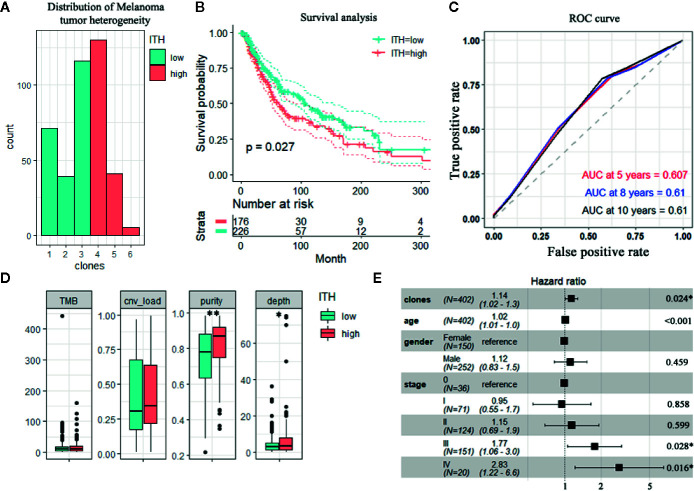
Clonal Heterogeneity Analysis Tool (CHAT) was used to estimate intratumor heterogeneity, and immune cell composition was estimated using CIBERSORT. The Overall Survival (OS) among groups was analyzed using Kaplan-Meier curves with the log-rank test and multivariate cox regression. RNA-seq data were evaluated to identify differentially expressed immunomodulatory genes. The reverse phase protein array (RPPA) data platform was used to validate immune responses at protein level.
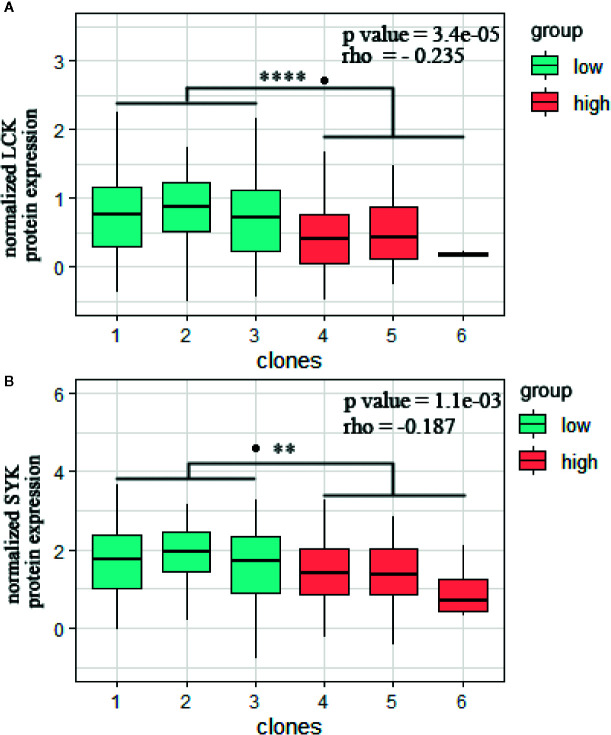
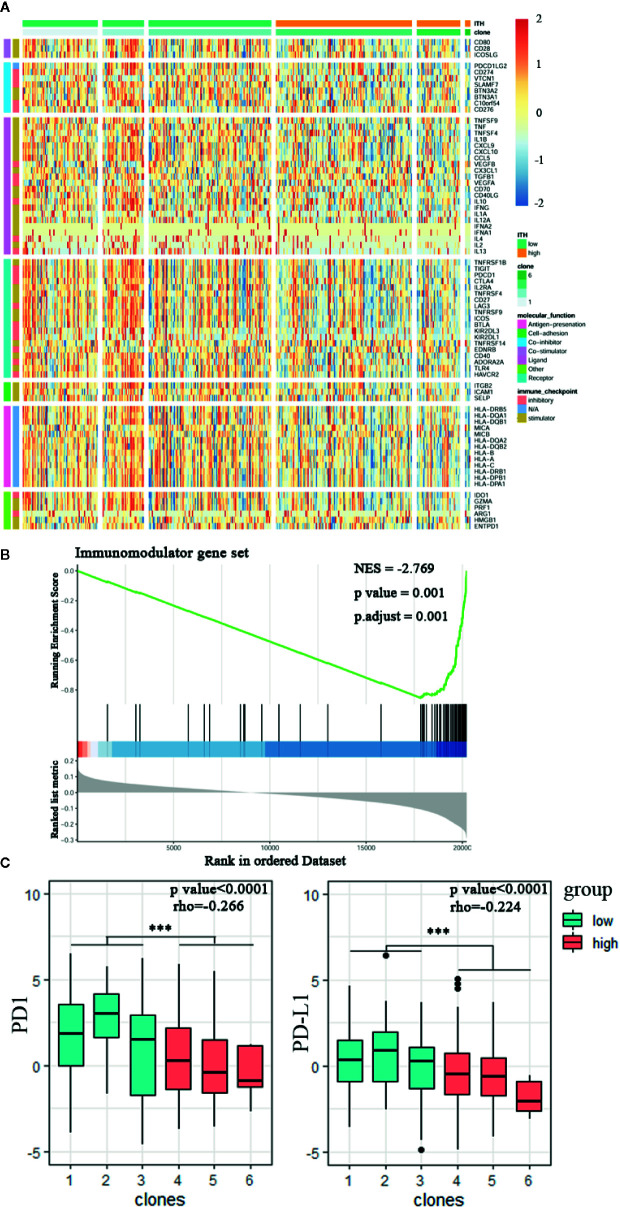
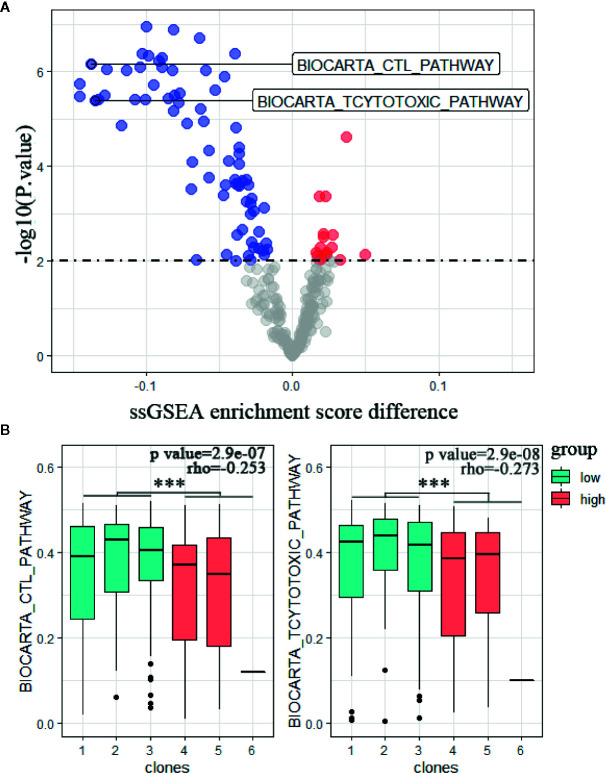
Tumors with high heterogeneity were associated with decreased overall survival (p = 0.027). High CHAT tumors were correlated with less infiltration by anti-tumor CD8 T cells (p = 0.0049), T follicular cells (p = 0.00091), and M1 macrophages (p = 0.0028), whereas tumor-promoting M2 macrophages were increased (p = 0.02). High CHAT tumors correlated with a reduced expression of immunomodulatory genes, particularly Programmed Cell Death 1 (PD1) and its ligand PD-L1. In addition, high CHAT tumors exhibited lower immune Cytotoxic T lymphocytes (CTLs)-mediated toxicity pathway score (p = 2.9E-07) and cytotoxic pathway score (p = 2.9E-08). High CHAT tumors were also associated with a lower protein level of immune-regulatory kinases, such as lymphocyte-specific protein tyrosine kinase (LCK) (p = 3.4e-5) and spleen tyrosine kinase (SYK) (p = 0.0011).
Highly heterogeneous melanoma tumors are associated with reduced immune cell infiltration and immune response activation as well as decreased survival. Our results reveal that intratumor heterogeneity is an indicative factor for patient survival due to its impact on anti-tumor immune response.
人类恶性黑色素瘤是一种具有高度侵袭性、异质性和耐药性的癌症。由于存在大量携带影响关键通路的各种突变的克隆,黑色素瘤存在异常高水平的表型变异和肿瘤内异质性(ITH)。这给个性化癌症医学带来了重大挑战。迄今为止,黑色素瘤的异质性在多大程度上影响免疫微环境仍不清楚。在此,我们利用癌症基因组图谱(TCGA)在一个黑色素瘤队列中探索肿瘤异质性与宿主免疫反应之间的相互作用。
使用克隆异质性分析工具(CHAT)估计肿瘤内异质性,并使用CIBERSORT估计免疫细胞组成。使用Kaplan-Meier曲线和对数秩检验以及多变量cox回归分析各组之间的总生存期(OS)。评估RNA-seq数据以鉴定差异表达的免疫调节基因。使用反相蛋白质阵列(RPPA)数据平台在蛋白质水平验证免疫反应。
高异质性肿瘤与总生存期降低相关(p = 0.027)。高CHAT肿瘤与抗肿瘤CD8 T细胞(p = 0.0049)、T滤泡细胞(p = 0.00091)和M1巨噬细胞(p = 0.0028)的浸润减少相关,而促肿瘤的M2巨噬细胞增加(p = 0.02)。高CHAT肿瘤与免疫调节基因的表达降低相关,尤其是程序性细胞死亡1(PD1)及其配体PD-L1。此外,高CHAT肿瘤表现出较低的免疫细胞毒性T淋巴细胞(CTL)介导的毒性途径评分(p = 2.9E-07)和细胞毒性途径评分(p = 2.9E-08)。高CHAT肿瘤还与免疫调节激酶的蛋白质水平较低相关,如淋巴细胞特异性蛋白酪氨酸激酶(LCK)(p = 3.4e-5)和脾酪氨酸激酶(SYK)(p = 0.0011)。
高度异质性的黑色素瘤肿瘤与免疫细胞浸润减少、免疫反应激活降低以及生存期缩短相关。我们的结果表明,肿瘤内异质性因其对抗肿瘤免疫反应的影响而成为患者生存的一个指示性因素。