Fang Tie, Xie Zi-Hang, Liu Ting-Hong, Deng Jie, Chen Shuai, Chen Feng, Zheng Li-Li
Department of Functional Neurosurgery, Beijing Children's Hospital, Capital Medical University, National Center for Children's Health, Beijing 100056, China.
World J Clin Cases. 2020 Dec 6;8(23):5918-5925. doi: 10.12998/wjcc.v8.i23.5918.
Implant vagus nerve stimulation is an adjunctive treatment for intractable epilepsy when patients are not suitable for resective surgery.
To identify the safety and efficacy of vagus nerve stimulation in children with intractable epilepsy and analyze the effects on different epilepsy syndromes.
Eligible children with intractable epilepsy were admitted to the study. We collected data from preoperative assessments as the baseline. During the follow-up time, we recorded the process of seizures (frequency, duration, and seizure type), the changes of drugs or parameters, the complications, . The mean reduction rate of seizures, response rate, and McHugh scale were chosen as the outcomes.
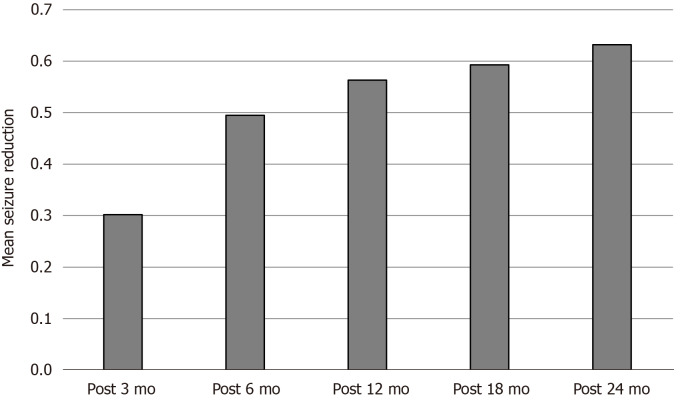
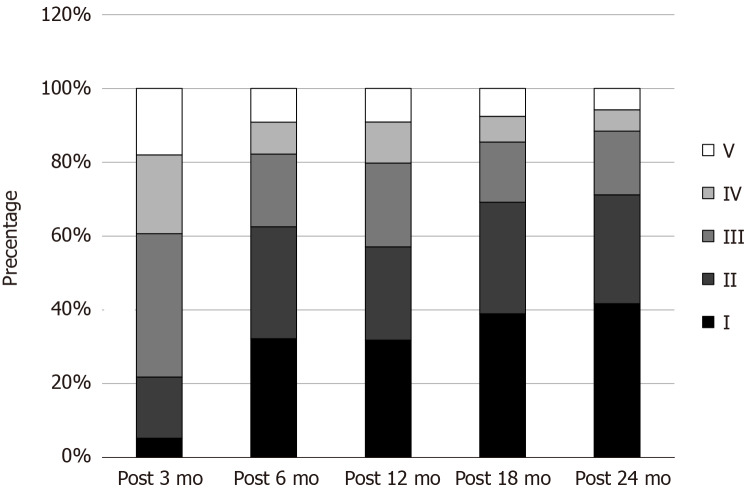
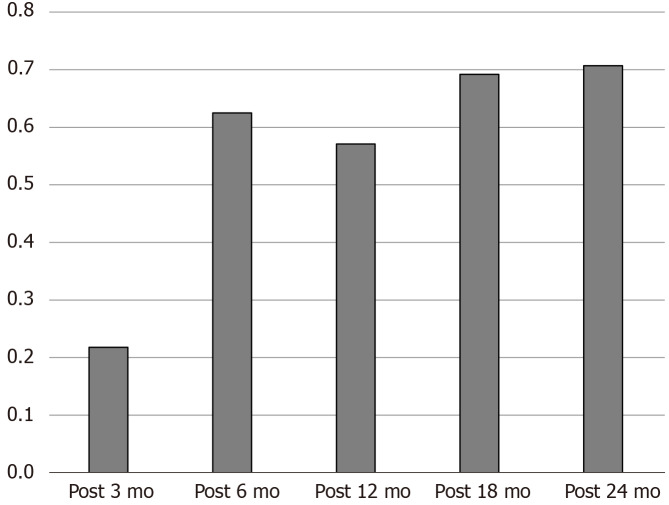
A total of 213 patients were implanted with Tsinghua Pins vagus nerve stimulators, and the average age was 6.6 years. In the follow-up time of postoperative 3 mo, 6 mo, 12 mo, 18 mo, and 24 mo, the average reduction rate was 30.2%, 49.5%, 56.3%, 59.4%, and 63.2%, while the response rate was 21.8%, 62.5%, 57.1%, 69.2%, and 70.7%. In addition, implanted vagus nerve stimulation had different effects on epilepsy syndromes. The reduction rate of West syndrome increased from 36.4% (postoperative 6 m) to 74.3% (postoperative 24 m). The reduction rate of Lennox-Gastaut syndrome improved from 25.4% to 73.1% in 24 mo. The chi-square test of the five efficacy grades showed < 0.05. The comparison between the 3-mo follow-up and the 6-mo follow-up showed < 0.05, and the comparison between the 6-mo follow-up and the 24-mo follow-up showed > 0.05.
Vagus nerve stimulation is safe and effective in children with intractable epilepsy, and the seizure reduction occurred in a time-dependent manner. Moreover, patients with West syndrome may get the most benefits.
当患者不适合进行切除性手术时,植入式迷走神经刺激术是治疗难治性癫痫的一种辅助疗法。
确定迷走神经刺激术在难治性癫痫患儿中的安全性和有效性,并分析其对不同癫痫综合征的影响。
符合条件的难治性癫痫患儿纳入本研究。我们收集术前评估数据作为基线。在随访期间,我们记录癫痫发作过程(频率、持续时间和发作类型)、药物或参数变化、并发症。选择癫痫发作平均减少率、有效率和麦克休量表作为观察指标。
共213例患者植入了清华品驰迷走神经刺激器,平均年龄6.6岁。在术后3个月、6个月、12个月、18个月和24个月的随访时间里,平均减少率分别为30.2%、49.5%、56.3%、59.4%和63.2%,而有效率分别为21.8%、62.5%、57.1%、69.2%和70.7%。此外,植入式迷走神经刺激术对癫痫综合征有不同影响。韦斯特综合征的减少率从术后6个月的36.4%增至术后24个月的74.3%。伦诺克斯-加斯托综合征的减少率在24个月内从25.4%提高到73.1%。五个疗效等级的卡方检验显示P<0.05。3个月随访与6个月随访比较显示P<0.05,6个月随访与24个月随访比较显示P>0.05。
迷走神经刺激术在难治性癫痫患儿中安全有效,癫痫发作减少呈时间依赖性。此外,韦斯特综合征患者可能获益最大。