L'Hermette Maxime, Castres Ingrid, Coquart Jeremy, Tabben Montassar, Ghoul Nihel, Andrieu Bernard, Tourny Claire
University of Rouen UFR STAPS, Cetaps EA, Rouen, France.
Aspetar Orthopaedic and Sports Medicine Hospital, Doha, Qatar.
Front Sports Act Living. 2020 Oct 20;2:581705. doi: 10.3389/fspor.2020.581705. eCollection 2020.
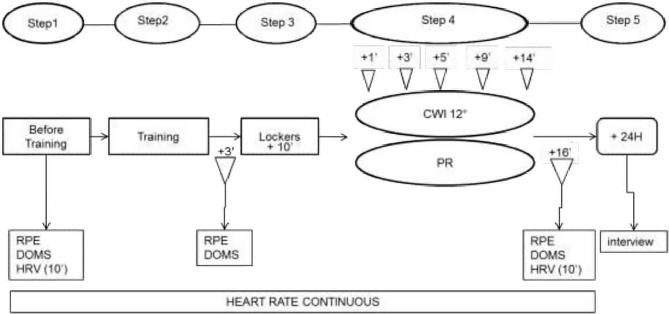
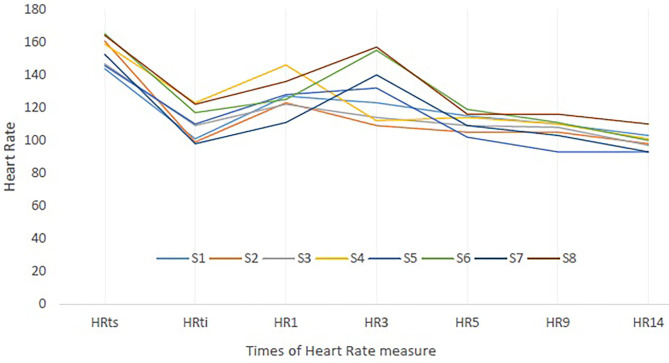
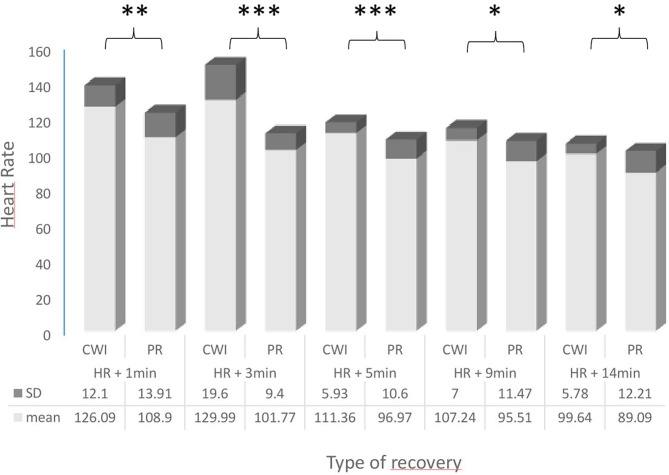
The aim of this study was to examine the relationship between the physiological data from subjects and their reported sensory experiences during two types of recovery methods following a handball training session. Female handball players (average age: 21.4 ± 1.3 years; weight: 59.2 ± 3.3 kg; height: 158 ± 3 cm; body mass index, 23.4 ± 2.0 kg.m) carried out an athletic training session (rating of perceived exertion RPE: 14.70 ± 0.89) with either a passive recovery (PR) period or cold water immersion (CWI) for 14 min) (cross-over design). Physiological data were collected during the recovery period: CWI had a greater effect than PR on heart rate (HR; bpm), the higher frequencies (HF) of heart rate variability (HRV: 46.44 ± 21.50 vs. 24.12 ± 17.62), delayed onset muscle soreness (DOMS: 1.37 ± 0.51 vs. 2.12 ± 1.25), and various reported emotional sensations. Spectrum HRV analysis showed a significant increase in HF during CWI. Sensorial experiences during the recovery periods were gathered from verbatim reports 24 h later. Players' comments about CWI revealed a congruence between the physiological data and sensorial reports. They used words such as: "," "," "," "," and "" to describe their sensations. In conclusion, this study demonstrated the link between physiological and experiential data during CWI and we propose that action of the parasympathetic system on the autonomic nervous system can, at least in part, explain the observed correlations between the corporeal data measured and the sensorial experiences reported.
本研究的目的是考察手球训练课后,两种恢复方法中受试者的生理数据与其报告的感觉体验之间的关系。女性手球运动员(平均年龄:21.4±1.3岁;体重:59.2±3.3千克;身高:158±3厘米;体重指数,23.4±2.0千克·米²)进行了一次运动训练课(主观用力程度评级RPE:14.70±0.89),之后进行14分钟的被动恢复(PR)期或冷水浸泡(CWI)(交叉设计)。在恢复期间收集生理数据:CWI对心率(HR;次/分钟)、心率变异性的高频(HF)(HRV:46.44±21.50对24.12±17.62)、延迟性肌肉酸痛(DOMS:1.37±0.51对2.12±1.25)以及各种报告的情绪感觉的影响比PR更大。频谱HRV分析显示CWI期间HF显著增加。恢复期间的感觉体验在24小时后从逐字报告中收集。运动员对CWI的评论揭示了生理数据与感觉报告之间的一致性。他们用“……”“……”“……”“……”和“……”等词来描述自己的感觉。总之,本研究证明了CWI期间生理数据与体验数据之间的联系,并且我们提出副交感神经系统对自主神经系统的作用至少可以部分解释所测量的身体数据与所报告的感觉体验之间观察到的相关性。