Haq Adnan, Ribbans William J, Hohenauer Erich, Baross Anthony W
Sports Studies, Moulton College, Moulton, United Kingdom.
Sport and Exercise Science, University of Northampton, Northampton, United Kingdom.
Front Sports Act Living. 2022 Jul 6;4:940516. doi: 10.3389/fspor.2022.940516. eCollection 2022.
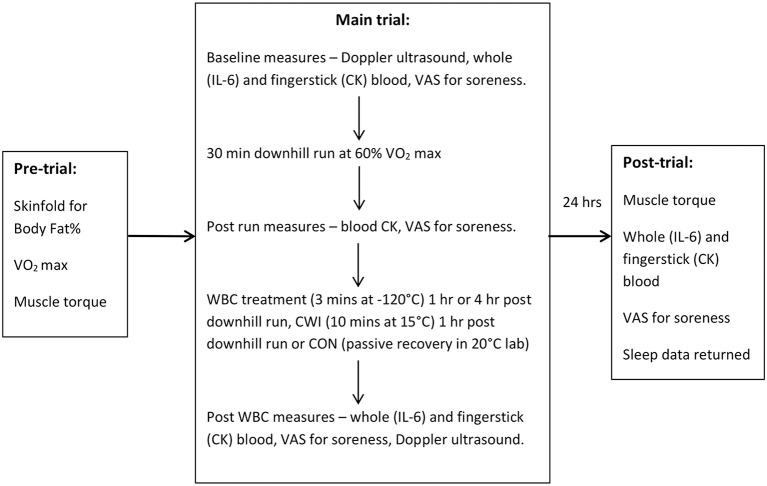
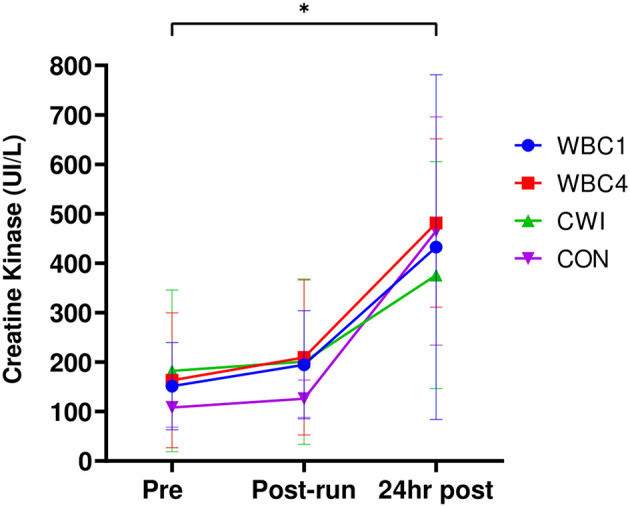
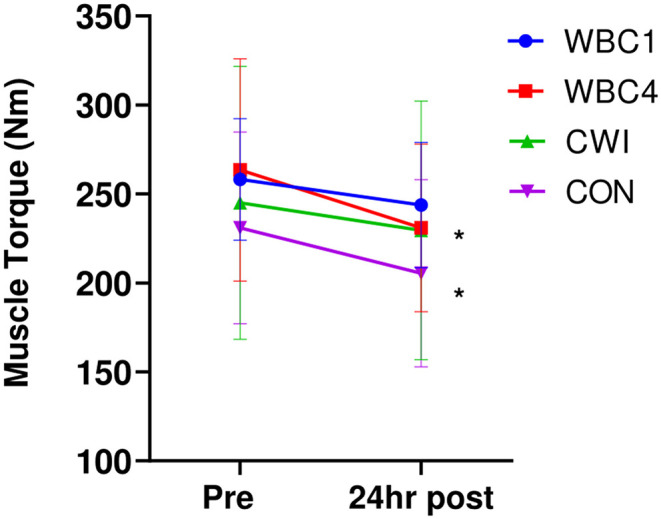
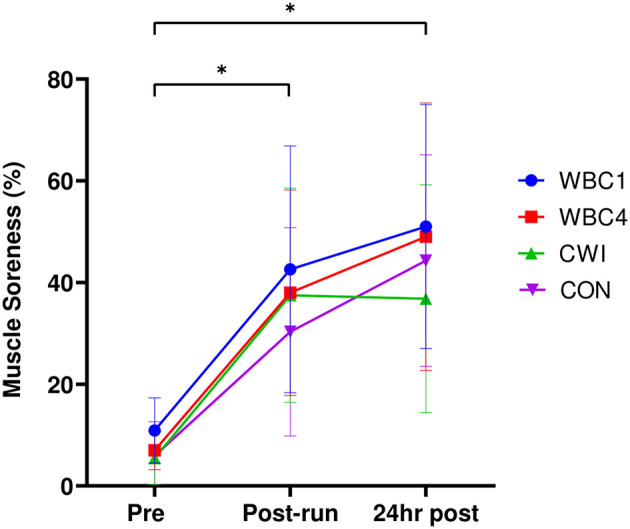
Despite several established benefits of Whole Body Cryotherapy (WBC) for post-exercise recovery, there is a scarcity of research which has identified the optimum WBC protocol for this purpose. This study investigated the influence of WBC treatment timing on physiological and functional responses following a downhill running bout. An additional purpose was to compare such responses with those following cold water immersion (CWI), since there is no clear consensus as to which cold modality is more effective for supporting athletic recovery. Thirty-three male participants (mean ± SD age 37.0 ± 13.3 years, height 1.76 ± 0.07 m, body mass 79.5 ± 13.7 kg) completed a 30 min downhill run (15% gradient) at 60% VO max and were then allocated into one of four recovery groups: WBC1 ( = 9) and WBC4 ( = 8) underwent cryotherapy (3 min, -120°C) 1 and 4 h post-run, respectively; CWI ( = 8) participants were immersed in cold water (10 min, 15°C) up to the waist 1 h post-run and control (CON, = 8) participants passively recovered in a controlled environment (20°C). Maximal isometric leg muscle torque was assessed pre and 24 h post-run. Blood creatine kinase (CK), muscle soreness, femoral artery blood flow, plasma IL-6 and sleep were also assessed pre and post-treatment. There were significant decreases in muscle torque for WBC4 (10.9%, = 0.04) and CON (11.3% = 0.00) and no significant decreases for WBC1 (5.6%, = 0.06) and CWI (5.1%, = 0.15). There were no significant differences between groups in muscle soreness, CK, IL-6 or sleep. Femoral artery blood flow significantly decreased in CWI ( = 0.02), but did not differ in other groups. WBC treatments within an hour may be preferable for muscle strength recovery compared to delayed treatments; however WBC appears to be no more effective than CWI. Neither cold intervention had an impact on inflammation or sleep.
尽管全身冷冻疗法(WBC)对运动后恢复有诸多既定益处,但针对此目的确定最佳WBC方案的研究却很匮乏。本研究调查了WBC治疗时机对下坡跑后生理和功能反应的影响。另一个目的是将这些反应与冷水浸泡(CWI)后的反应进行比较,因为对于哪种冷疗方式在支持运动员恢复方面更有效尚无明确共识。33名男性参与者(平均±标准差年龄37.0±13.3岁,身高1.76±0.07米,体重79.5±13.7千克)以最大摄氧量的60%完成了30分钟的下坡跑(坡度15%),然后被分配到四个恢复组之一:WBC1组(n = 9)和WBC4组(n = 8)分别在跑步后1小时和4小时接受冷冻疗法(3分钟,-120°C);CWI组(n = 8)的参与者在跑步后1小时腰部以下浸入冷水(10分钟,15°C),对照组(CON,n = 8)的参与者在受控环境(20°C)中被动恢复。在跑步前和跑步后24小时评估最大等长腿部肌肉扭矩。还在治疗前后评估了血液肌酸激酶(CK)、肌肉酸痛、股动脉血流量、血浆白细胞介素-6和睡眠情况。WBC4组(10.9%,P = 0.04)和CON组(11.3%,P = 0.00)的肌肉扭矩显著下降,而WBC1组(5.6%,P = 0.06)和CWI组(5.1%,P = 0.15)无显著下降。各组在肌肉酸痛、CK、白细胞介素-6或睡眠方面无显著差异。CWI组的股动脉血流量显著下降(P = 0.02),但其他组无差异。与延迟治疗相比,一小时内进行WBC治疗可能更有利于肌肉力量恢复;然而,WBC似乎并不比CWI更有效。两种冷干预对炎症或睡眠均无影响。