Department of Internal Medicine, University of Toledo, Toledo, Ohio.
The Wright Center for Graduate Medical Education, Scranton, Pennsylvania.
Am J Med Sci. 2021 Feb;361(2):216-225. doi: 10.1016/j.amjms.2020.09.017. Epub 2020 Nov 1.
The presence of olfactory dysfunction or "loss of smell" has been reported as an atypical symptom in patients with coronavirus disease 2019 (COVID-19). We performed a systematic review and meta-analysis of the available literature to evaluate the prevalence of "loss of smell" in COVID-19 as well as its utility for prognosticating the disease severity.
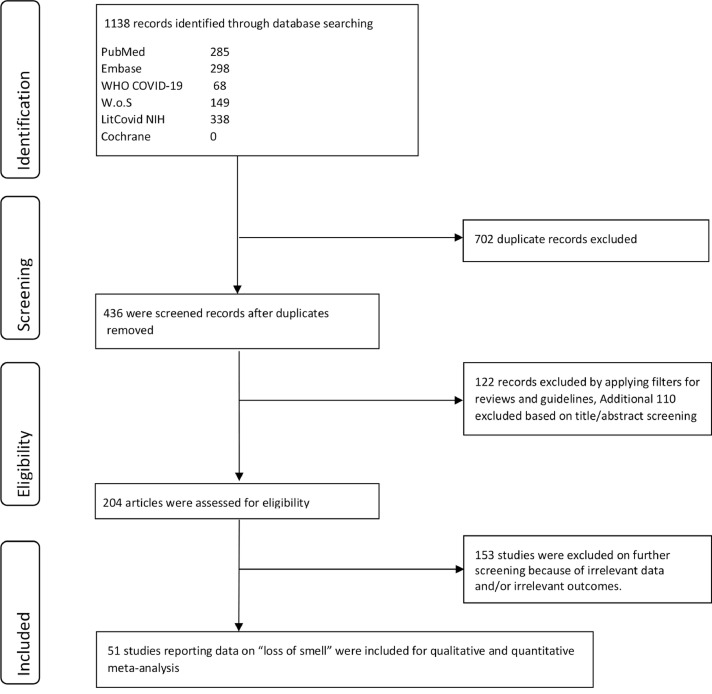
An exhaustive search of the PubMed/Medline, Embase, Web of Science, Cochrane Library, LitCovid NIH, and WHO COVID-19 database was conducted through August 6, 2020. All studies reporting the prevalence of "loss of smell" (anosmia and/or hyposmia/microsmia) in laboratory-confirmed COVID-19 patients were included. Pooled prevalence for cases (positive COVID-19 through reverse transcriptase (RT-PCR) and/or serology IgG/IgM) and controls (negative RT-PCR and/or serology) was compared, and the odds ratio (OR), 95% confidence interval (CI) and the p-value were calculated. A p-value of <0.05 was considered statistically significant.
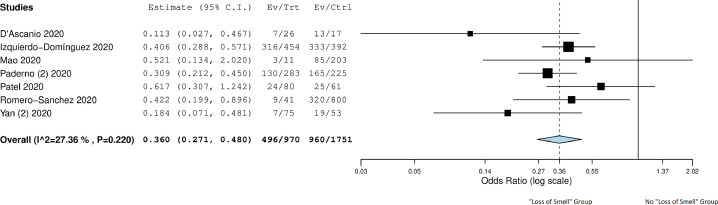
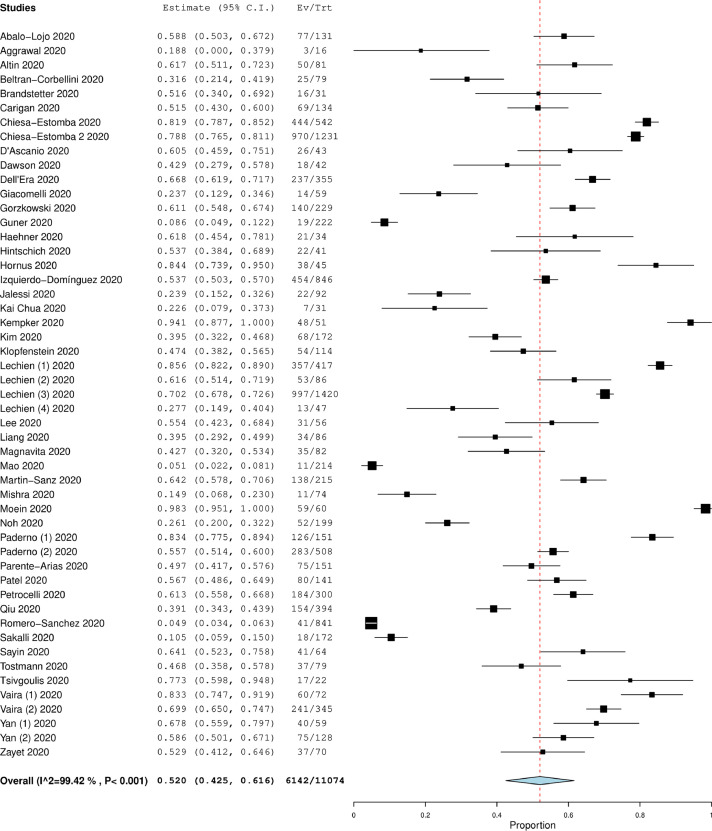
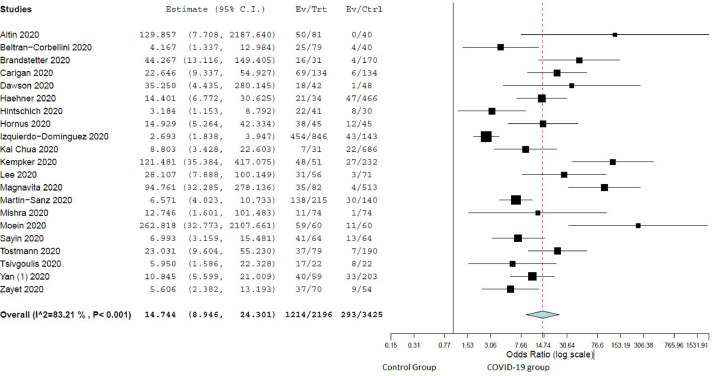
A total of 51 studies with 11074 confirmed COVID-19 patients were included. Of these, 21 studies used a control group with 3425 patients. The symptom of "loss of smell" (OR: 14.7, CI: 8.9-24.3) was significantly higher in the COVID-19 group when compared to the control group. Seven studies comparing severe COVID-19 patients with- and without "loss of smell" demonstrated favorable prognosis for patients with "loss of smell" (OR: 0.36, CI 0.27-0.48).
Olfactory dysfunction or "loss of smell" is a prevalent symptom in COVID-19 patients. Moreover, COVID-19 patients with "loss of smell" appear to have a milder course of the disease.
嗅觉功能障碍或“失去嗅觉”已被报道为 2019 年冠状病毒病(COVID-19)患者的非典型症状。我们对现有文献进行了系统评价和荟萃分析,以评估 COVID-19 中“失去嗅觉”的患病率,以及其对预测疾病严重程度的作用。
通过 2020 年 8 月 6 日对 PubMed/Medline、Embase、Web of Science、Cochrane 图书馆、LitCovid NIH 和 WHO COVID-19 数据库进行全面检索,纳入所有报告实验室确诊 COVID-19 患者“失去嗅觉”(嗅觉缺失和/或嗅觉减退/嗅觉减退)患病率的研究。比较病例(通过逆转录酶(RT-PCR)和/或血清学 IgG/IgM 阳性 COVID-19)和对照组(RT-PCR 和/或血清学阴性)的汇总患病率,并计算比值比(OR)、95%置信区间(CI)和 p 值。p 值<0.05 被认为具有统计学意义。
共纳入 51 项研究,共 11074 例确诊 COVID-19 患者。其中,21 项研究使用了包含 3425 例患者的对照组。与对照组相比,COVID-19 组的“失去嗅觉”症状(OR:14.7,CI:8.9-24.3)明显更高。7 项比较严重 COVID-19 患者与无嗅觉丧失患者的研究表明,嗅觉丧失患者的预后良好(OR:0.36,CI 0.27-0.48)。
嗅觉功能障碍或“失去嗅觉”是 COVID-19 患者的常见症状。此外,COVID-19 患者有嗅觉丧失的症状似乎疾病的病程较轻。