Neurology Unit, OCB Hospital, Azienda Ospedaliera-Universitaria, Modena, Italy.
Department of Biomedical, Metabolic and Neural Science, University of Modena and Reggio Emilia, Modena, Italy.
Brain Behav. 2021 Mar;11(3):e02006. doi: 10.1002/brb3.2006. Epub 2021 Jan 19.
Olfactory and taste disorders were reported in up to 30%-80% of COVID-19 patients. The purpose of our study was to objectively assess smell impairment in COVID-19 patients and to correlate olfactory function with viral recovery.
Between 15 and 30 April 2020, hospitalized patients with confirmed SARS-CoV-2 infection underwent an objective assessment of olfactory function with the Smell Identification subtest of the Sniffin' Sticks Test (SI-SST). Association between viral recovery and SI-SST performance was evaluated.
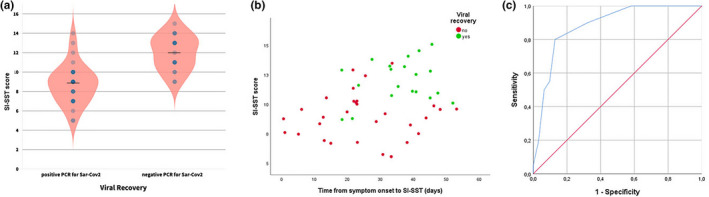
51 patients were enrolled (49% males, mean age 66.2 ± 14.6 years). At the time of test administration, 45% were clinically recovered and 39% were virus-free. Objective hyposmia/anosmia was found in 45% of the patients. Subjective olfactory disorders showed no association with the clinical or viral recovery status of the patients. On the contrary, none of the patients with anosmia and the 5% of hyposmic patients at test had viral recovery. The relative risk for hyposmic patients to be still positive at swab test was 10.323 (95% CI 1.483-71.869, p < .0001). Logistic regression analysis showed an independent and significant correlation between viral clearance and SI-SST scores (OR = 2.242; 95% CI 1.322-3.802, p < .003). ROC curve analysis confirmed that a SI-SST > 10.5 predicts viral clearance with 79% sensitivity and 87% specificity (AUC = 0.883).
Hyposmia is part of COVID-19 symptoms; however, only objectively assessed olfactory function is associated with viral recovery. SI-SST is an easy and safe instrument, and further large multicentric studies should assess its value to predict infection and recovery.
多达 30%-80%的 COVID-19 患者报告有嗅觉和味觉障碍。我们研究的目的是客观评估 COVID-19 患者的嗅觉障碍,并将嗅觉功能与病毒恢复相关联。
在 2020 年 4 月 15 日至 30 日期间,住院的确诊 SARS-CoV-2 感染患者接受了 Sniffin' Sticks 测试(SI-SST)的嗅觉识别子测试(SI-SST)的客观嗅觉功能评估。评估了病毒恢复与 SI-SST 表现之间的关联。
共纳入 51 例患者(49%为男性,平均年龄 66.2±14.6 岁)。在测试时,45%的患者临床康复,39%的患者病毒载量为零。45%的患者存在客观嗅觉减退/丧失。主观嗅觉障碍与患者的临床或病毒恢复状况无相关性。相反,嗅觉丧失的患者中无一例病毒恢复,嗅觉减退患者中也仅有 5%的患者病毒恢复。嗅觉减退患者在拭子检测中仍为阳性的相对风险为 10.323(95%可信区间 1.483-71.869,p<0.0001)。逻辑回归分析显示,病毒清除与 SI-SST 评分之间存在独立且显著的相关性(OR=2.242;95%可信区间 1.322-3.802,p<0.003)。ROC 曲线分析证实,SI-SST>10.5 可预测病毒清除,灵敏度为 79%,特异性为 87%(AUC=0.883)。
嗅觉减退是 COVID-19 症状的一部分;然而,只有客观评估的嗅觉功能与病毒恢复相关。SI-SST 是一种简单、安全的仪器,应进一步进行大型多中心研究来评估其预测感染和恢复的价值。