• 文献检索
  • 文档翻译
  • 深度研究
  • 学术资讯
  • Suppr Zotero 插件Zotero 插件
  • 邀请有礼
  • 套餐&价格
  • 历史记录
应用&插件
Suppr Zotero 插件Zotero 插件浏览器插件Mac 客户端Windows 客户端微信小程序
定价
高级版会员购买积分包购买API积分包
服务
文献检索文档翻译深度研究API 文档MCP 服务
关于我们
关于 Suppr公司介绍联系我们用户协议隐私条款
关注我们

Suppr 超能文献

核心技术专利:CN118964589B侵权必究
粤ICP备2023148730 号-1Suppr @ 2026

文献检索

告别复杂PubMed语法,用中文像聊天一样搜索,搜遍4000万医学文献。AI智能推荐,让科研检索更轻松。

立即免费搜索

文件翻译

保留排版,准确专业,支持PDF/Word/PPT等文件格式,支持 12+语言互译。

免费翻译文档

深度研究

AI帮你快速写综述,25分钟生成高质量综述,智能提取关键信息,辅助科研写作。

立即免费体验

重症监护病房谵妄预测模型:一项系统综述。

ICU Delirium-Prediction Models: A Systematic Review.

作者信息

Ruppert Matthew M, Lipori Jessica, Patel Sandip, Ingersent Elizabeth, Cupka Julie, Ozrazgat-Baslanti Tezcan, Loftus Tyler, Rashidi Parisa, Bihorac Azra

机构信息

Department of Medicine, University of Florida, Gainesville, FL.

Precision and Intelligent Systems in Medicine (Prisma), Division of Nephrology, Hypertension, & Renal Transplantation, Department of Medicine, University of Florida, Gainesville, FL.

出版信息

Crit Care Explor. 2020 Dec 16;2(12):e0296. doi: 10.1097/CCE.0000000000000296. eCollection 2020 Dec.

DOI:10.1097/CCE.0000000000000296
PMID:33354672
原文链接:https://pmc.ncbi.nlm.nih.gov/articles/PMC7746201/
Abstract

OBJECTIVE

Summarize performance and development of ICU delirium-prediction models published within the past 5 years.

DATA SOURCES

Systematic electronic searches were conducted in April 2019 using PubMed, Embase, Cochrane Central, Web of Science, and Cumulative Index to Nursing and Allied Health Literature to identify peer-reviewed studies.

STUDY SELECTION

Eligible studies were published in English during the past 5 years that specifically addressed the development, validation, or recalibration of delirium-prediction models in adult ICU populations.

DATA EXTRACTION

Screened citations were extracted independently by three investigators with a 42% overlap to verify consistency using the CHecklist for critical Appraisal and data extraction for systematic Reviews of prediction Modelling Studies.

DATA SYNTHESIS

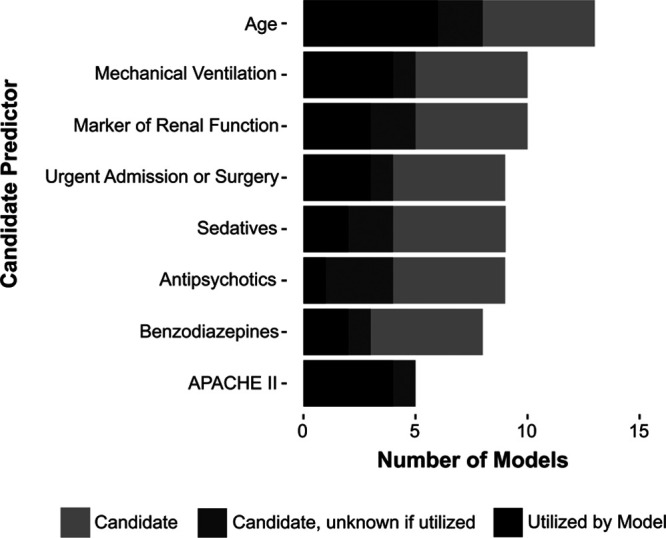
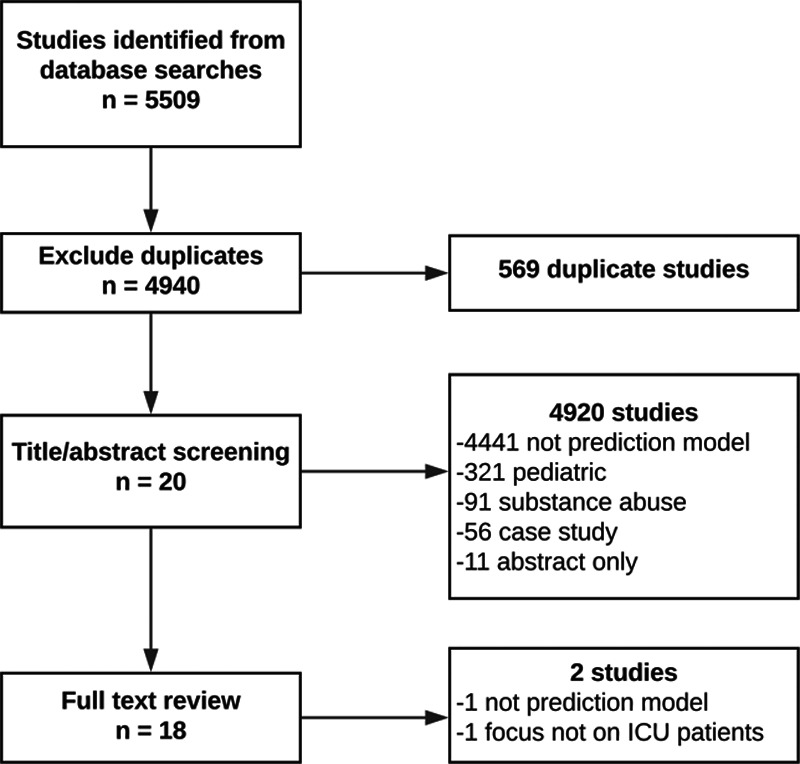
Eighteen studies featuring 23 distinct prediction models were included. Model performance varied greatly, as assessed by area under the receiver operating characteristic curve (0.62-0.94), specificity (0.50-0.97), and sensitivity (0.45-0.96). Most models used data collected from a single time point or window to predict the occurrence of delirium at any point during hospital or ICU admission, and lacked mechanisms for providing pragmatic, actionable predictions to clinicians.

CONCLUSIONS

Although most ICU delirium-prediction models have relatively good performance, they have limited applicability to clinical practice. Most models were static, making predictions based on data collected at a single time-point, failing to account for fluctuating conditions during ICU admission. Further research is needed to create clinically relevant dynamic delirium-prediction models that can adapt to changes in individual patient physiology over time and deliver actionable predictions to clinicians.

摘要

目的

总结过去5年发表的重症监护病房(ICU)谵妄预测模型的性能和发展情况。

数据来源

2019年4月使用PubMed、Embase、Cochrane Central、Web of Science以及护理与健康相关文献累积索引进行了系统的电子检索,以识别同行评审研究。

研究选择

符合条件的研究是过去5年以英文发表的,专门针对成人ICU人群谵妄预测模型的开发、验证或重新校准。

数据提取

由三名研究人员独立提取筛选出的文献引用,重叠率为42%,使用预测模型研究系统评价的关键评估和数据提取清单来验证一致性。

数据综合

纳入了18项研究,其中有23个不同的预测模型。通过受试者操作特征曲线下面积(0.62 - 0.94)、特异性(0.50 - 0.97)和敏感性(0.45 - 0.96)评估,模型性能差异很大。大多数模型使用从单个时间点或时间段收集的数据来预测住院或ICU入院期间任何时间点谵妄的发生,并且缺乏为临床医生提供实用、可操作预测的机制。

结论

尽管大多数ICU谵妄预测模型具有相对较好的性能,但它们在临床实践中的适用性有限。大多数模型是静态的,基于单个时间点收集的数据进行预测,没有考虑ICU入院期间病情的波动。需要进一步开展研究,以创建与临床相关的动态谵妄预测模型,该模型能够随着时间适应个体患者生理变化,并为临床医生提供可操作的预测。
https://cdn.ncbi.nlm.nih.gov/pmc/blobs/ab8a/7746201/44887e050e71/cc9-2-e0296-g002.jpg
https://cdn.ncbi.nlm.nih.gov/pmc/blobs/ab8a/7746201/381c699c13e5/cc9-2-e0296-g001.jpg
https://cdn.ncbi.nlm.nih.gov/pmc/blobs/ab8a/7746201/44887e050e71/cc9-2-e0296-g002.jpg
https://cdn.ncbi.nlm.nih.gov/pmc/blobs/ab8a/7746201/381c699c13e5/cc9-2-e0296-g001.jpg
https://cdn.ncbi.nlm.nih.gov/pmc/blobs/ab8a/7746201/44887e050e71/cc9-2-e0296-g002.jpg

相似文献

1
ICU Delirium-Prediction Models: A Systematic Review.重症监护病房谵妄预测模型:一项系统综述。
Crit Care Explor. 2020 Dec 16;2(12):e0296. doi: 10.1097/CCE.0000000000000296. eCollection 2020 Dec.
2
Delirium risk prediction models for intensive care unit patients: A systematic review.ICU 患者谵妄风险预测模型:系统评价。
Intensive Crit Care Nurs. 2020 Oct;60:102880. doi: 10.1016/j.iccn.2020.102880. Epub 2020 Jul 17.
3
External Validation of Two Models to Predict Delirium in Critically Ill Adults Using Either the Confusion Assessment Method-ICU or the Intensive Care Delirium Screening Checklist for Delirium Assessment.使用意识模糊评估法-重症监护病房或重症监护谵妄筛查检查表对谵妄进行评估的两种模型对危重症成人谵妄预测的外部验证。
Crit Care Med. 2019 Oct;47(10):e827-e835. doi: 10.1097/CCM.0000000000003911.
4
Development and validation of delirium prediction model for critically ill adults parameterized to ICU admission acuity.开发和验证针对 ICU 入院严重程度参数化的危重症成人谵妄预测模型。
PLoS One. 2020 Aug 19;15(8):e0237639. doi: 10.1371/journal.pone.0237639. eCollection 2020.
5
Prediction models for postoperative delirium after cardiac surgery: Systematic review and critical appraisal.心脏手术后术后谵妄预测模型:系统评价和批判性评价。
Int J Nurs Stud. 2022 Dec;136:104340. doi: 10.1016/j.ijnurstu.2022.104340. Epub 2022 Aug 6.
6
Beyond the black stump: rapid reviews of health research issues affecting regional, rural and remote Australia.超越黑木树:影响澳大利亚地区、农村和偏远地区的健康研究问题的快速综述。
Med J Aust. 2020 Dec;213 Suppl 11:S3-S32.e1. doi: 10.5694/mja2.50881.
7
Delirium prediction in the intensive care unit: comparison of two delirium prediction models.ICU 中谵妄的预测:两种谵妄预测模型的比较。
Crit Care. 2018 May 5;22(1):114. doi: 10.1186/s13054-018-2037-6.
8
A Machine Learning-Based Algorithm for the Prediction of Intensive Care Unit Delirium (PRIDE): Retrospective Study.一种基于机器学习的重症监护病房谵妄预测算法(PRIDE):回顾性研究
JMIR Med Inform. 2021 Jul 26;9(7):e23401. doi: 10.2196/23401.
9
Risk prediction models for intensive care unit-acquired weakness in critically ill patients: A systematic review.危重症患者重症监护病房获得性肌无力的风险预测模型:一项系统综述
Aust Crit Care. 2025 Jan;38(1):101066. doi: 10.1016/j.aucc.2024.05.003. Epub 2024 Jul 15.
10
Non-pharmacological interventions for sleep promotion in the intensive care unit.重症监护病房促进睡眠的非药物干预措施。
Cochrane Database Syst Rev. 2015 Oct 6;2015(10):CD008808. doi: 10.1002/14651858.CD008808.pub2.

引用本文的文献

1
Predicting Episodes of Hypovigilance in Intensive Care Units Using Routine Physiological Parameters and Artificial Intelligence: Derivation Study.使用常规生理参数和人工智能预测重症监护病房的警觉性降低发作:推导研究
JMIR AI. 2025 Aug 27;4:e60885. doi: 10.2196/60885.
2
DeLLiriuM: A large language model for delirium prediction in the ICU using structured EHR.谵妄:一种使用结构化电子健康记录在重症监护病房预测谵妄的大型语言模型。
Res Sq. 2025 Aug 13:rs.3.rs-7216692. doi: 10.21203/rs.3.rs-7216692/v1.
3
Predictive model for assessment of ICU delirium among patients in critical care units: Prospective observational study.

本文引用的文献

1
Models for Predicting Incident Delirium in Hospitalized Older Adults: A Systematic Review.预测住院老年人新发谵妄的模型:一项系统综述。
J Patient Cent Res Rev. 2017 Apr 25;4(2):69-77. doi: 10.17294/2330-0698.1414. eCollection 2017 Spring.
2
Postoperative delirium in critically ill surgical patients: incidence, risk factors, and predictive scores.术后危重病手术患者的意识混乱:发生率、危险因素和预测评分。
BMC Anesthesiol. 2019 Mar 20;19(1):39. doi: 10.1186/s12871-019-0694-x.
3
Development and validation of a dynamic delirium prediction rule in patients admitted to the Intensive Care Units (DYNAMIC-ICU): A prospective cohort study.
重症监护病房患者ICU谵妄评估的预测模型:前瞻性观察性研究。
J Educ Health Promot. 2025 Jul 4;14:243. doi: 10.4103/jehp.jehp_1262_24. eCollection 2025.
4
Predicting ICU Delirium in Critically Ill COVID-19 Patients Using Demographic, Clinical, and Laboratory Admission Data: A Machine Learning Approach.利用人口统计学、临床和实验室入院数据预测重症 COVID-19 患者的 ICU 谵妄:一种机器学习方法。
Life (Basel). 2025 Jun 30;15(7):1045. doi: 10.3390/life15071045.
5
Association of Central Nervous System-Related Biomarkers With Hospital Delirium in Patients With Respiratory Failure in the ICU.重症监护病房呼吸衰竭患者中枢神经系统相关生物标志物与医院谵妄的关联
CHEST Crit Care. 2025 Jun;3(2). doi: 10.1016/j.chstcc.2025.100143. Epub 2025 Mar 3.
6
Validation of PREdiction of DELIRium in ICu patients (PRE-DELIRIC) model for ICU delirium in general ICU and patients with liver disease: a retrospective cohort study.重症监护病房谵妄预测(PRE-DELIRIC)模型在综合重症监护病房及肝病患者中对重症监护病房谵妄的验证:一项回顾性队列研究
J Intensive Care. 2025 Jun 16;13(1):33. doi: 10.1186/s40560-025-00800-3.
7
Determining the ground truth for the prediction of delirium in adult patients in acute care: a scoping review.确定急性护理中成年患者谵妄预测的真实情况:一项范围综述
JAMIA Open. 2025 May 26;8(3):ooaf037. doi: 10.1093/jamiaopen/ooaf037. eCollection 2025 Jun.
8
Prediction model for delirium in advanced cancer patients receiving palliative care: development and validation.接受姑息治疗的晚期癌症患者谵妄预测模型:开发与验证
BMC Palliat Care. 2025 Feb 13;24(1):41. doi: 10.1186/s12904-025-01683-9.
9
The possible interaction between tryptophan and its metabolites with delirium in older patients with critical illnesses.危重症老年患者中色氨酸及其代谢产物与谵妄之间可能存在的相互作用。
Eur Geriatr Med. 2024 Dec;15(6):1937-1948. doi: 10.1007/s41999-024-01114-7. Epub 2024 Nov 27.
10
Predicting postoperative delirium assessed by the Nursing Screening Delirium Scale in the recovery room for non-cardiac surgeries without craniotomy: A retrospective study using a machine learning approach.使用机器学习方法进行的回顾性研究:在非开颅心脏手术的恢复室中,通过护理谵妄筛查量表评估术后谵妄。
PLOS Digit Health. 2024 Aug 14;3(8):e0000414. doi: 10.1371/journal.pdig.0000414. eCollection 2024 Aug.
动态谵妄预测规则在 ICU 患者中的制定和验证(DYNAMIC-ICU):一项前瞻性队列研究。
Int J Nurs Stud. 2019 May;93:64-73. doi: 10.1016/j.ijnurstu.2018.10.008. Epub 2019 Feb 14.
4
Validation of the Prediction of Delirium for Intensive Care model to predict subsyndromal delirium.用于预测亚综合征性谵妄的重症监护模型中谵妄预测的验证。
Acute Med Surg. 2018 Dec 3;6(1):54-59. doi: 10.1002/ams2.378. eCollection 2019 Jan.
5
Predicting postoperative delirium and postoperative cognitive decline with combined intraoperative electroencephalogram monitoring and cerebral near-infrared spectroscopy in patients undergoing cardiac interventions.在接受心脏介入治疗的患者中,通过联合术中脑电图监测和脑近红外光谱技术预测术后谵妄和术后认知功能下降。
J Clin Monit Comput. 2019 Dec;33(6):999-1009. doi: 10.1007/s10877-019-00253-8. Epub 2019 Jan 11.
6
PROBAST: A Tool to Assess the Risk of Bias and Applicability of Prediction Model Studies.PROBAST:一种用于评估偏倚风险和预测模型研究适用性的工具。
Ann Intern Med. 2019 Jan 1;170(1):51-58. doi: 10.7326/M18-1376.
7
Prediction of ICU Delirium: Validation of Current Delirium Predictive Models in Routine Clinical Practice.预测 ICU 谵妄:当前谵妄预测模型在常规临床实践中的验证。
Crit Care Med. 2019 Mar;47(3):428-435. doi: 10.1097/CCM.0000000000003577.
8
Reliability and accuracy of delirium assessments among investigators at multiple international centres.多个国际中心的研究人员进行谵妄评估的可靠性和准确性。
BMJ Open. 2018 Nov 21;8(11):e023137. doi: 10.1136/bmjopen-2018-023137.
9
Delirium Prediction using Machine Learning Models on Preoperative Electronic Health Records Data.基于术前电子健康记录数据,使用机器学习模型预测谵妄
Proc IEEE Int Symp Bioinformatics Bioeng. 2017 Oct;2017:568-573. doi: 10.1109/BIBE.2017.00014. Epub 2018 Jan 11.
10
Preoperative STOP-BANG Scores and Postoperative Delirium and Coma in Thoracic Surgery Patients.术前 STOP-BANG 评分与心胸外科术后谵妄和昏迷
Ann Thorac Surg. 2018 Oct;106(4):966-972. doi: 10.1016/j.athoracsur.2018.05.089. Epub 2018 Jul 3.