Functional Neuroimaging Laboratory, Center for Neuroscience and Cognitive Systems @ UniTn, Istituto Italiano di Tecnologia, Rovereto, Italy.
Center for Mind/Brain Sciences, University of Trento, 38068 Rovereto TN, Italy.
Sci Adv. 2020 Dec 18;6(51). doi: 10.1126/sciadv.abb7187. Print 2020 Dec.
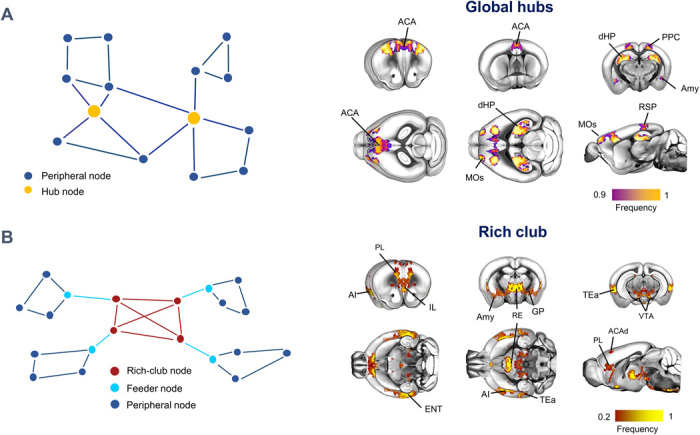
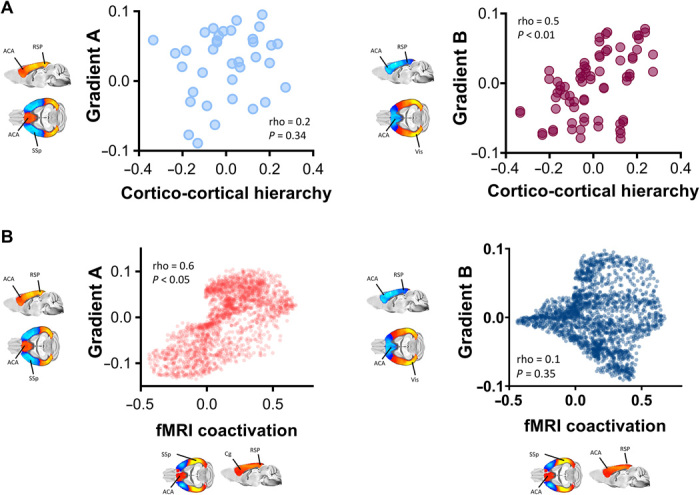
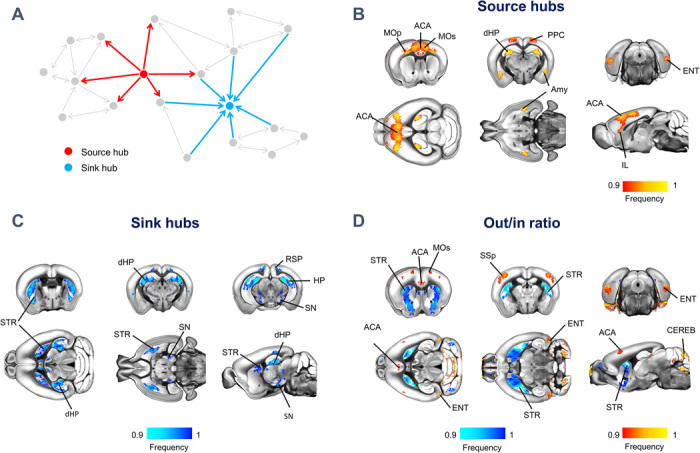
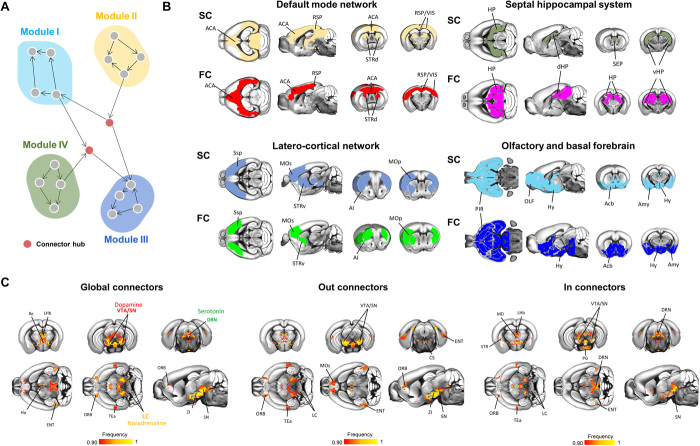
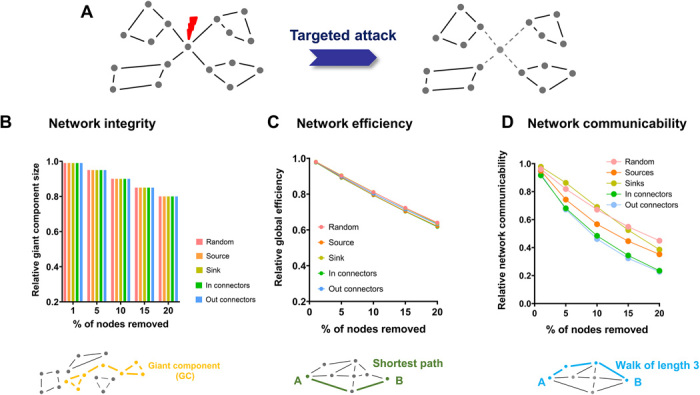
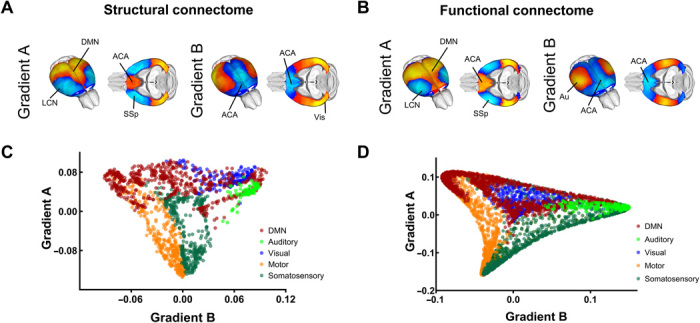
Fine-grained descriptions of brain connectivity are required to understand how neural information is processed and relayed across spatial scales. Previous investigations of the mouse brain connectome have used discrete anatomical parcellations, limiting spatial resolution and potentially concealing network attributes critical to connectome organization. Here, we provide a voxel-level description of the network and hierarchical structure of the directed mouse connectome, unconstrained by regional partitioning. We report a number of previously unappreciated organizational principles in the mammalian brain, including a directional segregation of hub regions into neural sink and sources, and a strategic wiring of neuromodulatory nuclei as connector hubs and critical orchestrators of network communication. We also find that the mouse cortical connectome is hierarchically organized along two superimposed cortical gradients reflecting unimodal-transmodal functional processing and a modality-specific sensorimotor axis, recapitulating a phylogenetically conserved feature of higher mammals. These findings advance our understanding of the foundational wiring principles of the mammalian connectome.
为了理解神经信息如何在空间尺度上被处理和传递,需要对大脑连接进行细粒度的描述。以前对小鼠大脑连接组的研究使用了离散的解剖分区,限制了空间分辨率,并可能掩盖了对连接组组织至关重要的网络属性。在这里,我们提供了一个无区域划分的、基于体素的、对定向小鼠连接组的网络和层次结构的描述。我们报告了哺乳动物大脑中一些以前未被注意到的组织原则,包括将枢纽区域分为神经汇和源的方向分离,以及作为连接器枢纽和网络通信关键协调器的神经调质核的战略性布线。我们还发现,小鼠皮质连接组沿着两个叠加的皮质梯度进行层次组织,反映了单模态-跨模态功能处理和模态特异性感觉运动轴,再现了高等哺乳动物中保守的系统发生特征。这些发现增进了我们对哺乳动物连接组基础布线原则的理解。