Institute for Experimental Cardiovascular Medicine, University Heart Center Freiburg·Bad Krozingen, Freiburg, Germany; Faculty of Medicine, University of Freiburg, Freiburg, Germany.
Institute for Experimental Cardiovascular Medicine, University Heart Center Freiburg·Bad Krozingen, Freiburg, Germany; Faculty of Medicine, University of Freiburg, Freiburg, Germany.
J Mol Cell Cardiol. 2021 Apr;153:86-92. doi: 10.1016/j.yjmcc.2020.12.006. Epub 2020 Dec 20.
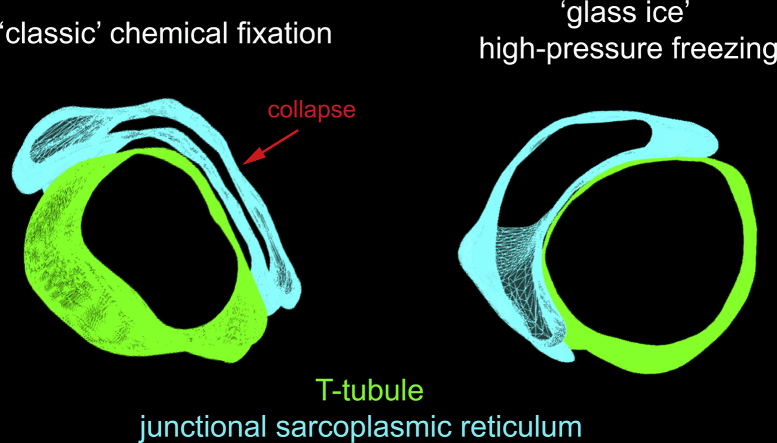
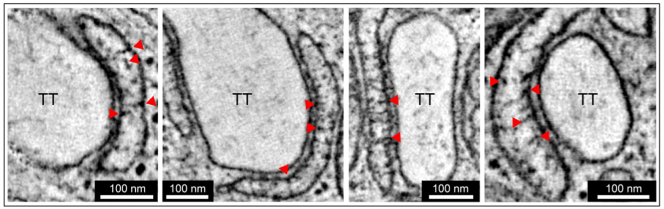
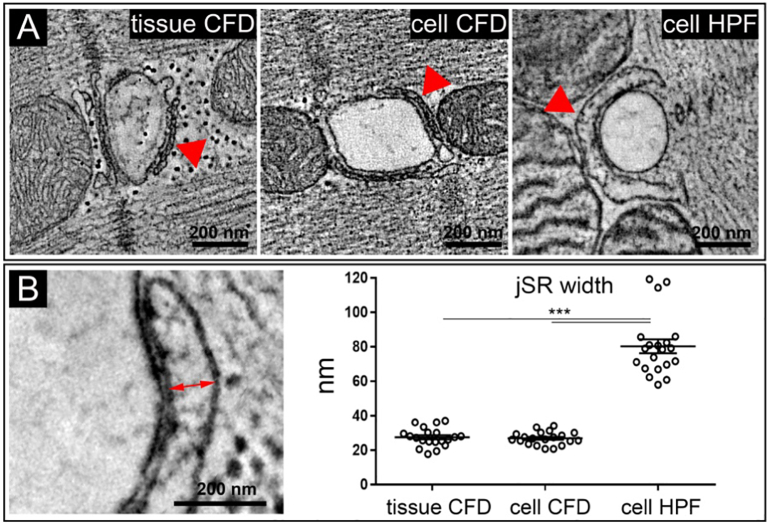
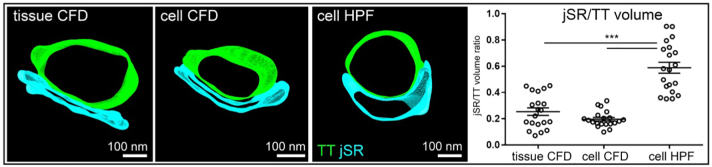
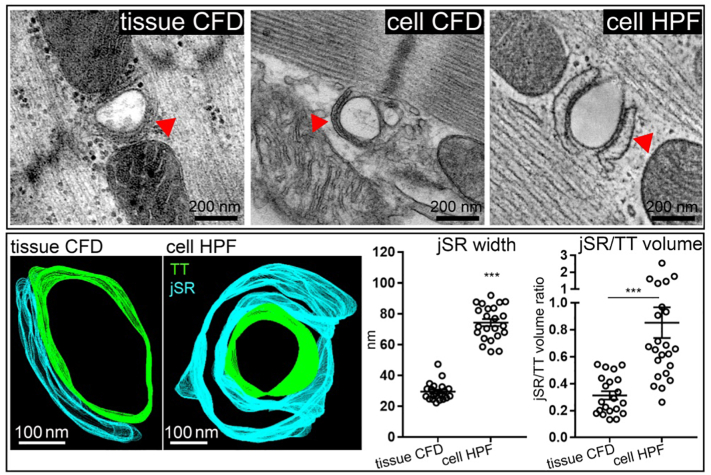
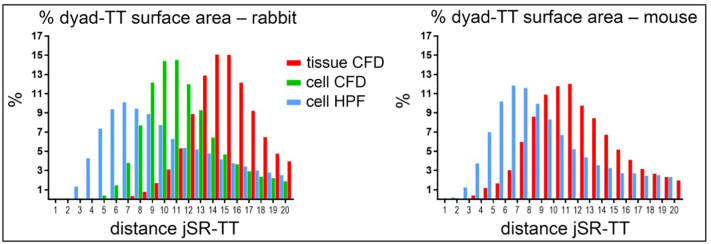
Detailed knowledge of the ultrastructure of intracellular compartments is a prerequisite for our understanding of how cells function. In cardiac muscle cells, close apposition of transverse (t)-tubule (TT) and sarcoplasmic reticulum (SR) membranes supports stable high-gain excitation-contraction coupling. Here, the fine structure of this key intracellular element is examined in rabbit and mouse ventricular cardiomyocytes, using ultra-rapid high-pressure freezing (HPF, omitting aldehyde fixation) and electron microscopy. 3D electron tomograms were used to quantify the dimensions of TT, terminal cisternae of the SR, and the space between SR and TT membranes (dyadic cleft). In comparison to conventional aldehyde-based chemical sample fixation, HPF-preserved samples of both species show considerably more voluminous SR terminal cisternae, both in absolute dimensions and in terms of junctional SR to TT volume ratio. In rabbit cardiomyocytes, the average dyadic cleft surface area of HPF and chemically fixed myocytes did not differ, but cleft volume was significantly smaller in HPF samples than in conventionally fixed tissue; in murine cardiomyocytes, the dyadic cleft surface area was higher in HPF samples with no difference in cleft volume. In both species, the apposition of the TT and SR membranes in the dyad was more likely to be closer than 10 nm in HPF samples compared to CFD, presumably resulting from avoidance of sample shrinkage associated with conventional fixation techniques. Overall, we provide a note of caution regarding quantitative interpretation of chemically-fixed ultrastructures, and offer novel insight into cardiac TT and SR ultrastructure with relevance for our understanding of cardiac physiology.
详细了解细胞内隔室的超微结构是理解细胞如何发挥功能的前提。在心肌细胞中,横管 (TT) 和肌浆网 (SR) 膜的紧密贴合支持稳定的高增益兴奋-收缩偶联。在这里,使用超快速高压冷冻 (HPF,省略醛固定) 和电子显微镜检查了兔和鼠心室心肌细胞中这一关键细胞内元件的精细结构。3D 电子断层图用于定量 TT、SR 的终末池和 SR 与 TT 膜之间的空间 (二联体裂) 的尺寸。与传统的基于醛的化学样品固定相比,两种物种的 HPF 保存的样品均显示出 SR 终末池体积明显更大,无论是在绝对尺寸还是在连接 SR 与 TT 体积比方面。在兔心肌细胞中,HPF 和化学固定心肌细胞的平均二联体裂表面面积没有差异,但裂体积在 HPF 样品中明显小于常规固定组织;在鼠心肌细胞中,HPF 样品中二联体裂表面面积较高,裂体积没有差异。在这两种物种中,与 CFD 相比,HPF 样品中二联体 TT 和 SR 膜的贴合更有可能小于 10nm,这可能是由于避免了与传统固定技术相关的样品收缩。总体而言,我们对化学固定超微结构的定量解释提出了警告,并为理解心脏 TT 和 SR 的超微结构提供了新的见解,这对我们理解心脏生理学具有重要意义。