• 文献检索
  • 文档翻译
  • 深度研究
  • 学术资讯
  • Suppr Zotero 插件Zotero 插件
  • 邀请有礼
  • 套餐&价格
  • 历史记录
应用&插件
Suppr Zotero 插件Zotero 插件浏览器插件Mac 客户端Windows 客户端微信小程序
定价
高级版会员购买积分包购买API积分包
服务
文献检索文档翻译深度研究API 文档MCP 服务
关于我们
关于 Suppr公司介绍联系我们用户协议隐私条款
关注我们

Suppr 超能文献

核心技术专利:CN118964589B侵权必究
粤ICP备2023148730 号-1Suppr @ 2026

文献检索

告别复杂PubMed语法,用中文像聊天一样搜索,搜遍4000万医学文献。AI智能推荐,让科研检索更轻松。

立即免费搜索

文件翻译

保留排版,准确专业,支持PDF/Word/PPT等文件格式,支持 12+语言互译。

免费翻译文档

深度研究

AI帮你快速写综述,25分钟生成高质量综述,智能提取关键信息,辅助科研写作。

立即免费体验

利用腕带生物信号区分心理和身体应激源。

Discrimination of simultaneous psychological and physical stressors using wristband biosignals.

机构信息

Department of Biomedical Engineering, Illinois Institute of Technology, Chicago, IL, 60616, USA.

Department of Chemical and Biological Engineering, Illinois Institute of Technology, Chicago, IL, 60616, USA.

出版信息

Comput Methods Programs Biomed. 2021 Feb;199:105898. doi: 10.1016/j.cmpb.2020.105898. Epub 2020 Dec 17.

DOI:10.1016/j.cmpb.2020.105898
PMID:33360529
原文链接:https://pmc.ncbi.nlm.nih.gov/articles/PMC7878428/
Abstract

BACKGROUND AND OBJECTIVE

In this work, we address the problem of detecting and discriminating acute psychological stress (APS) in the presence of concurrent physical activity (PA) using wristband biosignals. We focused on signals available from wearable devices that can be worn in daily life because the ultimate objective of this work is to provide APS and PA information in real-time management of chronic conditions such as diabetes by automated personalized insulin delivery. Monitoring APS noninvasively throughout free-living conditions remains challenging because the responses to APS and PA of many physiological variables measured by wearable devices are similar.

METHODS

Various classification algorithms are compared to simultaneously detect and discriminate the PA (sedentary state, treadmill running, and stationary bike) and the type of APS (non-stress state, mental stress, and emotional anxiety). The impact of APS inducements is verified with commonly used self-reported questionnaires (The State-Trait Anxiety Inventory (STAI)). To aid the classification algorithms, novel features are generated from the physiological variables reported by a wristband device during 117 hours of experiments involving simultaneous APS inducement and PA. We also translate the APS assessment into a quantitative metric for use in predicting the adverse outcomes.

RESULTS

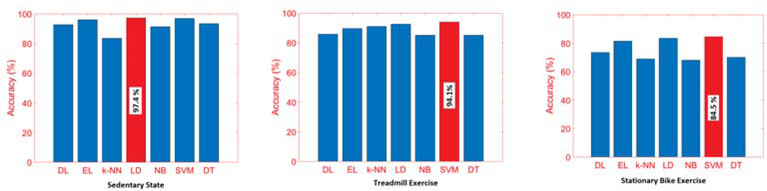
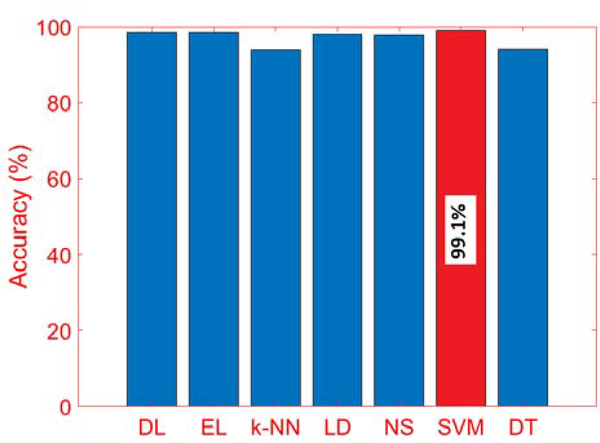
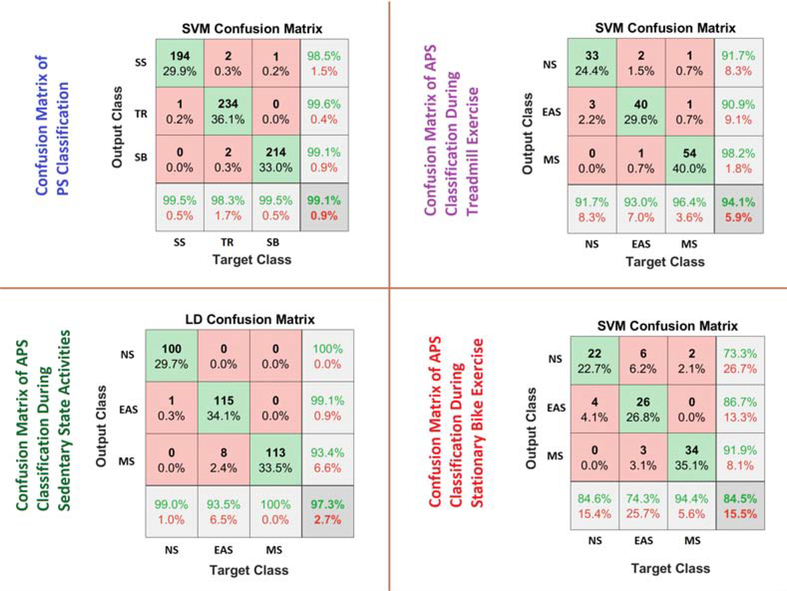
An accurate classification of the concurrent PA and APS states is achieved with an overall classification accuracy of 99% for PA and 92% for APS. The average accuracy of APS detection during sedentary state, treadmill running, and stationary bike is 97.3, 94.1, and 84.5%, respectively.

CONCLUSIONS

The simultaneous assessment of APS and PA throughout free-living conditions from a convenient wristband device is useful for monitoring the factors contributing to an elevated risk of acute events in people with chronic diseases like cardiovascular complications and diabetes.

摘要

背景与目的

在这项工作中,我们致力于利用腕带生物信号解决在同时存在身体活动(PA)的情况下检测和区分急性心理应激(APS)的问题。我们专注于可穿戴设备中可用的信号,这些信号可在日常生活中佩戴,因为这项工作的最终目标是通过自动化个性化胰岛素输送,为慢性疾病(如糖尿病)的实时管理提供 APS 和 PA 信息。在自由生活条件下进行非侵入性的 APS 监测仍然具有挑战性,因为可穿戴设备测量的许多生理变量对 APS 和 PA 的反应相似。

方法

比较了各种分类算法,以同时检测和区分 PA(静坐状态、跑步机跑步和固定自行车)和 APS 类型(非应激状态、心理应激和情绪焦虑)。使用常用的自我报告问卷(状态-特质焦虑量表(STAI))验证 APS 诱发的影响。为了帮助分类算法,从腕带设备在涉及同时 APS 诱发和 PA 的 117 小时实验中报告的生理变量生成新的特征。我们还将 APS 评估转换为一种定量指标,用于预测不良结果。

结果

通过对 PA 和 APS 状态进行整体分类精度为 99%的 PA 和 92%的 APS,实现了对同时 PA 和 APS 状态的准确分类。在静坐、跑步机跑步和固定自行车状态下,APS 检测的平均准确率分别为 97.3%、94.1%和 84.5%。

结论

从方便的腕带设备在自由生活条件下同时评估 APS 和 PA,对于监测导致心血管并发症和糖尿病等慢性疾病患者急性事件风险增加的因素是有用的。
https://cdn.ncbi.nlm.nih.gov/pmc/blobs/070b/7878428/e0a63dc58760/nihms-1658205-f0009.jpg
https://cdn.ncbi.nlm.nih.gov/pmc/blobs/070b/7878428/05856a3244d7/nihms-1658205-f0010.jpg
https://cdn.ncbi.nlm.nih.gov/pmc/blobs/070b/7878428/0f3981be1bda/nihms-1658205-f0011.jpg
https://cdn.ncbi.nlm.nih.gov/pmc/blobs/070b/7878428/3bc2307bcc7a/nihms-1658205-f0012.jpg
https://cdn.ncbi.nlm.nih.gov/pmc/blobs/070b/7878428/ad93e4a5e6d6/nihms-1658205-f0013.jpg
https://cdn.ncbi.nlm.nih.gov/pmc/blobs/070b/7878428/b23eef8279e9/nihms-1658205-f0014.jpg
https://cdn.ncbi.nlm.nih.gov/pmc/blobs/070b/7878428/ab005ce647ce/nihms-1658205-f0015.jpg
https://cdn.ncbi.nlm.nih.gov/pmc/blobs/070b/7878428/7ea741afc5bb/nihms-1658205-f0016.jpg
https://cdn.ncbi.nlm.nih.gov/pmc/blobs/070b/7878428/a203e33b6558/nihms-1658205-f0001.jpg
https://cdn.ncbi.nlm.nih.gov/pmc/blobs/070b/7878428/da35076e2290/nihms-1658205-f0002.jpg
https://cdn.ncbi.nlm.nih.gov/pmc/blobs/070b/7878428/f4e900d0ad61/nihms-1658205-f0003.jpg
https://cdn.ncbi.nlm.nih.gov/pmc/blobs/070b/7878428/b579b145a892/nihms-1658205-f0004.jpg
https://cdn.ncbi.nlm.nih.gov/pmc/blobs/070b/7878428/d7105556b09d/nihms-1658205-f0005.jpg
https://cdn.ncbi.nlm.nih.gov/pmc/blobs/070b/7878428/cd2b0ff59c5b/nihms-1658205-f0006.jpg
https://cdn.ncbi.nlm.nih.gov/pmc/blobs/070b/7878428/90e64f50361e/nihms-1658205-f0007.jpg
https://cdn.ncbi.nlm.nih.gov/pmc/blobs/070b/7878428/9beedf6f1209/nihms-1658205-f0008.jpg
https://cdn.ncbi.nlm.nih.gov/pmc/blobs/070b/7878428/e0a63dc58760/nihms-1658205-f0009.jpg
https://cdn.ncbi.nlm.nih.gov/pmc/blobs/070b/7878428/05856a3244d7/nihms-1658205-f0010.jpg
https://cdn.ncbi.nlm.nih.gov/pmc/blobs/070b/7878428/0f3981be1bda/nihms-1658205-f0011.jpg
https://cdn.ncbi.nlm.nih.gov/pmc/blobs/070b/7878428/3bc2307bcc7a/nihms-1658205-f0012.jpg
https://cdn.ncbi.nlm.nih.gov/pmc/blobs/070b/7878428/ad93e4a5e6d6/nihms-1658205-f0013.jpg
https://cdn.ncbi.nlm.nih.gov/pmc/blobs/070b/7878428/b23eef8279e9/nihms-1658205-f0014.jpg
https://cdn.ncbi.nlm.nih.gov/pmc/blobs/070b/7878428/ab005ce647ce/nihms-1658205-f0015.jpg
https://cdn.ncbi.nlm.nih.gov/pmc/blobs/070b/7878428/7ea741afc5bb/nihms-1658205-f0016.jpg
https://cdn.ncbi.nlm.nih.gov/pmc/blobs/070b/7878428/a203e33b6558/nihms-1658205-f0001.jpg
https://cdn.ncbi.nlm.nih.gov/pmc/blobs/070b/7878428/da35076e2290/nihms-1658205-f0002.jpg
https://cdn.ncbi.nlm.nih.gov/pmc/blobs/070b/7878428/f4e900d0ad61/nihms-1658205-f0003.jpg
https://cdn.ncbi.nlm.nih.gov/pmc/blobs/070b/7878428/b579b145a892/nihms-1658205-f0004.jpg
https://cdn.ncbi.nlm.nih.gov/pmc/blobs/070b/7878428/d7105556b09d/nihms-1658205-f0005.jpg
https://cdn.ncbi.nlm.nih.gov/pmc/blobs/070b/7878428/cd2b0ff59c5b/nihms-1658205-f0006.jpg
https://cdn.ncbi.nlm.nih.gov/pmc/blobs/070b/7878428/90e64f50361e/nihms-1658205-f0007.jpg
https://cdn.ncbi.nlm.nih.gov/pmc/blobs/070b/7878428/9beedf6f1209/nihms-1658205-f0008.jpg
https://cdn.ncbi.nlm.nih.gov/pmc/blobs/070b/7878428/e0a63dc58760/nihms-1658205-f0009.jpg

相似文献

1
Discrimination of simultaneous psychological and physical stressors using wristband biosignals.利用腕带生物信号区分心理和身体应激源。
Comput Methods Programs Biomed. 2021 Feb;199:105898. doi: 10.1016/j.cmpb.2020.105898. Epub 2020 Dec 17.
2
Physical Activity and Psychological Stress Detection and Assessment of Their Effects on Glucose Concentration Predictions in Diabetes Management.体力活动和心理应激的检测及其对糖尿病管理中血糖浓度预测影响的评估。
IEEE Trans Biomed Eng. 2021 Jul;68(7):2251-2260. doi: 10.1109/TBME.2020.3049109. Epub 2021 Jun 17.
3
Experimental Analysis of Artificial Neural Networks Performance for Physical Activity Recognition Using Belt and Wristband Devices.使用腰带和腕带设备进行身体活动识别的人工神经网络性能的实验分析
Annu Int Conf IEEE Eng Med Biol Soc. 2019 Jul;2019:2492-2495. doi: 10.1109/EMBC.2019.8856617.
4
Multi-Modal Acute Stress Recognition Using Off-the-Shelf Wearable Devices.使用现成可穿戴设备的多模态急性应激识别
Annu Int Conf IEEE Eng Med Biol Soc. 2019 Jul;2019:2196-2201. doi: 10.1109/EMBC.2019.8857130.
5
Comparison of Wrist- and Hip-Worn Activity Monitors When Meeting Step Guidelines.达到步数指南时手腕佩戴式和臀部佩戴式活动监测器的比较
Prev Chronic Dis. 2022 Apr 14;19:E18. doi: 10.5888/pcd19.210343.
6
Automated classification of hand gestures using a wristband and machine learning for possible application in pill intake monitoring.使用腕带和机器学习对手势进行自动分类,以便在药物摄入监测中可能得到应用。
Comput Methods Programs Biomed. 2022 Jun;219:106753. doi: 10.1016/j.cmpb.2022.106753. Epub 2022 Mar 15.
7
Determining Physical Activity Characteristics from Wristband Data for Use in Automated Insulin Delivery Systems.从腕带数据中确定身体活动特征以用于自动胰岛素输送系统。
IEEE Sens J. 2020 Nov;20(21):12859-12870. doi: 10.1109/jsen.2020.3000772. Epub 2020 Jun 8.
8
AI-Enabled Smart Wristband Providing Real-Time Vital Signs and Stress Monitoring.人工智能腕带实时提供生命体征和压力监测。
Sensors (Basel). 2023 Mar 4;23(5):2821. doi: 10.3390/s23052821.
9
Fall Risk Classification in Community-Dwelling Older Adults Using a Smart Wrist-Worn Device and the Resident Assessment Instrument-Home Care: Prospective Observational Study.使用智能腕戴设备和居家护理居民评估工具对社区老年人进行跌倒风险分类:前瞻性观察研究
JMIR Aging. 2019 Jun 7;2(1):e12153. doi: 10.2196/12153.
10
Impact of Daily Physical Activity as Measured by Commonly Available Wearables on Mealtime Glucose Control in Type 1 Diabetes.常见可穿戴设备测量的日常身体活动对 1 型糖尿病患者进餐时血糖控制的影响。
Diabetes Technol Ther. 2020 Oct;22(10):742-748. doi: 10.1089/dia.2019.0517.

引用本文的文献

1
Metabolic Models, in Silico Trials, and Algorithms.代谢模型、虚拟试验与算法
J Diabetes Sci Technol. 2025 Jul;19(4):895-907. doi: 10.1177/19322968251338300. Epub 2025 Jul 1.
2
Wearable Physiological Signals under Acute Stress and Exercise Conditions.急性应激和运动条件下的可穿戴生理信号
Sci Data. 2025 Mar 28;12(1):520. doi: 10.1038/s41597-025-04845-9.
3
Applying AI in the Context of the Association Between Device-Based Assessment of Physical Activity and Mental Health: Systematic Review.在基于设备的身体活动评估与心理健康之间的关联背景下应用人工智能:系统评价

本文引用的文献

1
Determining Physical Activity Characteristics from Wristband Data for Use in Automated Insulin Delivery Systems.从腕带数据中确定身体活动特征以用于自动胰岛素输送系统。
IEEE Sens J. 2020 Nov;20(21):12859-12870. doi: 10.1109/jsen.2020.3000772. Epub 2020 Jun 8.
2
Stress detection in daily life scenarios using smart phones and wearable sensors: A survey.利用智能手机和可穿戴传感器进行日常生活场景中的压力检测:调查研究。
J Biomed Inform. 2019 Apr;92:103139. doi: 10.1016/j.jbi.2019.103139. Epub 2019 Feb 27.
3
Accuracy and Precision of the COSMED K5 Portable Analyser.
JMIR Mhealth Uhealth. 2025 Mar 6;13:e59660. doi: 10.2196/59660.
4
Digital biomarkers for non-motor symptoms in Parkinson's disease: the state of the art.帕金森病非运动症状的数字生物标志物:现状
NPJ Digit Med. 2024 Jul 11;7(1):186. doi: 10.1038/s41746-024-01144-2.
5
Personalized Stress Detection Using Biosignals from Wearables: A Scoping Review.使用可穿戴设备的生物信号进行个性化压力检测:范围综述。
Sensors (Basel). 2024 May 18;24(10):3221. doi: 10.3390/s24103221.
6
Recent advances in the precision control strategy of artificial pancreas.人工胰腺精准控制策略的最新进展。
Med Biol Eng Comput. 2024 Jun;62(6):1615-1638. doi: 10.1007/s11517-024-03042-x. Epub 2024 Feb 28.
7
Prospective clinical validation of the Empatica EmbracePlus wristband as a reflective pulse oximeter.将Empatica EmbracePlus腕带作为反射式脉搏血氧仪的前瞻性临床验证。
Front Digit Health. 2023 Dec 4;5:1258915. doi: 10.3389/fdgth.2023.1258915. eCollection 2023.
8
Multivariable Automated Insulin Delivery System for Handling Planned and Spontaneous Physical Activities.多变量自动胰岛素输送系统,用于处理计划内和自发性身体活动。
J Diabetes Sci Technol. 2023 Nov;17(6):1456-1469. doi: 10.1177/19322968231204884.
9
Identification of heart rate change during the teaching process.识别教学过程中心率变化。
Sci Rep. 2023 Oct 4;13(1):16674. doi: 10.1038/s41598-023-43763-x.
10
A physiological signal database of children with different special needs for stress recognition.具有不同应激识别特殊需求的儿童的生理信号数据库。
Sci Data. 2023 Jun 14;10(1):382. doi: 10.1038/s41597-023-02272-2.
COSMED K5便携式分析仪的准确性和精密度
Front Physiol. 2018 Dec 21;9:1764. doi: 10.3389/fphys.2018.01764. eCollection 2018.
4
Portable System for Real-Time Detection of Stress Level.便携式实时压力水平检测系统。
Sensors (Basel). 2018 Aug 1;18(8):2504. doi: 10.3390/s18082504.
5
Incorporating Unannounced Meals and Exercise in Adaptive Learning of Personalized Models for Multivariable Artificial Pancreas Systems.将未宣布的进餐和运动纳入多变量人工胰腺系统个性化模型的自适应学习中。
J Diabetes Sci Technol. 2018 Sep;12(5):953-966. doi: 10.1177/1932296818789951. Epub 2018 Jul 31.
6
Adaptive and Personalized Plasma Insulin Concentration Estimation for Artificial Pancreas Systems.用于人工胰腺系统的自适应和个性化血浆胰岛素浓度估计
J Diabetes Sci Technol. 2018 May;12(3):639-649. doi: 10.1177/1932296818763959. Epub 2018 Mar 23.
7
Comparison of four Fitbit and Jawbone activity monitors with a research-grade ActiGraph accelerometer for estimating physical activity and energy expenditure.比较四种 Fitbit 和 Jawbone 活动监测器与研究级 ActiGraph 加速度计,以估计身体活动和能量消耗。
Br J Sports Med. 2018 Jul;52(13):844-850. doi: 10.1136/bjsports-2016-096990. Epub 2017 May 8.
8
Accurate Heart Rate Monitoring During Physical Exercises Using PPG.使用光电容积脉搏波描记法(PPG)在体育锻炼期间进行精确心率监测。
IEEE Trans Biomed Eng. 2017 Sep;64(9):2016-2024. doi: 10.1109/TBME.2017.2676243. Epub 2017 Mar 1.
9
Real-Time Robust Heart Rate Estimation From Wrist-Type PPG Signals Using Multiple Reference Adaptive Noise Cancellation.基于多参考自适应噪声消除的腕部 PPG 信号实时心率估计
IEEE J Biomed Health Inform. 2018 Mar;22(2):450-459. doi: 10.1109/JBHI.2016.2632201. Epub 2016 Nov 23.
10
Principal component analysis: a review and recent developments.主成分分析:综述与最新进展
Philos Trans A Math Phys Eng Sci. 2016 Apr 13;374(2065):20150202. doi: 10.1098/rsta.2015.0202.