Department of Biology, Stanford University, Stanford, CA, 94305, USA; Natural Capital Project, Woods Institute for the Environment, Stanford University, Stanford, CA 94305, USA.
Emmett Interdisciplinary Program in Environment and Resources, Stanford University, Stanford, CA, 94305, USA.
Epidemics. 2021 Mar;34:100430. doi: 10.1016/j.epidem.2020.100430. Epub 2020 Dec 21.
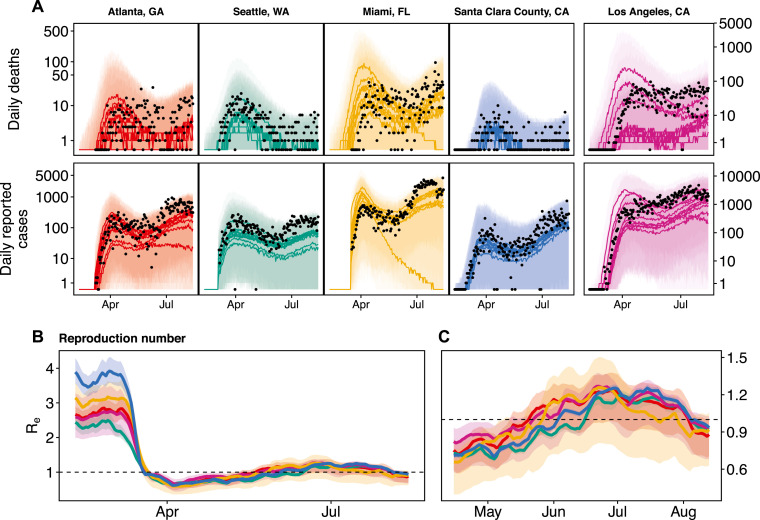
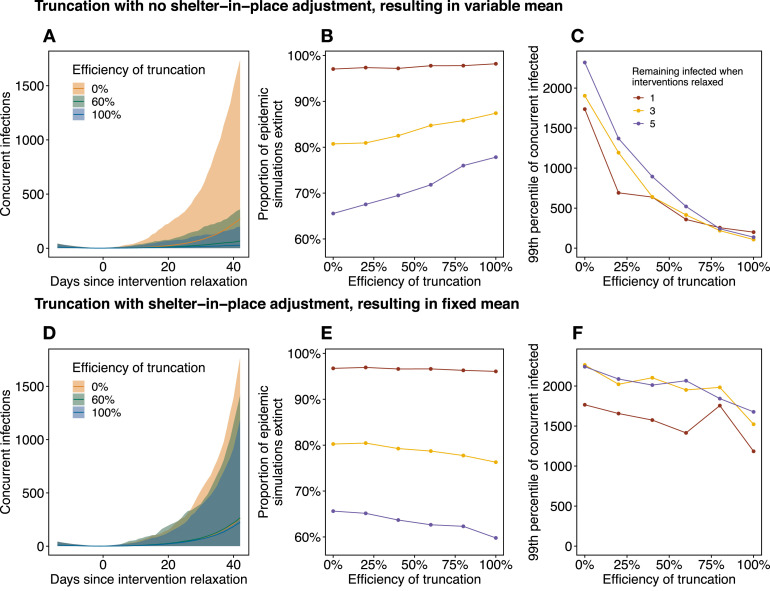
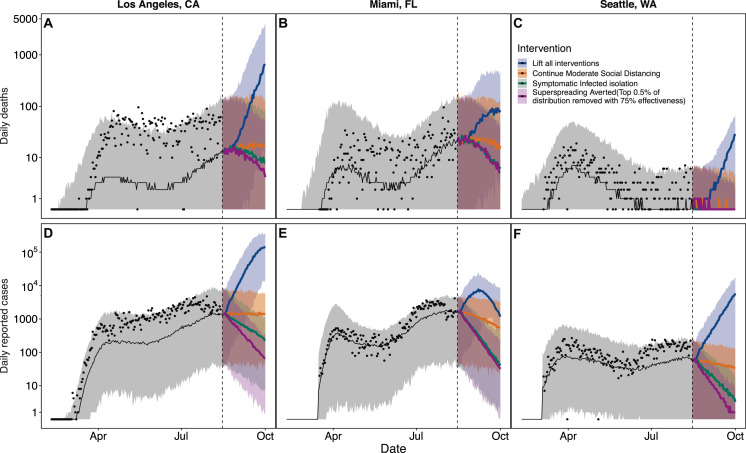
Disease transmission is notoriously heterogeneous, and SARS-CoV-2 is no exception. A skewed distribution where few individuals or events are responsible for the majority of transmission can result in explosive, superspreading events, which produce rapid and volatile epidemic dynamics, especially early or late in epidemics. Anticipating and preventing superspreading events can produce large reductions in overall transmission rates. Here, we present a stochastic compartmental (SEIR) epidemiological model framework for estimating transmission parameters from multiple imperfectly observed data streams, including reported cases, deaths, and mobile phone-based mobility that incorporates individual-level heterogeneity in transmission using previous estimates for SARS-CoV-1 and SARS-CoV-2. We parameterize the model for COVID-19 epidemic dynamics by estimating a time-varying transmission rate that incorporates the impact of non-pharmaceutical intervention strategies that change over time, in five epidemiologically distinct settings-Los Angeles and Santa Clara Counties, California; Seattle (King County), Washington; Atlanta (Dekalb and Fulton Counties), Georgia; and Miami (Miami-Dade County), Florida. We find that the effective reproduction number (R) dropped below 1 rapidly in all five locations following social distancing orders in mid-March, 2020, but that gradually increasing mobility starting around mid-April led to an R once again above 1 in late May (Los Angeles, Miami, and Atlanta) or early June (Santa Clara County and Seattle). However, we find that increased social distancing starting in mid-July in response to epidemic resurgence once again dropped R below 1 in all locations by August 14. We next used the fitted model to ask: how does truncating the individual-level transmission rate distribution (which removes periods of time with especially high individual transmission rates and thus models superspreading events) affect epidemic dynamics and control? We find that interventions that truncate the transmission rate distribution while partially relaxing social distancing are broadly effective, with impacts on epidemic growth on par with the strongest population-wide social distancing observed in April, 2020. Given that social distancing interventions will be needed to maintain epidemic control until a vaccine becomes widely available, "chopping off the tail" to reduce the probability of superspreading events presents a promising option to alleviate the need for extreme general social distancing.
疾病传播具有明显的异质性,SARS-CoV-2 也不例外。少数个体或事件导致大多数传播的偏态分布可能导致爆炸性的超级传播事件,从而产生快速和不稳定的疫情动态,尤其是在疫情早期或晚期。预测和预防超级传播事件可以大大降低整体传播率。在这里,我们提出了一个随机隔室(SEIR)流行病学模型框架,用于从多个不完全观察的数据流中估计传播参数,包括报告病例、死亡和基于移动电话的流动性,该框架使用 SARS-CoV-1 和 SARS-CoV-2 的先前估计值来整合个体传播的异质性。我们通过估计随时间变化的传播率来对 COVID-19 疫情动态进行参数化,该传播率结合了随时间变化的非药物干预策略的影响,这些策略在五个具有不同流行病学特征的地点进行了参数化:加利福尼亚州洛杉矶和圣克拉拉县;华盛顿州西雅图(金县);佐治亚州亚特兰大(迪卡尔布和富尔顿县);以及佛罗里达州迈阿密(迈阿密戴德县)。我们发现,在 2020 年 3 月中旬发布社交距离命令后,所有五个地点的有效繁殖数(R)迅速下降到 1 以下,但从 4 月中旬开始逐渐增加的流动性导致 5 月底(洛杉矶、迈阿密和亚特兰大)或 6 月初(圣克拉拉县和西雅图)R 再次超过 1。然而,我们发现,为应对疫情反弹,从 7 月中旬开始加强社交距离限制,到 8 月 14 日,所有地点的 R 再次下降到 1 以下。我们接下来使用拟合模型来问:截断个体传播率分布(去除个体传播率特别高的时间段,从而模拟超级传播事件)如何影响疫情动态和控制?我们发现,截断传播率分布同时部分放宽社交距离限制的干预措施是广泛有效的,对疫情增长的影响与 2020 年 4 月观察到的最强的全民社交距离限制相当。鉴于在广泛普及疫苗之前,将需要采取社交距离干预措施来维持疫情控制,“切掉尾巴”以降低超级传播事件的概率为缓解对极端普遍社交距离的需求提供了一个有希望的选择。