MRC Unit the Gambia at the London School of Hygiene and Tropical Medicine, Fajara, GM.
African Population and Health Policy Initiative, Gombe, NG.
Ann Glob Health. 2020 Dec 14;86(1):153. doi: 10.5334/aogh.3093.
Over the past three decades, double burden of malnutrition (DBM), a situation where high levels of undernutrition (stunting, thinness, or micronutrient deficiency) coexist with overnutrition (overweight and obesity), continues to rise in sub-Saharan Africa. Compared to other countries in the region, the evidence on DBM is limited in Nigeria.
This paper aimed to determine the comparative prevalence of population-level and individual-level DBM among adolescents in two emerging cities in northern and southern Nigeria.
This was a comparative cross-sectional study among apparently healthy secondary school adolescents aged 10-18 years in Gombe (northern Nigeria) and Uyo (southern Nigeria) between January 2015 and June 2017. A multistage random sampling technique was implemented to recruit adolescents from 24 secondary schools in both cities. Measures of general obesity (body mass index) and stature (height-for-age) were classified and Z-scores generated using the WHO software, which is based on the WHO 2006 growth reference. Population-level DBM was defined as the occurrence of thinness and overweight/obesity within the population. Individual-level DBM was defined as the proportion of individuals who were concurrently stunted and had truncal obesity or stunted and were overweight/obese.
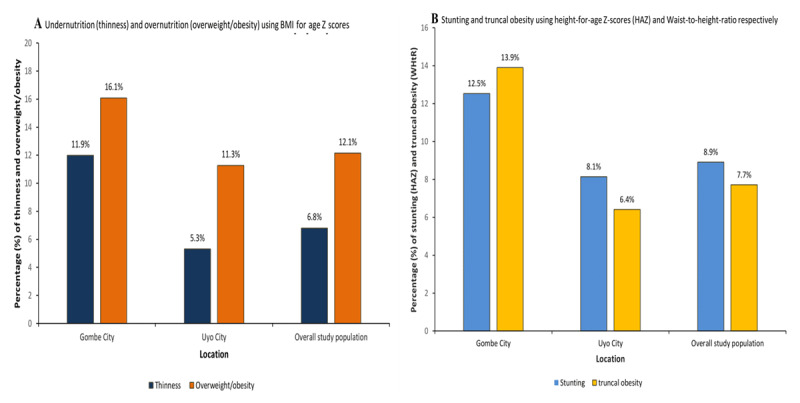
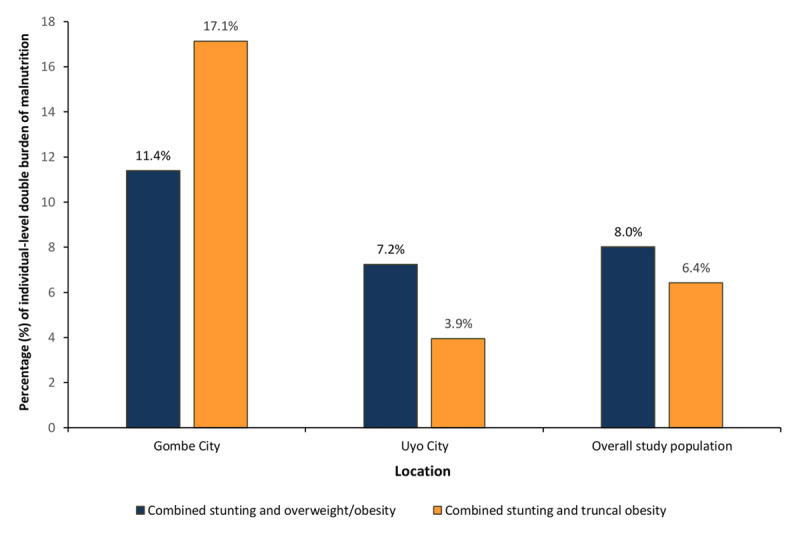
Overall, at the population-level in both settings, 6.8% of adolescents had thinness, while 12.4% were overweight/obese signifying a high burden of population-level DBM. Comparatively, the population-level DBM was higher in Gombe compared to Uyo (thinness: 11.98% vs 5.3% and overweight/obesity: 16.08% vs 11.27% in Gombe vs Uyo respectively). Overall, at the individual level, 6.42% of stunted adolescents had coexisting truncal obesity, while 8.02% were stunted and had coexisting general overweight/obesity. Like the trend with population-level DBM, individual-level DBM was higher in Gombe (northern Nigeria) compared to Uyo (southern Nigeria).
High levels of population-level and individual-level DBM exist in Gombe and Uyo. However, the level of DBM (under- and over-nutrition) is higher in Gombe located in northern Nigeria compared to Uyo in southern Nigeria.
在过去的三十年中,营养不良的双重负担(DBM)持续在撒哈拉以南非洲地区上升,这种情况是指高水平的营养不足(发育迟缓、消瘦或微量营养素缺乏)与营养过剩(超重和肥胖)并存。与该地区的其他国家相比,尼日利亚的 DBM 证据有限。
本研究旨在确定在尼日利亚北部和南部两个新兴城市的青少年中,人群层面和个体层面 DBM 的相对流行率。
这是一项在 2015 年 1 月至 2017 年 6 月期间,对来自北部城市贡贝和南部城市乌约的 10-18 岁明显健康的中学生进行的比较性横断面研究。采用多阶段随机抽样技术从两个城市的 24 所中学招募青少年。使用基于世卫组织 2006 年生长参考的世卫组织软件对一般肥胖(体重指数)和身高(身高-年龄)进行分类和 Z 评分。人群层面的 DBM 定义为人群中消瘦和超重/肥胖的发生。个体层面的 DBM 定义为同时发育迟缓且存在躯干肥胖或发育迟缓且超重/肥胖的个体比例。
总体而言,在两个地区的人群层面上,有 6.8%的青少年消瘦,而 12.4%的青少年超重/肥胖,表明人群层面 DBM 的负担很高。相比之下,在贡贝(消瘦:11.98% vs 5.3%,超重/肥胖:16.08% vs 11.27%),人群层面的 DBM 高于乌约。总体而言,在个体层面上,有 6.42%的发育迟缓青少年存在躯干肥胖,而 8.02%的发育迟缓青少年存在一般超重/肥胖。与人群层面 DBM 的趋势相似,个体层面的 DBM 在贡贝(北部尼日利亚)高于乌约(南部尼日利亚)。
在贡贝和乌约都存在高水平的人群层面和个体层面 DBM。然而,在位于尼日利亚北部的贡贝,DBM(营养不足和营养过剩)的水平高于位于尼日利亚南部的乌约。