Massimino Luca, Lovisa Sara, Antonio Lamparelli Luigi, Danese Silvio, Ungaro Federica
Department of Biomedical Sciences, Humanitas University, Pieve Emanuele, Milan, Italy.
IBD Center, Laboratory of Gastrointestinal Immunopathology, Humanitas Clinical and Research Center, Rozzano, Milan, Italy.
Comput Struct Biotechnol J. 2020 Dec 7;19:16-28. doi: 10.1016/j.csbj.2020.11.055. eCollection 2021.
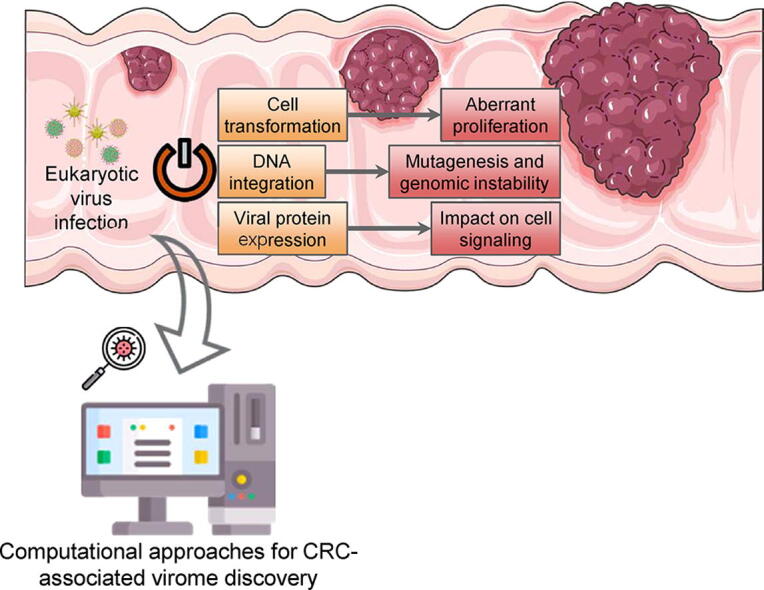
The human gut microbiota is composed of bacteria and viruses that might be associated with colorectal cancer (CRC) onset and progression. Indeed, although viral infections have been reported to be the primary trigger in many diseases, the role of eukaryotic viruses populating the gut mucosa during early colorectal carcinogenesis is underinvestigated. Human eukaryotic viruses in the gut were found to induce alterations of the immune homeostasis so that some viral-dependent mechanisms likely able to induce DNA alterations in the bowel wall have been proposed, although no demonstration is available yet. However, thanks to the latest advancements in computational biology and the implementation of the bioinformatic pipelines, the option of establishing a direct causative link between intestinal virome and CRC will be possible soon, hopefully paving the way to innovative therapeutic strategies blocking or reverting the CRC pathogenesis.
人类肠道微生物群由细菌和病毒组成,它们可能与结直肠癌(CRC)的发生和发展有关。事实上,尽管病毒感染已被报道为许多疾病的主要触发因素,但在结直肠癌早期发生过程中,定居于肠道黏膜的真核病毒的作用仍未得到充分研究。肠道中的人类真核病毒被发现会诱导免疫稳态的改变,因此有人提出了一些可能能够诱导肠壁DNA改变的病毒依赖性机制,尽管目前尚无证据。然而,由于计算生物学的最新进展以及生物信息学管道的应用,很快就有可能建立肠道病毒组与结直肠癌之间的直接因果联系,有望为阻断或逆转结直肠癌发病机制的创新治疗策略铺平道路。