Al Mamun Abdullah, Wu Yanqing, Monalisa Ilma, Jia Chang, Zhou Kailiang, Munir Fahad, Xiao Jian
Molecular Pharmacology Research Center, School of Pharmaceutical Sciences, Wenzhou Medical University, Wenzhou, 325035 Zhejiang Province, China.
Institute of Life Sciences, Wenzhou University, Wenzhou, 325035 Zhejiang Province, China.
J Adv Res. 2020 Aug 18;28:97-109. doi: 10.1016/j.jare.2020.08.004. eCollection 2021 Feb.
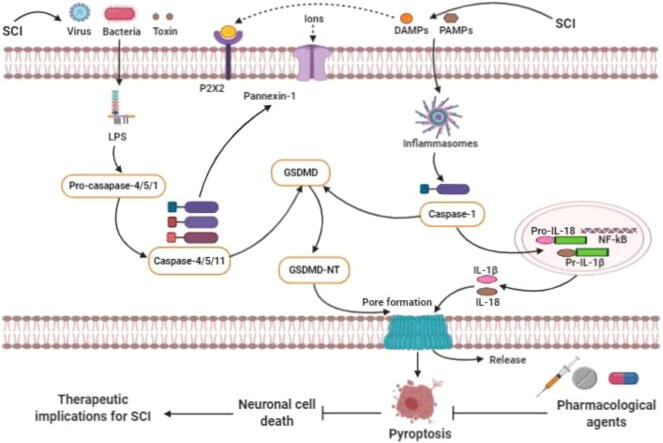
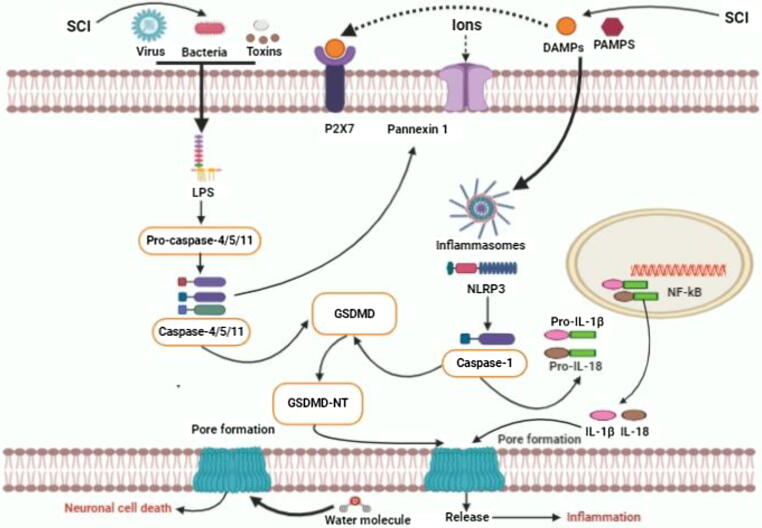
Currently, spinal cord injury (SCI) is a pathological incident that triggers several neuropathological conditions, leading to the initiation of neuronal damage with several pro-inflammatory mediators' release. However, pyroptosis is recognized as a new programmed cell death mechanism regulated by the stimulation of caspase-1 and/or caspase-11/-4/-5 signaling pathways with a series of inflammatory responses.
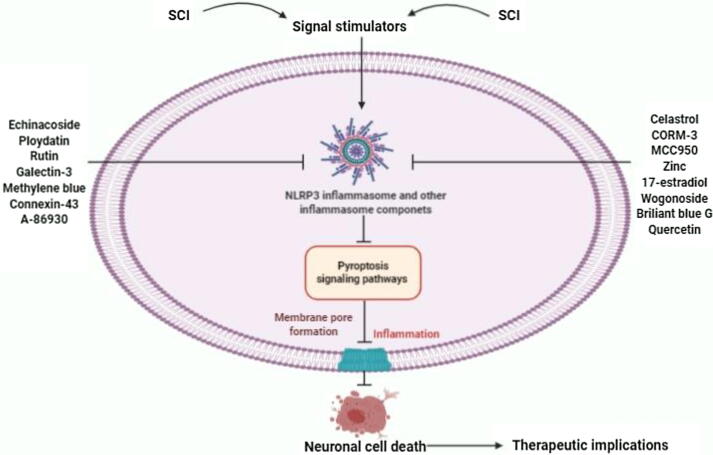
Our current review concisely summarizes the potential role of pyroptosis-regulated programmed cell death in SCI, according to several molecular and pathophysiological mechanisms. This review also highlights the targeting of pyroptosis signaling pathways and inflammasome components and its therapeutic implications for the treatment of SCI.
Multiple pieces of evidence have illustrated that pyroptosis plays significant roles in cell swelling, plasma membrane lysis, chromatin fragmentation and intracellular pro-inflammatory factors including IL-18 and IL-1β release. In addition, pyroptosis is directly mediated by the recently discovered family of pore-forming protein known as GSDMD. Current investigations have documented that pyroptosis-regulated cell death plays a critical role in the pathogenesis of multiple neurological disorders as well as SCI. Our narrative article suggests that inhibiting the pyroptosis-regulated cell death and inflammasome components could be a promising therapeutic approach for the treatment of SCI in the near future.
目前,脊髓损伤(SCI)是一种引发多种神经病理状况的病理事件,会导致神经元损伤,并释放多种促炎介质。然而,细胞焦亡被认为是一种新的程序性细胞死亡机制,受半胱天冬酶 -1和/或半胱天冬酶 -11/-4/-5信号通路刺激,并伴有一系列炎症反应。
我们当前的综述根据多种分子和病理生理机制,简要总结细胞焦亡调控的程序性细胞死亡在脊髓损伤中的潜在作用。本综述还强调了细胞焦亡信号通路和炎性小体成分的靶向作用及其对脊髓损伤治疗的意义。
多项证据表明,细胞焦亡在细胞肿胀、质膜溶解、染色质碎片化以及包括白细胞介素 -18和白细胞介素 -1β在内的细胞内促炎因子释放中发挥重要作用。此外,细胞焦亡直接由最近发现的成孔蛋白家族——Gasdermin D(GSDMD)介导。目前的研究表明,细胞焦亡调控的细胞死亡在多种神经疾病以及脊髓损伤的发病机制中起关键作用。我们的叙述性文章表明,抑制细胞焦亡调控的细胞死亡和炎性小体成分可能是在不久的将来治疗脊髓损伤的一种有前景的治疗方法。