Burdette Brandon E, Esparza Ashley N, Zhu Hua, Wang Shanzhi
Biology Department, University of Arkansas at Little Rock, Little Rock, AR 72204, USA.
Department of Surgery, the Ohio State University Wexner Medical Center, Columbus, OH 43210, USA.
Acta Pharm Sin B. 2021 Sep;11(9):2768-2782. doi: 10.1016/j.apsb.2021.02.006. Epub 2021 Apr 28.
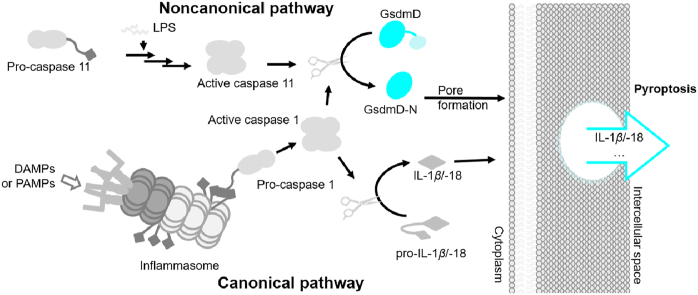
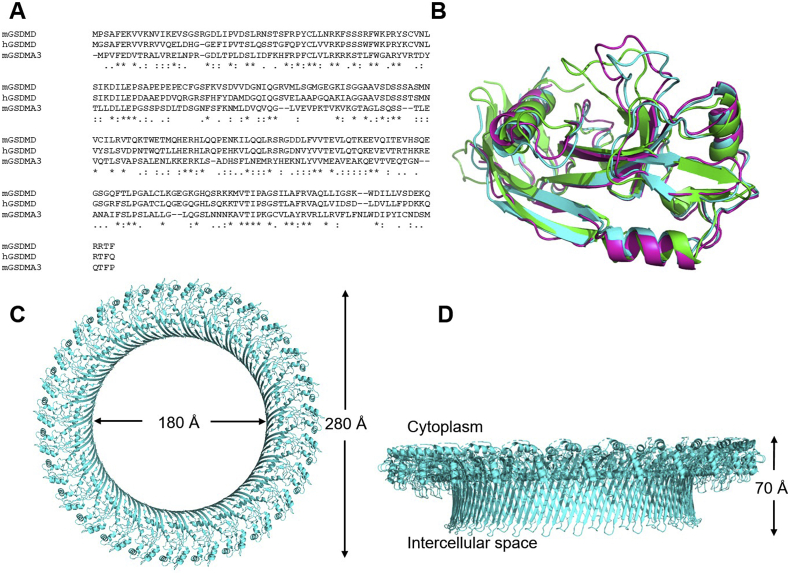
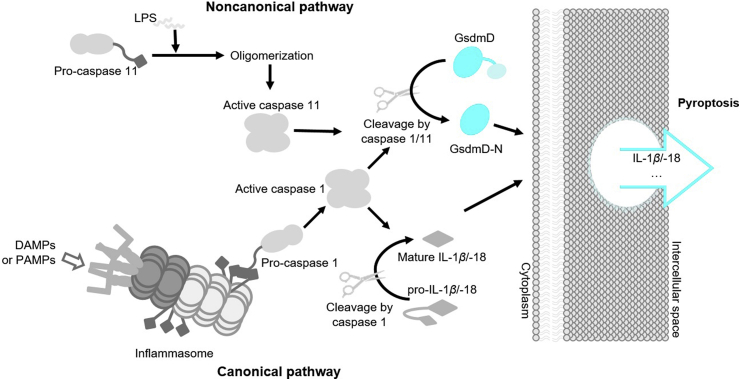
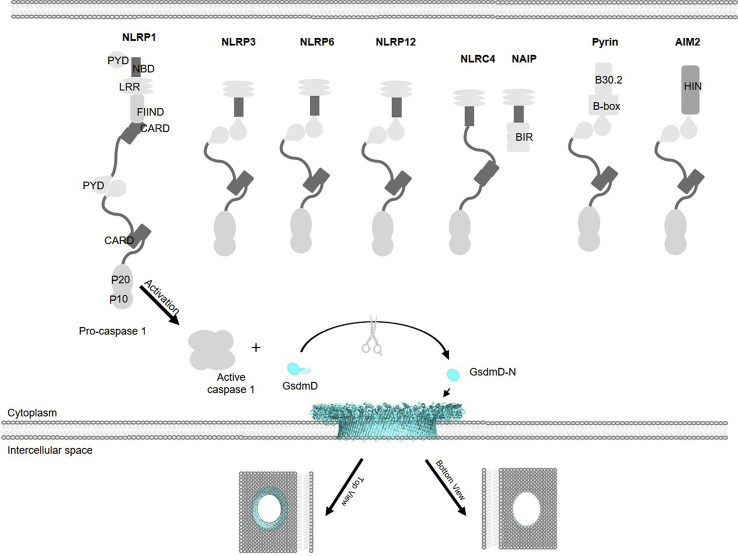
Pyroptosis is the process of inflammatory cell death. The primary function of pyroptosis is to induce strong inflammatory responses that defend the host against microbe infection. Excessive pyroptosis, however, leads to several inflammatory diseases, including sepsis and autoimmune disorders. Pyroptosis can be canonical or noncanonical. Upon microbe infection, the canonical pathway responds to pathogen-associated molecular patterns (PAMPs) and damage-associated molecular patterns (DAMPs), while the noncanonical pathway responds to intracellular lipopolysaccharides (LPS) of Gram-negative bacteria. The last step of pyroptosis requires the cleavage of gasdermin D (GsdmD) at D275 (numbering after human GSDMD) into N- and C-termini by caspase 1 in the canonical pathway and caspase 4/5/11 (caspase 4/5 in humans, caspase 11 in mice) in the noncanonical pathway. Upon cleavage, the N-terminus of GsdmD (GsdmD-N) forms a transmembrane pore that releases cytokines such as IL-1 and IL-18 and disturbs the regulation of ions and water, eventually resulting in strong inflammation and cell death. Since GsdmD is the effector of pyroptosis, promising inhibitors of GsdmD have been developed for inflammatory diseases. This review will focus on the roles of GsdmD during pyroptosis and in diseases.
细胞焦亡是炎性细胞死亡的过程。细胞焦亡的主要功能是引发强烈的炎症反应,以保护宿主抵御微生物感染。然而,过度的细胞焦亡会导致包括败血症和自身免疫性疾病在内的多种炎症性疾病。细胞焦亡可分为经典途径和非经典途径。在微生物感染时,经典途径对病原体相关分子模式(PAMPs)和损伤相关分子模式(DAMPs)作出反应,而非经典途径则对革兰氏阴性菌的细胞内脂多糖(LPS)作出反应。细胞焦亡的最后一步需要在经典途径中由半胱天冬酶1以及在非经典途径中由半胱天冬酶4/5/11(人类中的半胱天冬酶4/5,小鼠中的半胱天冬酶11)将gasdermin D(GsdmD)在D275(以人类GSDMD编号)处切割成N端和C端。切割后,GsdmD的N端(GsdmD-N)形成一个跨膜孔,释放诸如白细胞介素-1和白细胞介素-18等细胞因子,并扰乱离子和水的调节,最终导致强烈的炎症和细胞死亡。由于GsdmD是细胞焦亡的效应器,已开发出有前景的GsdmD抑制剂用于治疗炎症性疾病。本综述将聚焦于GsdmD在细胞焦亡过程中和疾病中的作用。