Baumann Oliver, McFadyen Jessica, Humphreys Michael S
School of Psychology & Interdisciplinary Centre for the Artificial Mind, Bond University, Gold Coast, QLD, Australia.
Queensland Brain Institute, The University of Queensland, Brisbane, QLD, Australia.
Front Psychol. 2020 Dec 7;11:591231. doi: 10.3389/fpsyg.2020.591231. eCollection 2020.
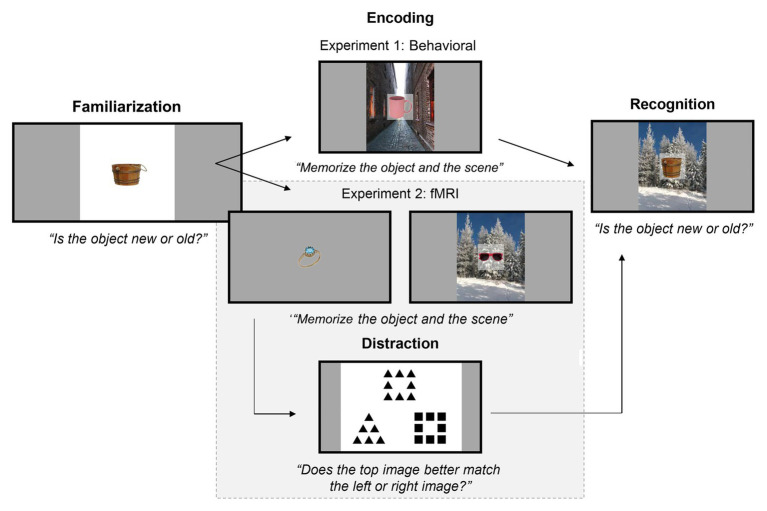
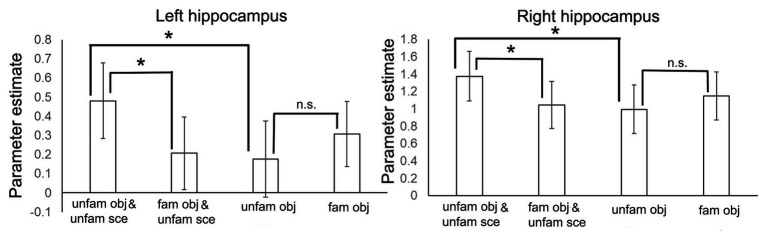
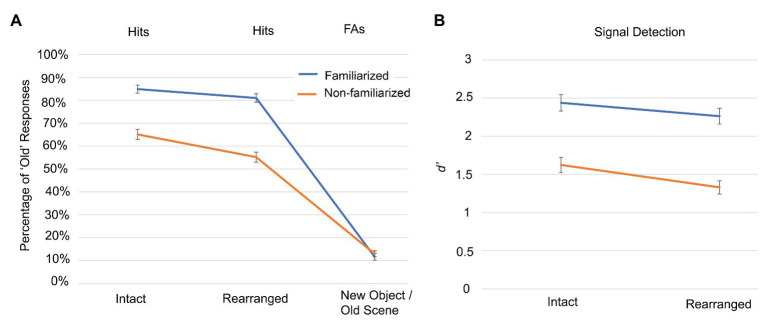
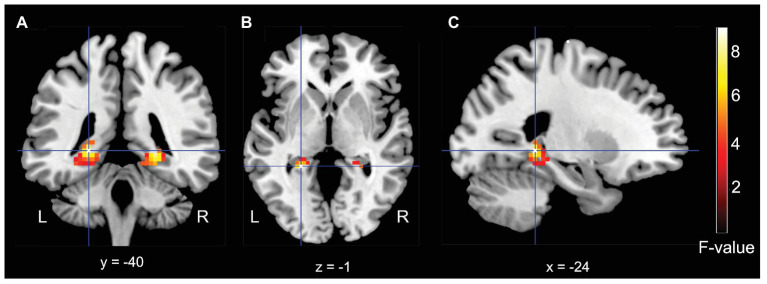
Associative memory is the ability to link together components of stimuli. Previous evidence suggests that prior familiarization with study items affects the nature of the association between stimuli. More specifically, novel stimuli are learned in a more context-dependent fashion than stimuli that have been encountered previously without the current context. In the current study, we first acquired behavioral data from 62 human participants to conceptually replicate this effect. Participants were instructed to memorize multiple object-scene pairs (study phase) and were then tested on their recognition memory for the objects (test phase). Importantly, 1 day prior, participants had been familiarized with half of the object stimuli. During the test phase, the objects were either matched to the same scene as during study (intact pair) or swapped with a different object's scene (rearranged pair). Our results conceptually replicated the context-dependency effect by showing that breaking up a studied object-context pairing is more detrimental to object recognition performance for non-familiarized objects than for familiarized objects. Second, we used functional magnetic resonance imaging (fMRI) to determine whether medial temporal lobe encoding-related activity patterns are reflective of this familiarity-related context effect. Data acquired from 25 human participants indicated a larger effect of familiarization on encoding-related hippocampal activity for objects presented within a scene context compared to objects presented alone. Our results showed that both retrieval-related accuracy patterns and hippocampal activation patterns were in line with a familiarization-mediated context-dependency effect.
联想记忆是将刺激的各个组成部分联系起来的能力。先前的证据表明,对学习项目的预先熟悉会影响刺激之间关联的性质。更具体地说,与之前在当前情境之外遇到的刺激相比,新的刺激是以一种更依赖情境的方式被学习的。在本研究中,我们首先从62名人类参与者那里获取行为数据,以从概念上复制这种效应。参与者被指示记忆多个物体-场景对(学习阶段),然后对他们对物体的识别记忆进行测试(测试阶段)。重要的是,在一天前,参与者已经熟悉了一半的物体刺激。在测试阶段,物体要么与学习期间的同一场景匹配(完整对),要么与不同物体的场景进行交换(重新排列对)。我们的结果从概念上复制了情境依赖效应,表明打破已学习的物体-情境配对对未熟悉物体的物体识别性能的损害比对熟悉物体的更大。其次,我们使用功能磁共振成像(fMRI)来确定内侧颞叶编码相关的活动模式是否反映了这种与熟悉度相关的情境效应。从25名人类参与者那里获取的数据表明,与单独呈现的物体相比,熟悉度对在场景情境中呈现的物体的编码相关海马体活动有更大的影响。我们的结果表明,与检索相关的准确性模式和海马体激活模式都与熟悉度介导的情境依赖效应一致。