Department of Radiology and Nuclear Medicine, Amsterdam Gastroenterology, Endocrinology and Metabolism, Amsterdam UMC, University of Amsterdam, Amsterdam, The Netherlands.
Department of Gastroenterology and Hepatology, Amsterdam Gastroenterology, Endocrinology and Metabolism, Amsterdam UMC, University of Amsterdam, Amsterdam, The Netherlands.
Neurogastroenterol Motil. 2021 Jun;33(6):e14062. doi: 10.1111/nmo.14062. Epub 2020 Dec 27.
Chronic intestinal pseudo-obstruction (CIPO) is a severe intestinal motility disorder of which the pathophysiology is largely unknown. This study aimed at gaining insight in fasted and fed small bowel motility in CIPO patients using cine-MRI with caloric stimulation.
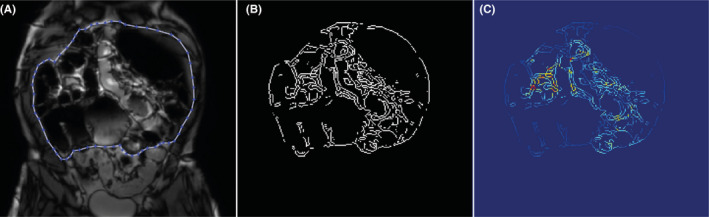
Eight adult patients with manometrically confirmed CIPO were prospectively included. Patients underwent a cine-MRI protocol after an overnight fast, comprising fasting-state scans and scans after ingestion of a meal (Nutridrink, 300 kcal). Small bowel motility was quantified resulting in a motility score in arbitrary units (AU) and visually assessed by three radiologists. Findings were compared with those in 16 healthy volunteers.
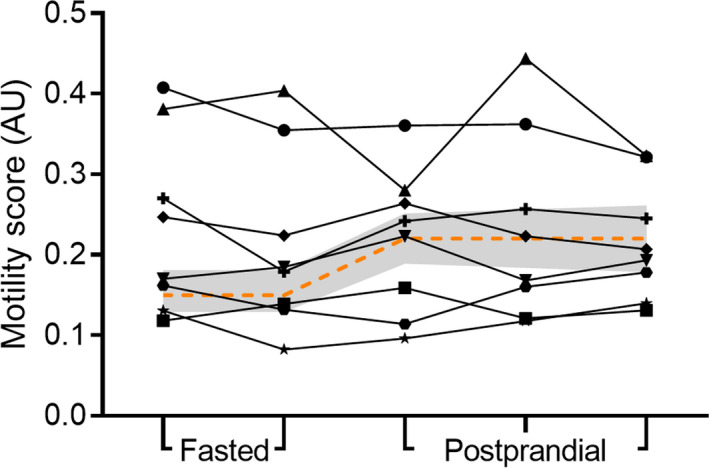
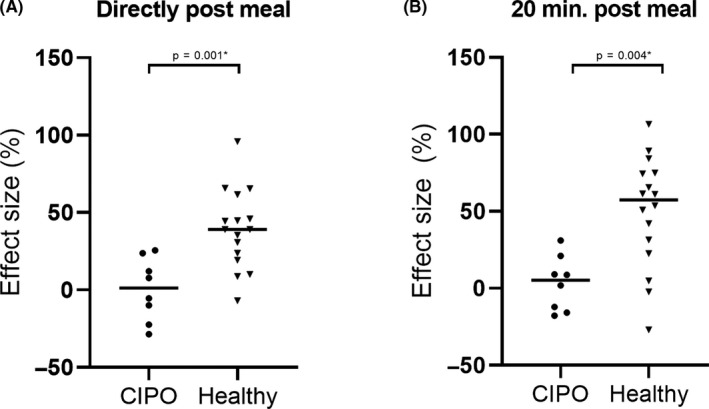
Motility scores (median, IQR) in CIPO patients were 0.21 (0.15-0.30) in the fasting state and 0.23 (0.15-0.27) directly postprandially. In healthy volunteers, corresponding motility scores were 0.15 (0.13-0.18) and 0.22 (0.19-0.25), respectively. The postprandial change in motility score was +1% (-19 to +21%) in CIPO and +39% (+23 to +50%) in healthy volunteers (p = 0.001*). Visual analysis revealed increased small bowel contractility in four, normal in two, and decreased in two CIPO patients.
CONCLUSIONS & INFERENCES: Surprisingly, we found hyperactive small bowel motility in half of the CIPO patients, suggestive of uncoordinated motility. A wide variation in motility patterns was observed, both higher, lower, and comparable contractility compared with healthy subjects. No clear postprandial activation was seen in patients. Cine-MRI helps to gain insight in this complex disease and can potentially impact treatment decisions in the future.
慢性肠道假性梗阻(CIPO)是一种严重的肠道运动障碍,其病理生理学在很大程度上尚不清楚。本研究旨在使用带热量刺激的电影-MRI 来观察禁食和进食状态下 CIPO 患者的小肠运动情况。
前瞻性纳入 8 名经测压证实的 CIPO 成年患者。患者在禁食过夜后接受电影-MRI 方案,包括禁食状态扫描和摄入餐后扫描(Nutridrink,300 千卡)。通过三位放射科医生对小肠运动进行定量评估,得到任意单位(AU)的运动评分,并进行视觉评估。将结果与 16 名健康志愿者进行比较。
CIPO 患者在禁食状态下的运动评分(中位数,IQR)为 0.21(0.15-0.30),直接餐后为 0.23(0.15-0.27)。健康志愿者相应的运动评分分别为 0.15(0.13-0.18)和 0.22(0.19-0.25)。CIPO 患者餐后运动评分变化为+1%(-19 至+21%),而健康志愿者为+39%(+23 至+50%)(p=0.001*)。视觉分析显示,4 名 CIPO 患者小肠收缩力增加,2 名正常,2 名减少。
令人惊讶的是,我们发现一半的 CIPO 患者小肠运动过度活跃,提示运动不协调。观察到运动模式的广泛变化,与健康受试者相比,收缩力较高、较低或相当。患者没有明显的餐后激活。电影-MRI 有助于深入了解这种复杂的疾病,并可能对未来的治疗决策产生影响。