Public Health Ontario, Toronto, Ontario, Canada.
Dalla Lana School of Public Health, University of Toronto, Toronto, Ontario, Canada.
PLoS One. 2020 Dec 28;15(12):e0244477. doi: 10.1371/journal.pone.0244477. eCollection 2020.
Protecting healthcare workers (HCWs) from Severe Acute Respiratory Syndrome Coronavirus-2 (SARS-CoV-2) is a priority to maintain a safe and functioning healthcare system. Our objective was to describe and compare the epidemiology, clinical characteristics, and lethality of SARS-CoV-2 infections among HCWs compared to non-HCWs.
Using reportable disease data at Public Health Ontario, we conducted a population-based cross-sectional study comparing demographic, exposure, and clinical variables between HCWs and non-HCWs with SARS-CoV-2 infections as of 30 September 2020. We calculated rates of infections over time and determined the frequency of within household transmissions using natural language processing based on residential address. We evaluated the risk of death using a multivariable logistic regression model adjusting for age, sex, comorbidities, symptoms, and long-term care home exposure.
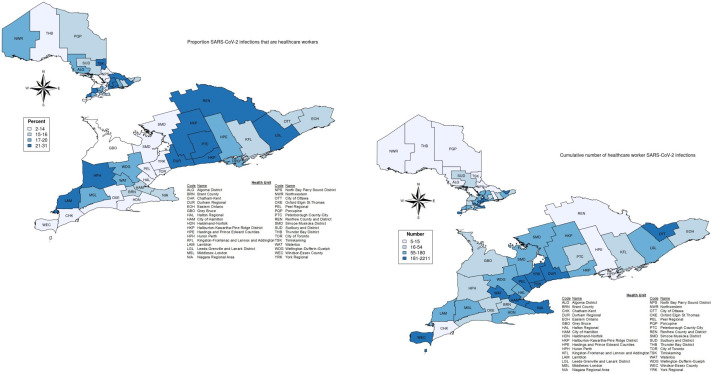
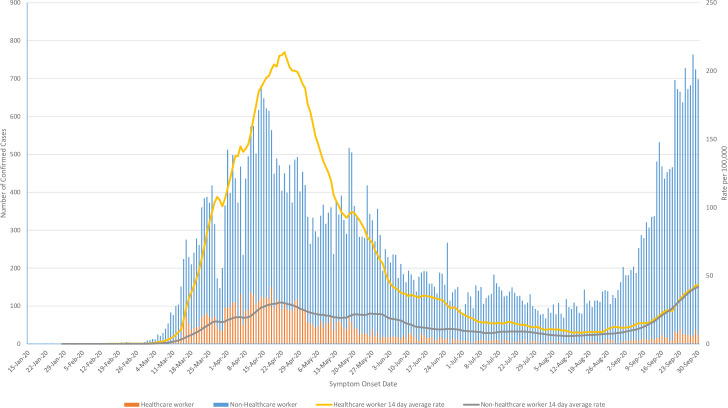
There were 7,050 (12.5%) HCW SARS-CoV-2 infections in Ontario, Canada, of whom 24.9% were nurses, 2.3% were physicians, and the remaining 72.8% other specialties, including personal support workers. Overall HCWs had an infection rate of 1,276 per 100,000 compared to non-HCWs of 346 per 100,000 (3.7 times higher). This difference decreased from a 7 times higher rate in April to no difference in September 2020. Twenty-six percent of HCWs had a household member with SARS-CoV-2 infection; 6.8% were probable acquisitions, 12.3% secondary transmissions, and 6.9% unknown direction of transmission. Death among HCWs was 0.2% compared to 6.1% of non-HCWs. The risk of death in HCWs remained significantly lower than non-HCWs after adjustment (adjusted odds ratio 0.09; 95%CI 0.05-0.17).
HCWs represent a disproportionate number of diagnosed SARS-CoV-2 infections in Ontario, however this discrepancy is at least partially explained by limitations in testing earlier in the pandemic for non-HCWs. We observed a low risk of death in HCWs which could not be completely explained by other factors.
保护医护人员(HCWs)免受严重急性呼吸系统综合症冠状病毒 2 型(SARS-CoV-2)的感染是维持安全和正常运作的医疗体系的首要任务。我们的目标是描述和比较 HCWs 与非 HCWs 之间 SARS-CoV-2 感染的流行病学、临床特征和死亡率。
我们利用安大略省公共卫生局的报告性疾病数据,开展了一项基于人群的横断面研究,比较了截至 2020 年 9 月 30 日患有 SARS-CoV-2 感染的 HCWs 和非 HCWs 的人口统计学、暴露和临床变量。我们计算了随时间变化的感染率,并使用基于居住地址的自然语言处理确定了家庭内传播的频率。我们使用多变量逻辑回归模型评估了死亡风险,该模型调整了年龄、性别、合并症、症状和长期护理院暴露等因素。
在加拿大安大略省,有 7050 名(12.5%)HCW 感染了 SARS-CoV-2,其中 24.9%是护士,2.3%是医生,其余 72.8%是其他专业人员,包括个人支持人员。总体而言,HCWs 的感染率为每 100000 人中有 1276 人,而非 HCWs 的感染率为每 100000 人中有 346 人(高 3.7 倍)。这一差异从 4 月份的 7 倍高降至 2020 年 9 月的无差异。26%的 HCWs 有家庭成员感染 SARS-CoV-2;其中 6.8%是可能的获得性感染,12.3%是继发性传播,6.9%是未知传播方向。HCWs 的死亡率为 0.2%,而非 HCWs 的死亡率为 6.1%。调整后,HCWs 的死亡风险仍然明显低于非 HCWs(调整后的优势比为 0.09;95%CI 0.05-0.17)。
在安大略省,HCWs 代表了大量确诊的 SARS-CoV-2 感染病例,但这一差异至少部分可以解释为在疫情早期对非 HCWs 的检测存在局限性。我们观察到 HCWs 的死亡风险较低,但这并不能完全用其他因素来解释。