Emerging Pathogen Institute, University of Florida, Gainesville, FL 32608, USA.
Department of Pathology, Immunology and Laboratory Medicine, University of Florida, Gainesville, FL 32610, USA.
Int J Mol Sci. 2020 Dec 23;22(1):80. doi: 10.3390/ijms22010080.
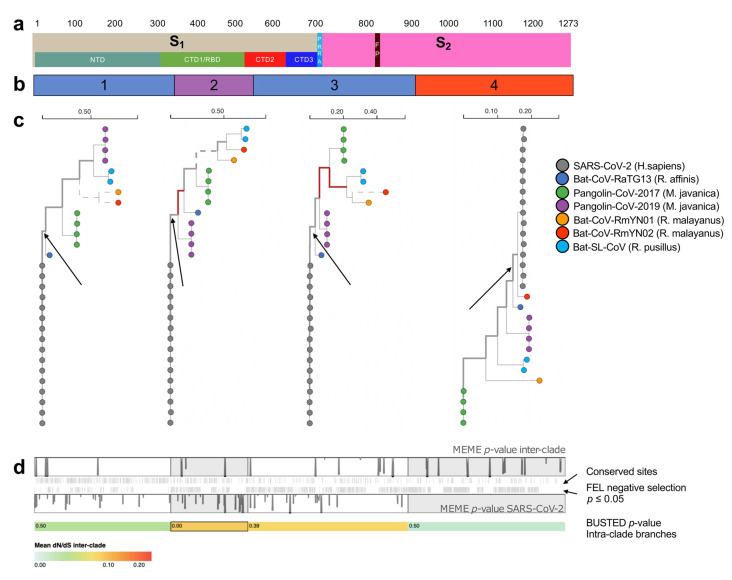
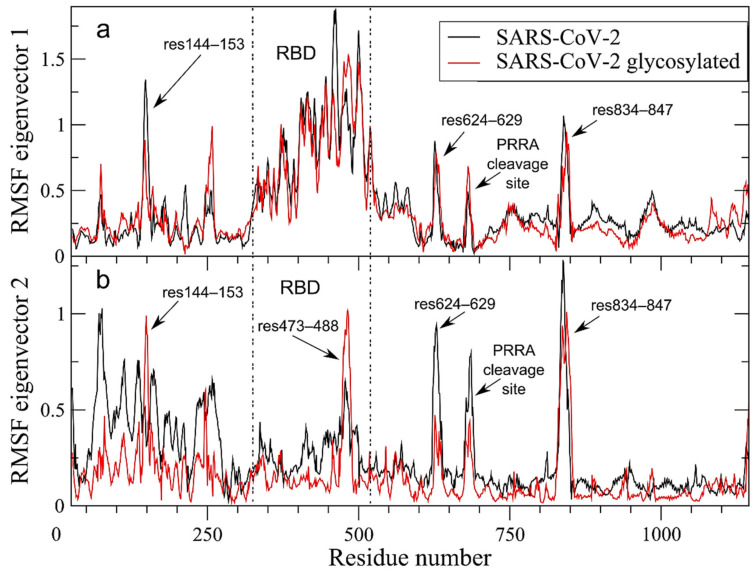
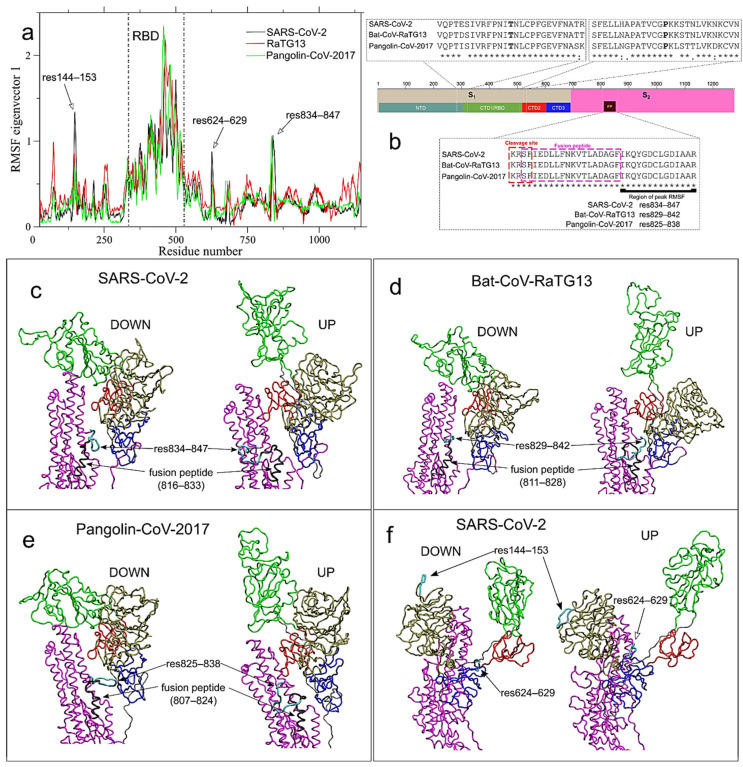
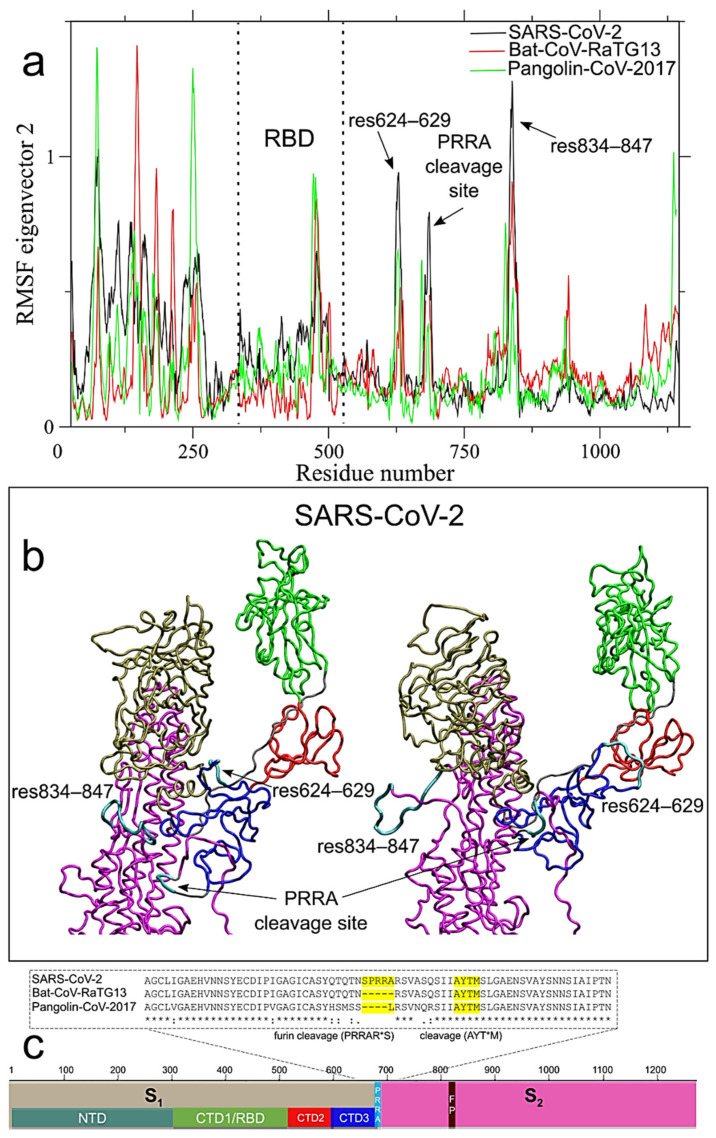
Our evolutionary and structural analyses revealed that the severe acute respiratory syndrome (SARS) coronavirus 2 (SARS-CoV-2) spike gene is a complex mosaic resulting from several recombination events. Additionally, the fixation of variants has mainly been driven by purifying selection, suggesting the presence of conserved structural features. Our dynamic simulations identified two main long-range covariant dynamic movements of the novel glycoprotein, and showed that, as a result of the evolutionary duality, they are preserved. The first movement involves the receptor binding domain with the -terminal domain and the -terminal domain 2 and is maintained across human, bat and pangolin coronaviruses. The second is a complex network of long-range dynamics specific to SARS-CoV-2 involving the novel PRRA and the conserved KR*SF cleavage sites, as well as conserved segments in -terminal domain 3. These movements, essential for host cell binding, are maintained by hinges conserved across human, bat, and pangolin coronaviruses glycoproteins. The hinges, located around Threonine 333 and Proline 527 within the -terminal domain and -terminal domain 2, represent candidate targets for the future development of novel pan-coronavirus inhibitors. In summary, we show that while recombination created a new configuration that increased the covariant dynamic movements of the SARS-CoV-2 glycoprotein, negative selection preserved its inter-domain structure throughout evolution in different hosts and inter-species transmissions.
我们的进化和结构分析表明,严重急性呼吸综合征(SARS)冠状病毒 2(SARS-CoV-2)的刺突基因是由多个重组事件产生的复杂嵌合体。此外,变异的固定主要是由纯化选择驱动的,这表明存在保守的结构特征。我们的动态模拟确定了新型糖蛋白的两个主要长程协变动态运动,并表明由于进化的双重性,它们得以保留。第一个运动涉及受体结合域与 N 端结构域和 N 端结构域 2,并在人类、蝙蝠和穿山甲冠状病毒中得到保持。第二个是 SARS-CoV-2 特有的复杂长程动态网络,涉及新型 PRRA 和保守的 KR*SF 切割位点,以及 N 端结构域 3 中的保守片段。这些对于宿主细胞结合至关重要的运动,由在人类、蝙蝠和穿山甲冠状病毒糖蛋白中保守的铰链来维持。铰链位于 N 端结构域和 N 端结构域 2 内的苏氨酸 333 和脯氨酸 527 周围,代表未来开发新型泛冠状病毒抑制剂的候选靶点。总之,我们表明,虽然重组产生了一种新的构型,增加了 SARS-CoV-2 糖蛋白的协变动态运动,但负选择在不同宿主和种间传播的整个进化过程中保持了其结构域间结构。