Fyfe Caroline, Telfar Lucy, Howden-Chapman Philippa, Douwes Jeroen
He Kianga Oranga, Department of Public Health, University of Otago Wellington, PO Box 7343, Wellington South 6242, New Zealand
He Kianga Oranga, Department of Public Health, University of Otago Wellington, PO Box 7343, Wellington South 6242, New Zealand.
BMJ. 2020 Dec 29;371:m4571. doi: 10.1136/bmj.m4571.
To investigate whether retrofitting insulation into homes can reduce cold associated hospital admission rates among residents and to identify whether the effect varies between different groups within the population and by type of insulation.
A quasi-experimental retrospective cohort study using linked datasets to evaluate a national intervention programme.
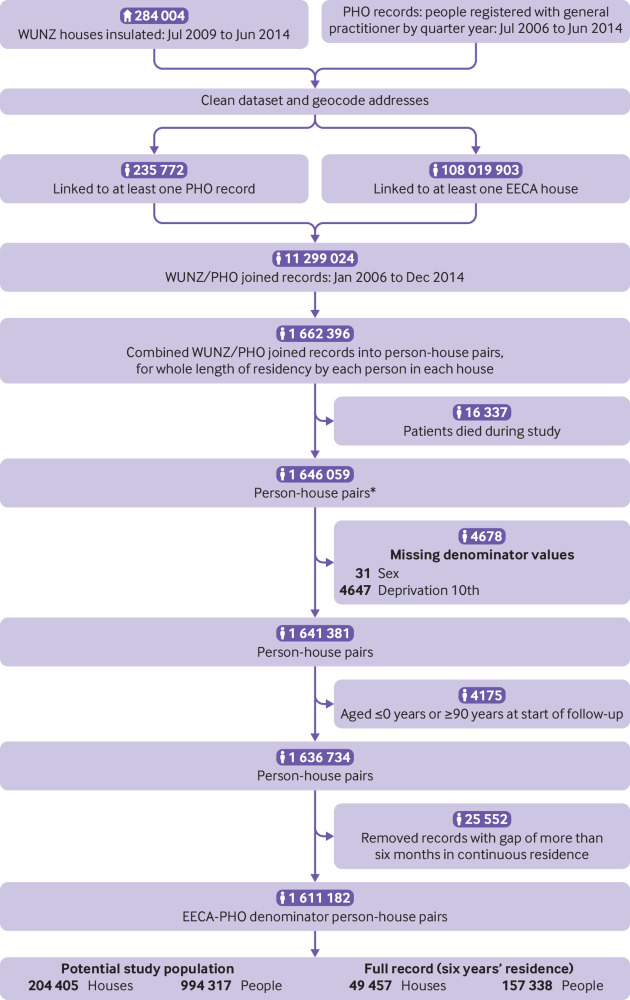
994 317 residents of 204 405 houses who received an insulation subsidy through the Energy Efficiency and Conservation Authority Warm-up New Zealand: Heat Smart retrofit programme between July 2009 and June 2014.
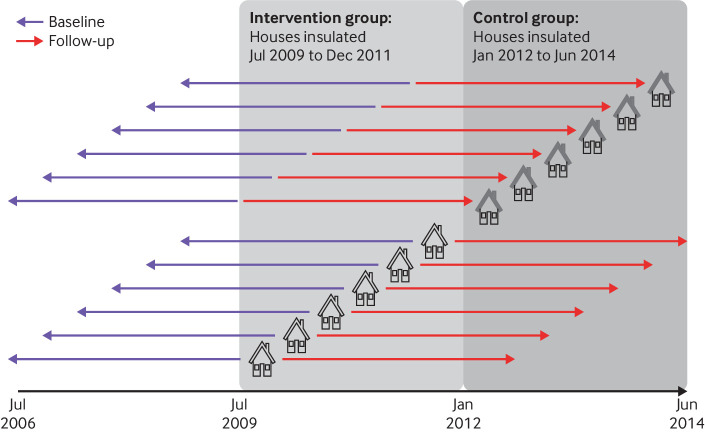
A difference-in-difference approach was used to compare the change in hospital admissions of the study population post-insulation with the change in hospital admissions of the control population that did not receive the intervention over the same two timeframes. Relative rate ratios were used to compare the two groups.
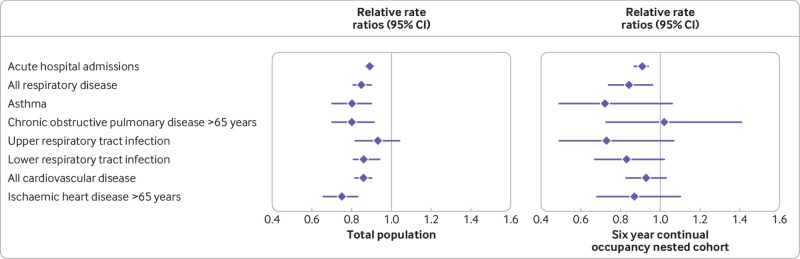
234 873 hospital admissions occurred during the study period. Hospital admission rates after the intervention increased in the intervention and control groups for all population categories and conditions with the exception of acute hospital admissions among Pacific Peoples (rate ratio 0.94, 95% confidence interval 0.90 to 0.98), asthma (0.92, 0.86 to 0.99), cardiovascular disease (0.90, 0.88 to 0.93), and ischaemic heart disease for adults older than 65 years (0.79, 0.74 to 0.84). Post-intervention increases were, however, significantly lower (11%) in the intervention group compared with the control group (relative rate ratio 0.89, 95% confidence interval 0.88 to 0.90), representing 9.26 (95% confidence interval 9.05 to 9.47) fewer hospital admissions per 1000 in the intervention population. Effects were more pronounced for respiratory disease (0.85, 0.81 to 0.90), asthma in all age groups (0.80, 0.70 to 0.90), and ischaemic heart disease in those older than 65 years (0.75, 0.66 to 0.83).
This study showed that a national home insulation intervention was associated with reduced hospital admissions, supporting previous research, which found an improvement in self-reported health.
调查对房屋进行隔热改造是否能降低居民中与寒冷相关的住院率,并确定该效果在人群中的不同群体以及不同类型的隔热措施之间是否存在差异。
一项准实验性回顾性队列研究,使用关联数据集来评估一项全国性干预计划。
204405所房屋中的994317名居民,他们在2009年7月至2014年6月期间通过能源效率与保护局的“新西兰暖身:明智供热”改造计划获得了隔热补贴。
采用差异-in-差异方法,比较隔热后研究人群的住院率变化与同期未接受干预的对照人群的住院率变化。使用相对率比来比较两组。
研究期间共发生234873次住院。除太平洋岛民的急性住院(率比0.94,95%置信区间0.90至0.98)、哮喘(0.92,0.86至0.99)、心血管疾病(0.90,0.88至0.93)以及65岁以上成年人的缺血性心脏病(0.79,0.74至0.84)外,干预组和对照组中所有人群类别和疾病的干预后住院率均有所上升。然而,干预组的干预后上升幅度(11%)显著低于对照组(相对率比0.89,95%置信区间0.88至0.90),这意味着干预人群中每1000人住院次数减少9.26次(95%置信区间9.05至9.47)。对呼吸系统疾病(0.85,0.81至0.90)、各年龄组的哮喘(0.80,0.70至0.90)以及65岁以上人群的缺血性心脏病(0.75,0.66至0.83)的影响更为明显。
本研究表明,一项全国性的家庭隔热干预与住院率降低相关,支持了先前发现自我报告健康状况有所改善的研究。