
轴突形态受局部环境的调节,并影响其结构-功能关系的非侵入性研究。
Axon morphology is modulated by the local environment and impacts the noninvasive investigation of its structure-function relationship.
机构信息
Danish Research Centre for Magnetic Resonance, Centre for Functional and Diagnostic Imaging and Research, Copenhagen University Hospital Hvidovre, 2650 Hvidovre, Denmark;
Department of Applied Mathematics and Computer Science, Technical University of Denmark, 2800 Kongens Lyngby, Denmark.
出版信息
Proc Natl Acad Sci U S A. 2020 Dec 29;117(52):33649-33659. doi: 10.1073/pnas.2012533117. Epub 2020 Dec 21.
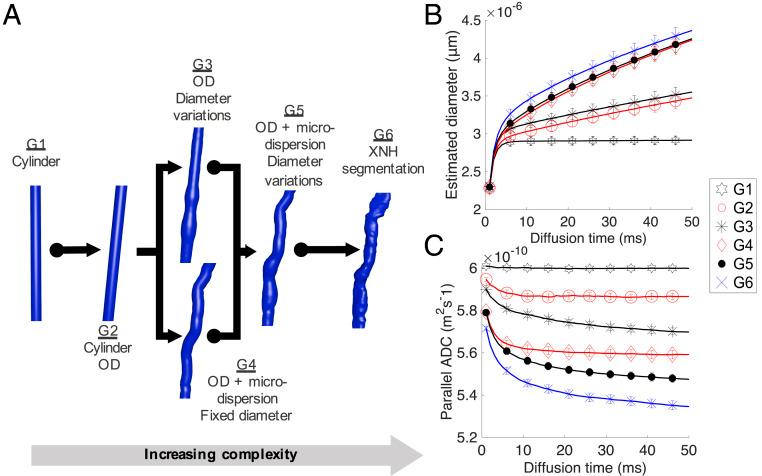
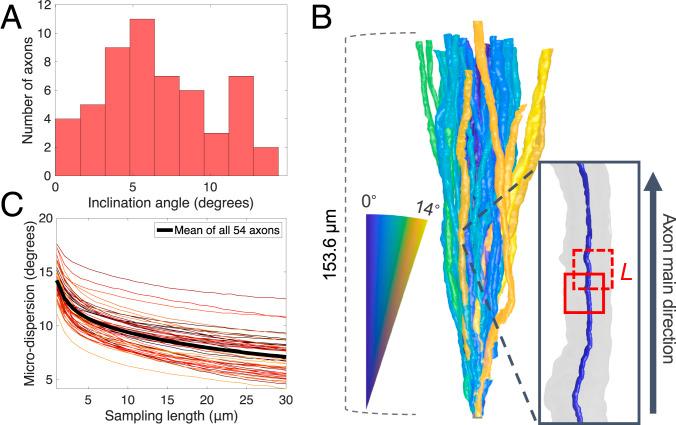
Axonal conduction velocity, which ensures efficient function of the brain network, is related to axon diameter. Noninvasive, in vivo axon diameter estimates can be made with diffusion magnetic resonance imaging, but the technique requires three-dimensional (3D) validation. Here, high-resolution, 3D synchrotron X-ray nano-holotomography images of white matter samples from the corpus callosum of a monkey brain reveal that blood vessels, cells, and vacuoles affect axonal diameter and trajectory. Within single axons, we find that the variation in diameter and conduction velocity correlates with the mean diameter, contesting the value of precise diameter determination in larger axons. These complex 3D axon morphologies drive previously reported 2D trends in axon diameter and -ratio. Furthermore, we find that these morphologies bias the estimates of axon diameter with diffusion magnetic resonance imaging and, ultimately, impact the investigation and formulation of the axon structure-function relationship.
轴突传导速度是大脑网络有效运作的保证,与轴突直径有关。利用扩散磁共振成像可以无创、在体估计轴突直径,但该技术需要三维(3D)验证。在这里,来自猴脑胼胝体白质样本的高分辨率、3D 同步加速器 X 射线纳米断层扫描图像显示,血管、细胞和空泡会影响轴突直径和轨迹。在单个轴突内,我们发现直径和传导速度的变化与平均直径相关,这对在较大轴突中进行精确直径测定的价值提出了质疑。这些复杂的 3D 轴突形态推动了先前报道的 2D 轴突直径和比率趋势。此外,我们发现这些形态会影响扩散磁共振成像对轴突直径的估计,并最终影响对轴突结构-功能关系的研究和构建。




 Zotero 插件