• 文献检索
  • 文档翻译
  • 深度研究
  • 学术资讯
  • Suppr Zotero 插件Zotero 插件
  • 邀请有礼
  • 套餐&价格
  • 历史记录
应用&插件
Suppr Zotero 插件Zotero 插件浏览器插件Mac 客户端Windows 客户端微信小程序
定价
高级版会员购买积分包购买API积分包
服务
文献检索文档翻译深度研究API 文档MCP 服务
关于我们
关于 Suppr公司介绍联系我们用户协议隐私条款
关注我们

Suppr 超能文献

核心技术专利:CN118964589B侵权必究
粤ICP备2023148730 号-1Suppr @ 2026

文献检索

告别复杂PubMed语法,用中文像聊天一样搜索,搜遍4000万医学文献。AI智能推荐,让科研检索更轻松。

立即免费搜索

文件翻译

保留排版,准确专业,支持PDF/Word/PPT等文件格式,支持 12+语言互译。

免费翻译文档

深度研究

AI帮你快速写综述,25分钟生成高质量综述,智能提取关键信息,辅助科研写作。

立即免费体验

埃塞俄比亚西南部吉马地区常用药用植物的民族植物学评估及理化性质:基于传统治疗师的横断面研究

Ethnobotanical Assessment and Physicochemical Properties of Commonly Used Medicinal Plants in Jimma Zone, Southwest Ethiopia: Traditional Healers Based Cross-Sectional Study.

作者信息

Siraj Jafer, Belew Sileshi, Suleman Sultan

机构信息

School of Pharmacy, College of Medicine and Health Sciences, Mizan-Tepi University, Mizan-Aman, Ethiopia.

Jimma University Laboratory of Drug Quality (JuLaDQ), Jimma University, Jimma, Ethiopia.

出版信息

J Exp Pharmacol. 2020 Dec 21;12:665-681. doi: 10.2147/JEP.S267903. eCollection 2020.

DOI:10.2147/JEP.S267903
PMID:33376416
原文链接:https://pmc.ncbi.nlm.nih.gov/articles/PMC7762448/
Abstract

BACKGROUND

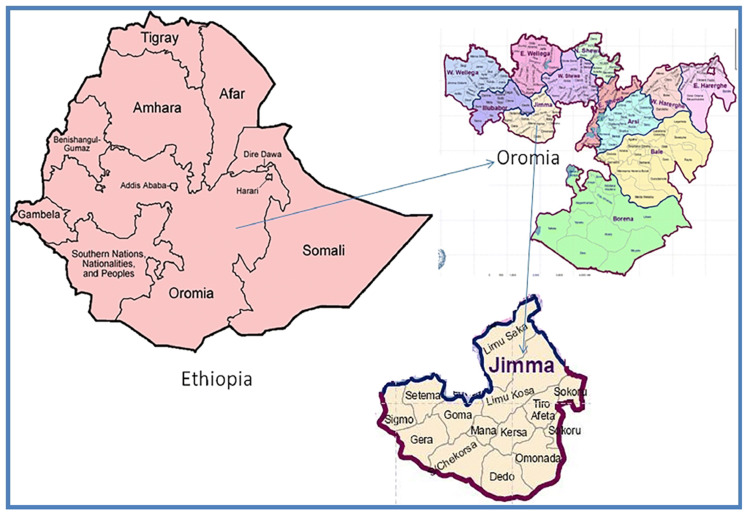
The demand for traditional herbal medicine is increasing and about 85% of the world population use herbal medicines for the prevention and treatment of diseases. More than 62.5% of the forest areas in Ethiopia are found in the southwest region, which have been used as a source of traditional medicine to treat different human and livestock ailments. The aim of this study was the investigation of the ethnobotanical and physicochemical properties of commonly used medicinal plants in Jimma zone, southwest Ethiopia.

MATERIALS AND METHODS

A cross-sectional study was conducted in the district of Jimma zone from June 1 to 30, 2017. The ethnobotanical data were collected from traditional healers through semi-structured questionnaires. Specimens collected from various habitats were taken into Jimma University, Herbarium laboratory, dried, and prepared using standard herbarium specimen techniques for identification. Physicochemical analysis was done for selected medicinal plants.

RESULTS

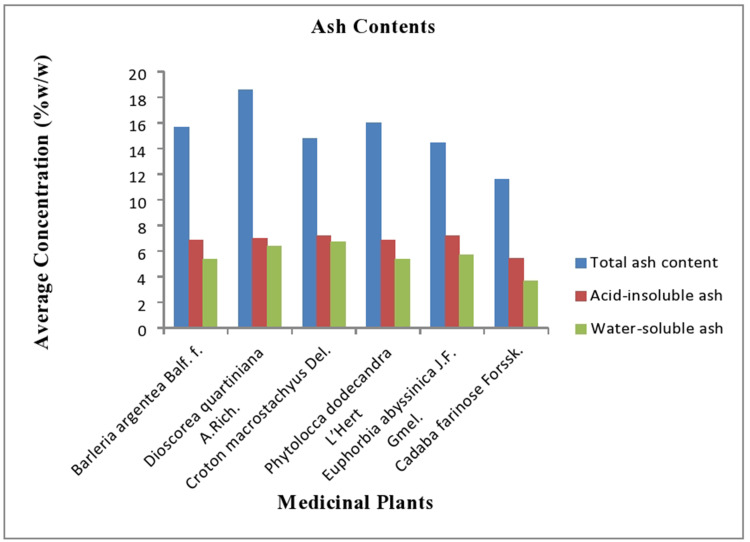
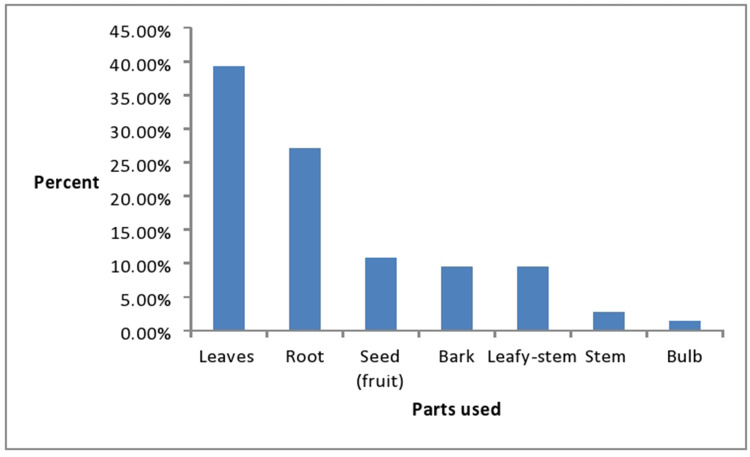
A total of 72 medicinal plants categorized under 61 genera and 39 families were stated by the respondents for the treatment of different human and livestock ailments. Herbs constitute the largest category (28 species, 38.89%) followed by shrubs (21 species, 29.17%), trees (20 species, 27.78%) and climbers (3 species, 4.17%). Leaves (39.19%) were the most commonly used plant parts followed by roots (27%) and seeds (10.81%). Traditional healers reported processing remedies mainly through crushing (46.91%), powdering (18.52%), pounding (11.11%), and pressing (9.88%). The water-soluble extractive value of the selected medicinal plants were between 1.825 to 18.507%w/w and the alcohol-soluble extractive value were between 0.143 to 1.107%w/w. The moisture content (%LOD) of Balf. f. was higher than the recommended standard which consisted of 21.063%w/w and followed by high %LOD of D.C. Prodr (8.143%w/w) and J.F. Gmel. (16.347%w/w). The highest total ash value was registered in A.Rich. species which consisted of 18.563%w/w and followed by D.C. Prodr (16.033%w/w) and Balf. f. (15.648%w/w). High acid-insoluble ash value (7.227%w/w) and water-soluble ash (6.731%w/w) was recorded in J.F. Gmel.

CONCLUSION

The study revealed that the water-soluble extractive value of the selected medicinal plants indicates the presence of water-soluble components such as sugar, acids, and inorganic compounds. In the future, these characters can be used to check the genuine nature of the crude drug; thus, it plays an important role in preventing the possible steps of adulteration.

摘要

背景

对传统草药的需求日益增加,全球约85%的人口使用草药预防和治疗疾病。埃塞俄比亚超过62.5%的森林位于西南部地区,该地区一直被用作治疗人类和牲畜各种疾病的传统药物来源。本研究的目的是调查埃塞俄比亚西南部吉马地区常用药用植物的民族植物学和理化性质。

材料与方法

2017年6月1日至30日在吉马地区进行了一项横断面研究。通过半结构化问卷从传统治疗师那里收集民族植物学数据。从不同栖息地采集的标本被带到吉马大学植物标本室实验室,干燥后按照标准植物标本技术进行制备以进行鉴定。对选定的药用植物进行了理化分析。

结果

受访者列出了总共72种药用植物,分属61属39科,用于治疗人类和牲畜的各种疾病。草本植物占最大类别(共28种,占38.89%),其次是灌木(21种,占29.17%)、乔木(20种,占27.78%)和攀缘植物(3种,占4.17%)。叶子(占39.19%)是最常用的植物部位,其次是根(占27%)和种子(占10.81%)。传统治疗师报告的加工药物的方法主要有捣碎(占46.91%)、磨粉(占18.52%)、舂捣(占11.11%)和压榨(占9.88%)。选定药用植物的水溶性浸出物值在1.825%至18.507%(w/w)之间,醇溶性浸出物值在0.143%至1.107%(w/w)之间。Balf. f.的水分含量(%LOD)高于推荐标准,为21.063%(w/w),其次是D.C. Prodr的高%LOD(8.143%(w/w))和J.F. Gmel.的(16.347%(w/w))。A.Rich.物种的总灰分最高,为18.563%(w/w),其次是D.C. Prodr(16.033%(w/w))和Balf. f.(15.648%(w/w))。J.F. Gmel.的酸不溶性灰分值高(7.227%(w/w)),水溶性灰分高(6.731%(w/w))。

结论

该研究表明,选定药用植物的水溶性浸出物值表明存在糖、酸和无机化合物等水溶性成分。未来,这些特性可用于检验生药的真伪;因此,它在防止可能的掺假步骤中起着重要作用。
https://cdn.ncbi.nlm.nih.gov/pmc/blobs/6b59/7762448/cf4332690cae/JEP-12-665-g0003.jpg
https://cdn.ncbi.nlm.nih.gov/pmc/blobs/6b59/7762448/46c9365b78d0/JEP-12-665-g0001.jpg
https://cdn.ncbi.nlm.nih.gov/pmc/blobs/6b59/7762448/4233404a5ee9/JEP-12-665-g0002.jpg
https://cdn.ncbi.nlm.nih.gov/pmc/blobs/6b59/7762448/cf4332690cae/JEP-12-665-g0003.jpg
https://cdn.ncbi.nlm.nih.gov/pmc/blobs/6b59/7762448/46c9365b78d0/JEP-12-665-g0001.jpg
https://cdn.ncbi.nlm.nih.gov/pmc/blobs/6b59/7762448/4233404a5ee9/JEP-12-665-g0002.jpg
https://cdn.ncbi.nlm.nih.gov/pmc/blobs/6b59/7762448/cf4332690cae/JEP-12-665-g0003.jpg

相似文献

1
Ethnobotanical Assessment and Physicochemical Properties of Commonly Used Medicinal Plants in Jimma Zone, Southwest Ethiopia: Traditional Healers Based Cross-Sectional Study.埃塞俄比亚西南部吉马地区常用药用植物的民族植物学评估及理化性质:基于传统治疗师的横断面研究
J Exp Pharmacol. 2020 Dec 21;12:665-681. doi: 10.2147/JEP.S267903. eCollection 2020.
2
An ethnobotanical study of medicinal plants in Wayu Tuka District, East Welega Zone of Oromia Regional State, West Ethiopia.埃塞俄比亚西部奥罗米亚州东韦莱格地区瓦尤图卡区药用植物的民族植物学研究。
J Ethnobiol Ethnomed. 2013 Sep 25;9(1):68. doi: 10.1186/1746-4269-9-68.
3
Ethnobotanical study of medicinal plants in Adwa District, Central Zone of Tigray Regional State, Northern Ethiopia.埃塞俄比亚提格雷地区阿达瓦地区药用植物民族植物学研究。
J Ethnobiol Ethnomed. 2021 Dec 24;17(1):71. doi: 10.1186/s13002-021-00498-1.
4
Ethnobotanical study of medicinal plants in Ganta Afeshum District, Eastern Zone of Tigray, Northern Ethiopia.埃塞俄比亚提格雷州东地区甘塔阿费舒姆区药用植物民族植物学研究。
J Ethnobiol Ethnomed. 2018 Nov 3;14(1):64. doi: 10.1186/s13002-018-0266-z.
5
Ethno-medicinal study of plants used for treatment of human and livestock ailments by traditional healers in South Omo, Southern Ethiopia.埃塞俄比亚南部南奥莫地区传统医者用于治疗人类和牲畜疾病的植物的民族医学研究。
J Ethnobiol Ethnomed. 2013 May 16;9:32. doi: 10.1186/1746-4269-9-32.
6
Ethnobotanical study of endemic and non-endemic medicinal plants used by indigenous people in environs of Gullele botanical garden Addis Ababa, central Ethiopia: A major focus on Asteraceae family.埃塞俄比亚中部亚的斯亚贝巴古莱勒植物园周边地区原住民使用的本地和非本地药用植物的民族植物学研究:主要聚焦于菊科植物。
Front Pharmacol. 2022 Nov 23;13:1020097. doi: 10.3389/fphar.2022.1020097. eCollection 2022.
7
Medicinal Plants Used to Treat Human and Livestock Ailments in Basona Werana District, North Shewa Zone, Amhara Region, Ethiopia.埃塞俄比亚阿姆哈拉州北谢瓦区巴萨诺韦拉纳地区用于治疗人类和牲畜疾病的药用植物
Evid Based Complement Alternat Med. 2022 Apr 14;2022:5242033. doi: 10.1155/2022/5242033. eCollection 2022.
8
Ethnobotanical study of medicinal plants in the Hawassa Zuria District, Sidama zone, Southern Ethiopia.埃塞俄比亚南部锡达马地区 Hawassa Zuria 区药用植物的民族植物学研究。
J Ethnobiol Ethnomed. 2019 May 24;15(1):25. doi: 10.1186/s13002-019-0302-7.
9
Ethnoveterinary medicines in four districts of Jimma zone, Ethiopia: cross sectional survey for plant species and mode of use.埃塞俄比亚吉马地区四个区的民族兽医药物:植物物种和使用方式的横断面调查。
BMC Vet Res. 2014 Mar 28;10:76. doi: 10.1186/1746-6148-10-76.
10
Medicinal plants potential and use by pastoral and agro-pastoral communities in Erer Valley of Babile Wereda, Eastern Ethiopia.埃塞俄比亚东部巴巴利县埃雷雷谷的牧民和农牧民社区利用药用植物的潜力
J Ethnobiol Ethnomed. 2012 Oct 22;8:42. doi: 10.1186/1746-4269-8-42.

引用本文的文献

1
Ethnobotanical Study of Medicinal Plants in Tehuledere District, Northwest Ethiopia.埃塞俄比亚西北部特胡莱德地区药用植物的民族植物学研究。
ScientificWorldJournal. 2024 Sep 26;2024:3420352. doi: 10.1155/2024/3420352. eCollection 2024.
2
Ethnobotanical study of medicinal plants in Dibatie district, Metekel zone, Benishangul Gumuz Regional State, western Ethiopia.埃塞俄比亚西部本尚古勒-古马兹州梅特克尔地区 Dibatie 区药用植物民族植物学研究。
J Ethnobiol Ethnomed. 2024 Sep 15;20(1):85. doi: 10.1186/s13002-024-00723-7.
3
The ethnomedicine, phytochemistry, and pharmacological properties of the genus Bersama: current review and future perspectives.

本文引用的文献

1
Quality of fixed dose artemether/lumefantrine products in Jimma Zone, Ethiopia.埃塞俄比亚吉马地区固定剂量青蒿琥酯/苯芴醇产品质量。
Malar J. 2019 Jul 15;18(1):236. doi: 10.1186/s12936-019-2872-1.
2
Medicinal plants used in traditional medicine by Oromo people, Ghimbi District, Southwest Ethiopia.埃塞俄比亚西南部吉门地区奥罗莫人在传统医学中使用的药用植物。
J Ethnobiol Ethnomed. 2014 May 8;10:40. doi: 10.1186/1746-4269-10-40.
3
Current concepts and prospects of herbal nutraceutical: A review.草药营养保健品的当前概念与前景:综述
贝斯玛属植物的民族医学、植物化学及药理特性:当前综述与未来展望
Front Pharmacol. 2024 Mar 21;15:1366427. doi: 10.3389/fphar.2024.1366427. eCollection 2024.
4
Medicinal plants utilized in the management of epilepsy in Ethiopia: ethnobotany, pharmacology and phytochemistry.埃塞俄比亚用于癫痫治疗的药用植物:民族植物学、药理学与植物化学
Chin Med. 2022 Nov 19;17(1):129. doi: 10.1186/s13020-022-00686-5.
5
Medicinal plants used for management of hemorrhoids in Ethiopia: A systematic review.埃塞俄比亚用于治疗痔疮的药用植物:一项系统综述。
Heliyon. 2022 Aug 13;8(8):e10211. doi: 10.1016/j.heliyon.2022.e10211. eCollection 2022 Aug.
J Adv Pharm Technol Res. 2013 Jan;4(1):4-8. doi: 10.4103/2231-4040.107494.
4
An ethnobotanical study of medicinal plants in Mana Angetu district, southeastern Ethiopia.埃塞俄比亚东南部马纳安格图地区药用植物的民族植物学研究。
J Ethnobiol Ethnomed. 2008 Apr 28;4:10. doi: 10.1186/1746-4269-4-10.
5
Medicinal plants of the Shinasha, Agew-awi and Amhara peoples in northwest Ethiopia.埃塞俄比亚西北部Shinasha、Agew-awi和阿姆哈拉族的药用植物。
J Ethnopharmacol. 2007 Apr 4;110(3):516-25. doi: 10.1016/j.jep.2006.10.011. Epub 2006 Oct 20.
6
Ethnomedicinal plants used by the people of Manang district, central Nepal.尼泊尔中部马囊地区人们使用的民族药用植物。
J Ethnobiol Ethnomed. 2006 Oct 4;2:41. doi: 10.1186/1746-4269-2-41.
7
Knowledge and use of medicinal plants by local specialists in an region of Atlantic Forest in the state of Pernambuco (Northeastern Brazil).巴西东北部伯南布哥州大西洋森林地区当地专家对药用植物的了解与应用。
J Ethnobiol Ethnomed. 2005 Nov 1;1:9. doi: 10.1186/1746-4269-1-9.
8
Adverse reaction to an adrenergic herbal extract (Citrus aurantium).对一种肾上腺素能草药提取物(枳实)的不良反应。
Phytomedicine. 2005 Mar;12(3):247-8. doi: 10.1016/j.phymed.2004.02.005.
9
Herbal medication: potential for adverse interactions with analgesic drugs.草药疗法:与镇痛药发生不良相互作用的可能性。
J Clin Pharm Ther. 2002 Dec;27(6):391-401. doi: 10.1046/j.1365-2710.2002.00444.x.