Lang David, Haslinger Wolfgang, Akbari Kaveh, Scala Mario, Hergan Benedikt, Asel Christian, Horner Andreas, Wass Romana, Brehm Elmar, Kaiser Bernhard, Lamprecht Bernd
Johannes Kepler University Hospital, Department of Pulmonology, Linz, Austria.
Johannes Kepler University, Medical Faculty, Linz, Austria.
Lung Cancer (Auckl). 2020 Dec 18;11:113-121. doi: 10.2147/LCTT.S286228. eCollection 2020.
To evaluate serum tumor markers (STM) as predictive biomarkers in advanced non-small cell lung cancer (NSCLC) treated with chemo-immunotherapy.
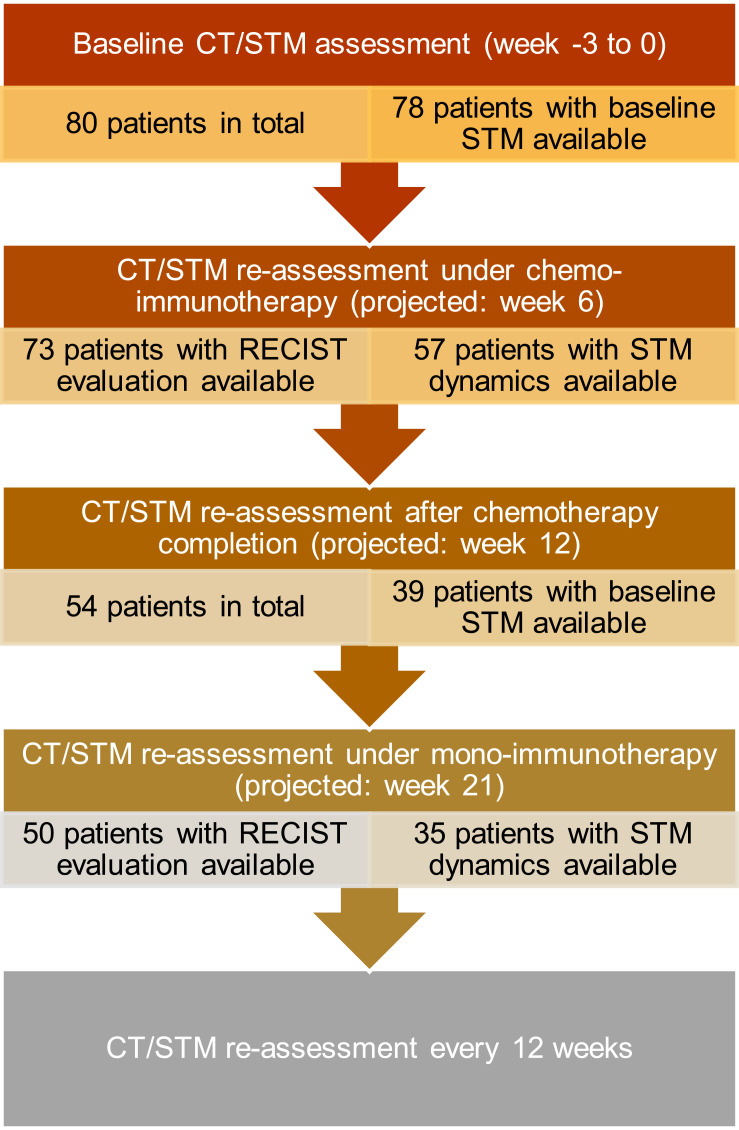
Patients having received platinum-based chemo-(CHT) and PD-1/PD-L1-directed immune checkpoint inhibitor (ICI) combination therapy were retrospectively followed. Carcinoembryonic antigen (CEA), carbohydrate antigen 19-9 (CA19-9), cytokeratin-19 fragments (CYFRA 21-1) and neuron specific enolase (NSE) were routinely measured at NSCLC diagnosis. The marker with the highest relative elevation was defined "leading STM", its change was assessed between CHT-ICI as well as mono-ICI maintenance initiation and the respective subsequent restaging. Corresponding computed tomography evaluations were analyzed using response evaluation criteria in solid tumors (RECIST). For CHT-ICI combination and subsequent mono-ICI-maintenance therapy, leading STM and RECIST response were evaluated regarding progression-free (PFS) and overall survival (OS) in Kaplan-Meier analyses.
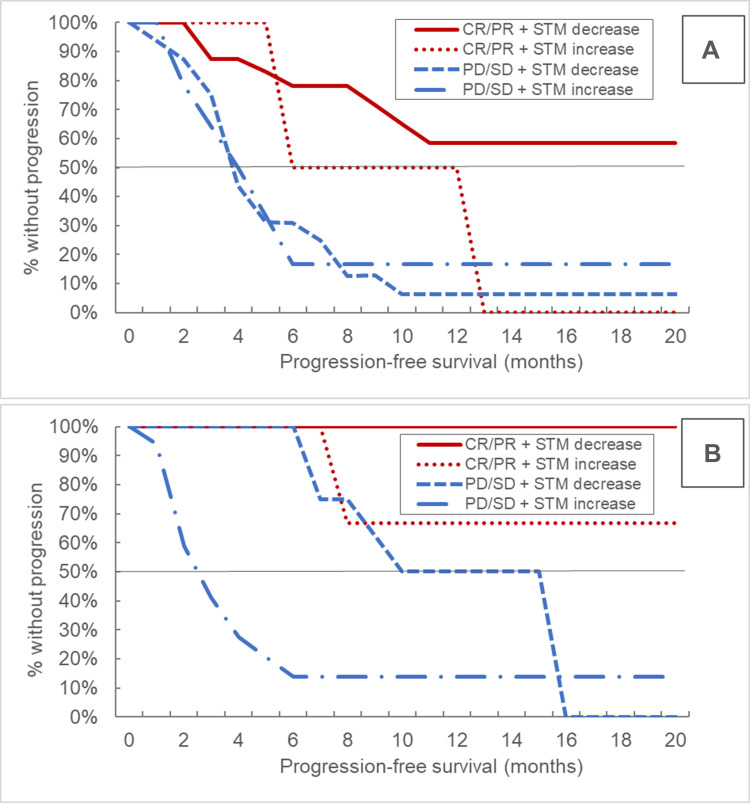
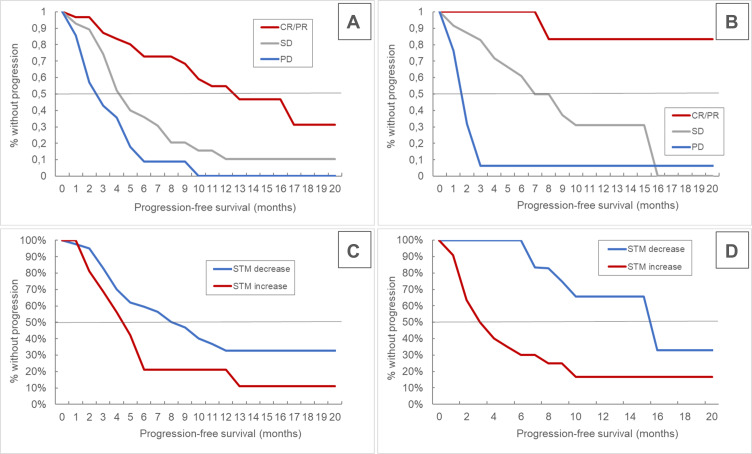
Among 80 CHT-ICI patients (41% women, mean age 63 years), median PFS was 5 months (M;4,9), median OS was 15M (10,/). PFS was significantly (p=0.042) longer, when the leading STM had decreased at first restaging under CHT-ICI combination therapy (9M (5,12; n=41) vs 5M (3,6; n=16)). In the 54 (67.5%) patients who received subsequent mono-ICI maintenance therapy, STM decrease was similarly associated with significantly (p<0.001) longer PFS (16M (7,/; n=16) vs 3.5M (2,6; n=22)). Patients with radiologically stable or progressive disease and concomitant leading STM decrease had similar PFS in the CHT-ICI combination phase (4M (3,7; n=16) vs 4.5M (2,6; n=14)), but longer PFS in the mono-ICI maintenance setting (13M (7,16; n=10) vs 3M (2,4; n=17)). Median OS was not reached in most subgroups.
Leading STM dynamics provide predictive biomarker information additional to radiological response evaluation patients receiving CHT-ICI combination therapy, especially in the mono-ICI maintenance setting.
评估血清肿瘤标志物(STM)作为接受化疗免疫治疗的晚期非小细胞肺癌(NSCLC)的预测生物标志物。
对接受铂类化疗(CHT)和PD-1/PD-L1导向的免疫检查点抑制剂(ICI)联合治疗的患者进行回顾性随访。在NSCLC诊断时常规检测癌胚抗原(CEA)、糖类抗原19-9(CA19-9)、细胞角蛋白19片段(CYFRA 21-1)和神经元特异性烯醇化酶(NSE)。将相对升高最高的标志物定义为“主要STM”,评估其在CHT-ICI以及单药ICI维持治疗开始时与各自随后的重新分期之间的变化。使用实体瘤疗效评价标准(RECIST)分析相应的计算机断层扫描评估结果。对于CHT-ICI联合治疗及随后的单药ICI维持治疗,在Kaplan-Meier分析中评估主要STM和RECIST反应与无进展生存期(PFS)和总生存期(OS)的关系。
在80例接受CHT-ICI治疗的患者中(41%为女性,平均年龄63岁),中位PFS为5个月(4,9),中位OS为15个月(10,/)。在CHT-ICI联合治疗的首次重新分期时主要STM下降的患者,PFS显著更长(p=0.042)(9个月(5,12;n=41)对5个月(3,6;n=16))。在接受后续单药ICI维持治疗的54例(67.5%)患者中,STM下降同样与显著更长的PFS相关(p<0.001)(16个月(7,/;n=16)对3.5个月(2,6;n=22))。在CHT-ICI联合治疗阶段,放射学稳定或进展性疾病且伴随主要STM下降的患者PFS相似(4个月(3,7;n=16)对4.5个月(2,6;n=14)),但在单药ICI维持治疗中PFS更长(13个月(7,16;n=10)对3个月(2,4;n=17))。大多数亚组未达到中位OS。
主要STM动态变化为接受CHT-ICI联合治疗的患者提供了除放射学反应评估之外的预测生物标志物信息,尤其是在单药ICI维持治疗中。