Tang Yin, Cui Yu, Li Lin-Lin, Guan Ya-Ping, Feng Dong-Feng, Yin Bei-Bei, Liang Xue-Feng, Yin Jing, Jiang Rui, Liang Jing, Sun Ya-Hong, Wang Jun
Postgraduate Department, Shandong First Medical University & Shandong Academy of Medical Sciences, Jinan, 250117, People's Republic of China.
Department of Oncology, The Third Affiliated Hospital of Shandong First Medical University (Affiliated Hospital of Shandong Academy of Medical Sciences), Jinan, 250031, People's Republic of China.
Cancer Manag Res. 2021 Nov 2;13:8241-8255. doi: 10.2147/CMAR.S329963. eCollection 2021.
To evaluate the dynamics of early serum tumour markers (STMs) and the neutrophil-to-lymphocyte ratio (NLR) to predict clinical efficacy and prognosis of advanced non-small-cell lung cancer (NSCLC) patients who received programmed cell death-1 (PD-1)/programmed cell death-ligand 1 (PD-L1) inhibitors.
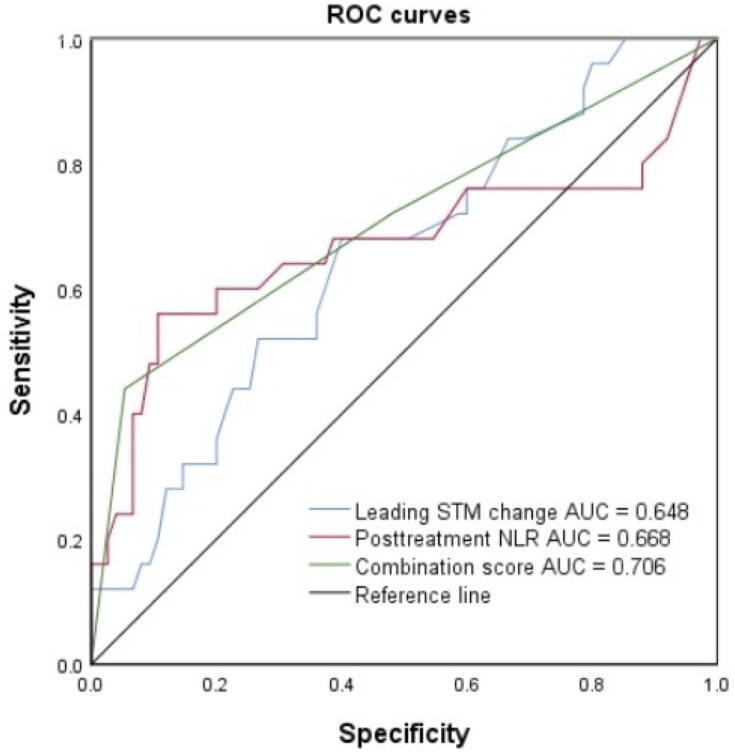
We retrospectively reviewed patients with advanced NSCLC treated with PD-1/PD-L1 inhibitors between September 2017 and August 2020. NLR and STMs were routinely measured between immunotherapy initiation and the first radiological evaluation. A combination score based on the leading STM and NLR and their dynamic changes was established. The effects of leading STM change, NLR change, and the combination score on the objective response rate (ORR), durable clinical benefit (DCB), progression-free survival (PFS), and overall survival (OS) were analysed. The accuracy of the combination score was evaluated by receiver operating characteristic (ROC) curve and the area under the curve (AUC).
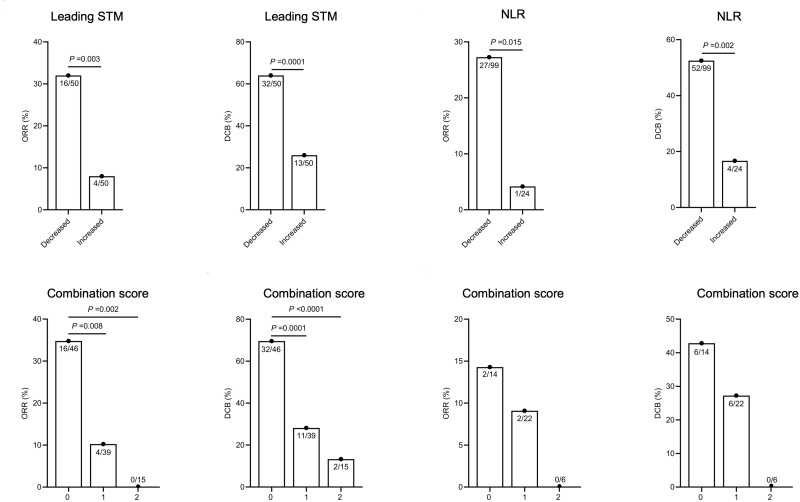
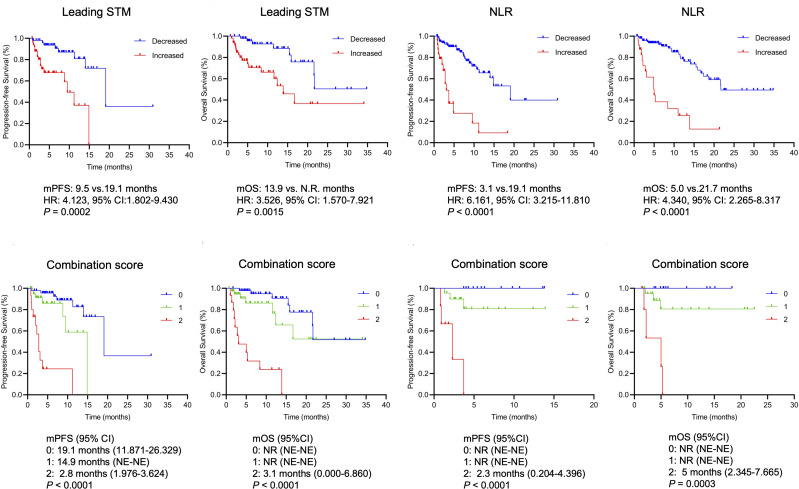
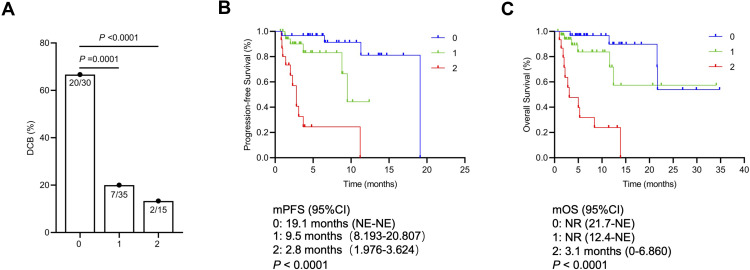
Overall, 124 patients were included in this retrospective cohort study. The ORR was 22.8%, DCB was 54.5%, and the median OS and PFS were 21.6 and 14.9 months, respectively. Patients with low combination scores had a significantly improved ORR and DCB compared with those with intermediate or high scores ( = 0.002 for ORR, < 0.0001 for DCB). In a multivariate model, the combination score was an independent indicator of PFS ( < 0.0001) and OS ( < 0.0001). The AUC demonstrated that the combination score (AUC = 0.706) has greater predictive power than either the posttreatment NLR (AUC = 0.668) or the leading STM change (AUC = 0.648) alone.
An easy, cost-effective, and novel combination score based on the dynamics of an early STM and the NLR can accurately predict the clinical efficacy of PD-1/PD-L1 inhibitors and prognosis in advanced NSCLC patients.
评估早期血清肿瘤标志物(STMs)和中性粒细胞与淋巴细胞比值(NLR)的动态变化,以预测接受程序性细胞死亡蛋白1(PD-1)/程序性细胞死亡配体1(PD-L1)抑制剂治疗的晚期非小细胞肺癌(NSCLC)患者的临床疗效和预后。
我们回顾性分析了2017年9月至2020年8月期间接受PD-1/PD-L1抑制剂治疗的晚期NSCLC患者。在免疫治疗开始至首次影像学评估期间,常规测量NLR和STMs。基于主要的STM、NLR及其动态变化建立了一个综合评分。分析主要STM变化、NLR变化和综合评分对客观缓解率(ORR)、持久临床获益(DCB)、无进展生存期(PFS)和总生存期(OS)的影响。通过受试者工作特征(ROC)曲线和曲线下面积(AUC)评估综合评分的准确性。
总体而言,124例患者纳入了这项回顾性队列研究。ORR为22.8%,DCB为54.5%,中位OS和PFS分别为21.6个月和14.9个月。综合评分低的患者与综合评分中等或高的患者相比,ORR和DCB显著改善(ORR,P = 0.002;DCB,P < 0.0001)。在多变量模型中,综合评分是PFS(P < 0.0001)和OS(P < 0.0001)的独立指标。AUC表明,综合评分(AUC = 0.706)比单独的治疗后NLR(AUC = 0.668)或主要STM变化(AUC =