Mayer Kathryn J, Wang Xiaofei, Santander Mitchell V, Mitts Brock A, Sauer Jonathan S, Sultana Camille M, Cappa Christopher D, Prather Kimberly A
Department of Chemistry and Biochemistry, University of California, San Diego, La Jolla, California 92093, United States.
Shanghai Key Laboratory of Atmospheric Particle Pollution and Prevention, Department of Environmental Science and Engineering, Fudan University, Shanghai 200433, China.
ACS Cent Sci. 2020 Dec 23;6(12):2259-2266. doi: 10.1021/acscentsci.0c00793. Epub 2020 Nov 25.
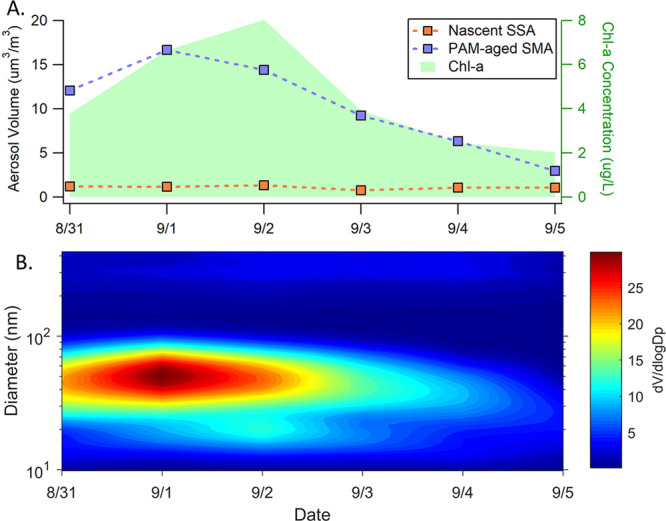
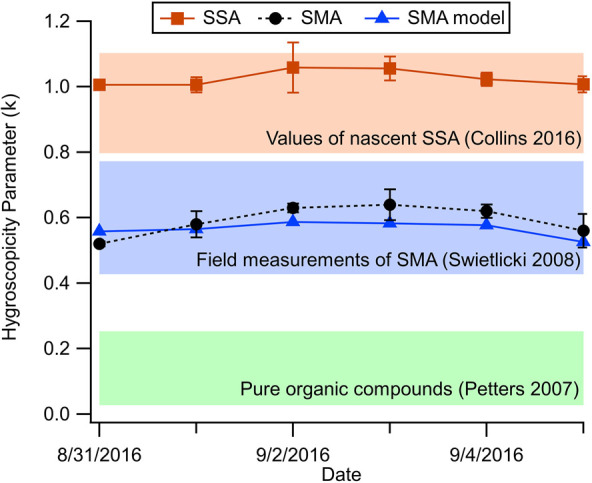
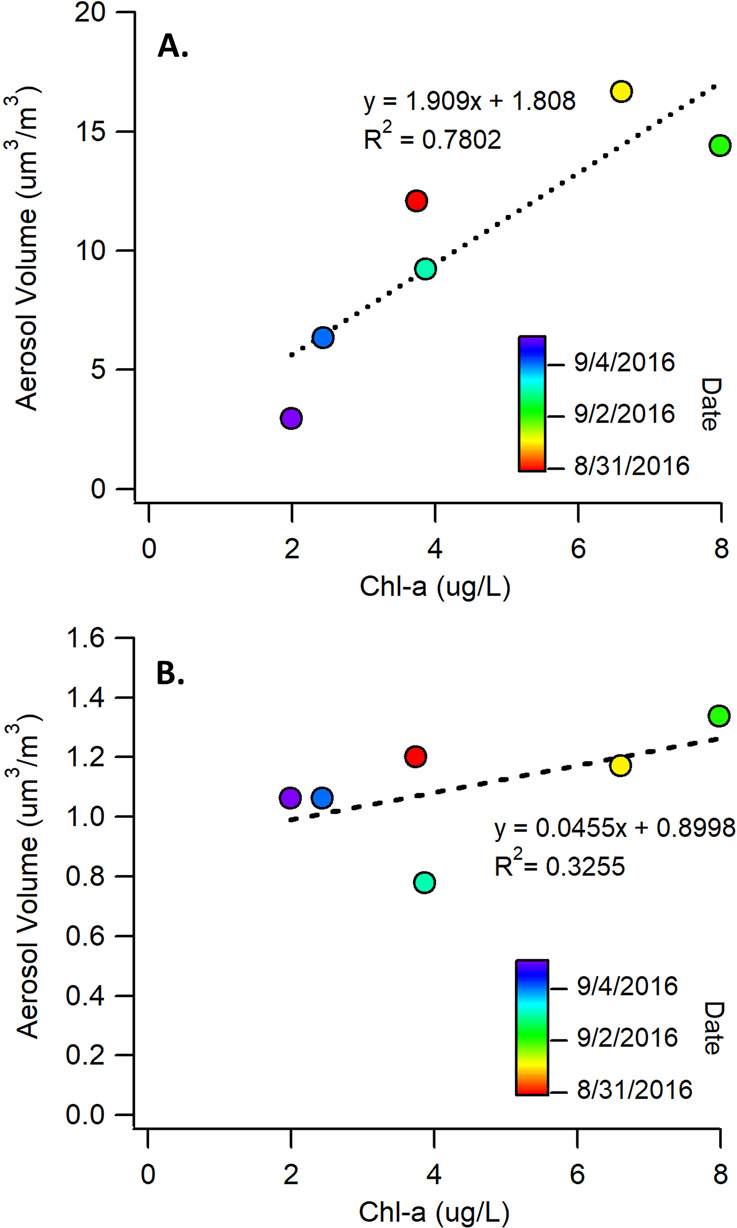
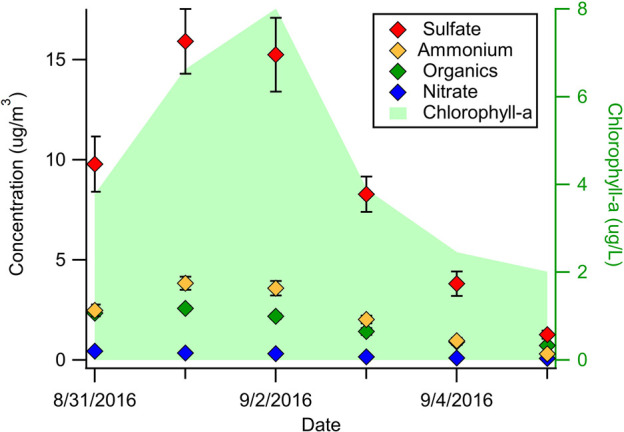
Marine aerosols play a critical role in impacting our climate by seeding clouds over the oceans. Despite decades of research, key questions remain regarding how ocean biological activity changes the composition and cloud-forming ability of marine aerosols. This uncertainty largely stems from an inability to independently determine the cloud-forming potential of primary versus secondary marine aerosols in complex marine environments. Here, we present results from a unique 6-day mesocosm experiment where we isolated and studied the cloud-forming potential of primary and secondary marine aerosols over the course of a phytoplankton bloom. The results from this controlled laboratory approach can finally explain the long-observed changes in the hygroscopic properties of marine aerosols observed in previous field studies. We find that secondary marine aerosols, consisting of sulfate, ammonium, and organic species, correlate with phytoplankton biomass (i.e., chlorophyll-a concentrations), whereas primary sea spray aerosol does not. Importantly, the measured CCN activity (κ = 0.59 ± 0.04) of the resulting secondary marine aerosol matches the values observed in previous field studies, suggesting secondary marine aerosols play the dominant role in affecting marine cloud properties. Given these findings, future studies must address the physical, chemical, and biological factors controlling the emissions of volatile organic compounds that form secondary marine aerosol, with the goal of improving model predictions of ocean biology on atmospheric chemistry, clouds, and climate.
海洋气溶胶通过在海洋上空播撒云滴,在影响我们的气候方面发挥着关键作用。尽管经过了数十年的研究,但关于海洋生物活动如何改变海洋气溶胶的组成和云形成能力,仍存在一些关键问题。这种不确定性主要源于无法在复杂的海洋环境中独立确定原生海洋气溶胶与次生海洋气溶胶的云形成潜力。在此,我们展示了一项为期6天的独特中尺度实验的结果,在该实验中,我们在一次浮游植物大量繁殖过程中,分离并研究了原生和次生海洋气溶胶的云形成潜力。这种受控实验室方法的结果最终可以解释在以前的实地研究中长期观察到的海洋气溶胶吸湿特性的变化。我们发现,由硫酸盐、铵和有机物质组成的次生海洋气溶胶与浮游植物生物量(即叶绿素a浓度)相关,而原生海浪花气溶胶则不然。重要的是,所产生的次生海洋气溶胶的实测云凝结核活性(κ = 0.59 ± 0.04)与以前实地研究中观察到的值相符,这表明次生海洋气溶胶在影响海洋云特性方面起主导作用。鉴于这些发现,未来的研究必须解决控制形成次生海洋气溶胶的挥发性有机化合物排放的物理、化学和生物因素,以期改进对海洋生物学对大气化学、云和气候影响的模型预测。