Gao Liang, Cucchiarini Magali, Madry Henning
Center of Experimental Orthopaedics, Saarland University Medical Center and Saarland University, Homburg, Germany.
Clin Transl Med. 2020 Dec;10(8):e248. doi: 10.1002/ctm2.248.
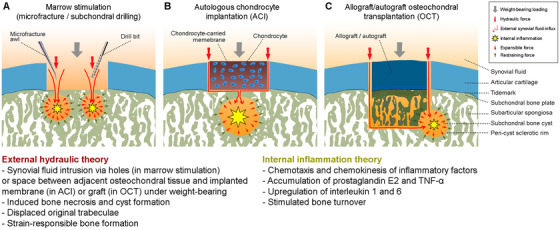
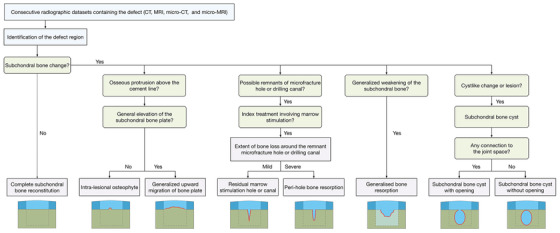
Subchondral bone cysts represent an early postoperative sign associated with many articular cartilage repair procedures. They may be defined as an abnormal cavity within the subchondral bone in close proximity of a treated cartilage defect with a possible communication to the joint cavity in the absence of osteoarthritis. Two synergistic mechanisms of subchondral cyst formation, the theory of internal upregulation of local proinflammatory factors, and the external hydraulic theory, are proposed to explain their occurrence. This review describes subchondral bone cysts in the context of articular cartilage repair to improve investigations of these pathological changes. It summarizes their epidemiology in both preclinical and clinical settings with a focus on individual cartilage repair procedures, examines an algorithm for subchondral bone analysis, elaborates on the underlying mechanism of subchondral cyst formation, and condenses the clinical implications and perspectives on subchondral bone cyst formation in cartilage repair.
软骨下骨囊肿是许多关节软骨修复手术相关的早期术后征象。它们可被定义为软骨下骨内的异常腔隙,紧邻经治疗的软骨缺损处,在无骨关节炎的情况下可能与关节腔相通。为解释其发生,提出了软骨下囊肿形成的两种协同机制,即局部促炎因子内部上调理论和外部液压理论。本综述在关节软骨修复的背景下描述软骨下骨囊肿,以改进对这些病理变化的研究。它总结了其在临床前和临床环境中的流行病学,重点关注个体软骨修复手术,研究软骨下骨分析算法,阐述软骨下囊肿形成的潜在机制,并概括软骨修复中软骨下骨囊肿形成的临床意义和前景。