Department of Toxicogenomics, GROW-School for Oncology and Developmental Biology, Maastricht University Medical Center, P.O. Box 616, 6200 MD Maastricht, The Netherlands.
Netherlands Food and Consumer Product Safety Authority, P.O. Box 43006, 3540 AA Utrecht, The Netherlands.
Int J Mol Sci. 2020 Dec 28;22(1):207. doi: 10.3390/ijms22010207.
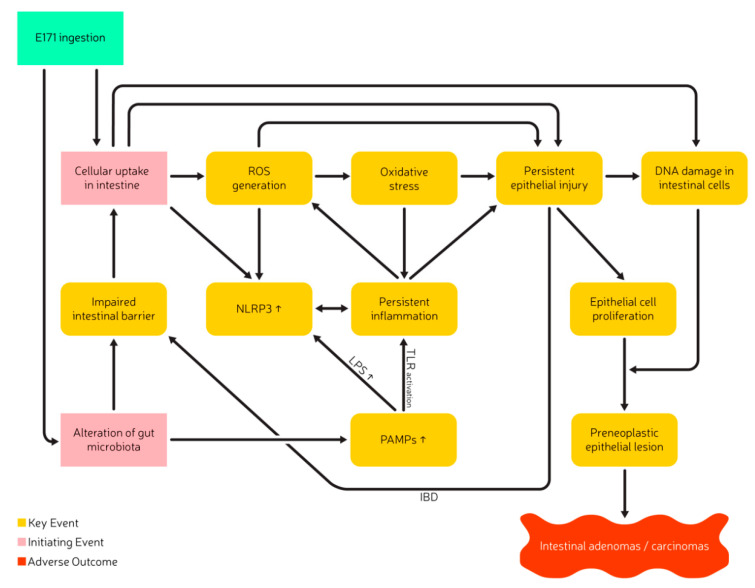
Titanium dioxide (TiO) is used as a food additive (E171) and can be found in sauces, icings, and chewing gums, as well as in personal care products such as toothpaste and pharmaceutical tablets. Along with the ubiquitous presence of TiO and recent insights into its potentially hazardous properties, there are concerns about its application in commercially available products. Especially the nano-sized particle fraction (<100 nm) of TiO warrants a more detailed evaluation of potential adverse health effects after ingestion. A workshop organized by the Dutch Office for Risk Assessment and Research (BuRO) identified uncertainties and knowledge gaps regarding the gastrointestinal absorption of TiO, its distribution, the potential for accumulation, and induction of adverse health effects such as inflammation, DNA damage, and tumor promotion. This review aims to identify and evaluate recent toxicological studies on food-grade TiO and nano-sized TiO in ex-vivo, in-vitro, and in-vivo experiments along the gastrointestinal route, and to postulate an Adverse Outcome Pathway (AOP) following ingestion. Additionally, this review summarizes recommendations and outcomes of the expert meeting held by the BuRO in 2018, in order to contribute to the hazard identification and risk assessment process of ingested TiO.
二氧化钛(TiO)用作食品添加剂(E171),可在酱汁、糖衣和口香糖中找到,也存在于牙膏和药片等个人护理产品中。随着 TiO 的广泛存在以及对其潜在有害特性的最新了解,人们对其在市售产品中的应用表示担忧。特别是 TiO 的纳米颗粒部分(<100nm)需要更详细地评估摄入后潜在的不良健康影响。荷兰风险评估和研究办公室(BuRO)组织的一次研讨会确定了关于 TiO 的胃肠道吸收、分布、潜在积累以及诱发炎症、DNA 损伤和肿瘤促进等不良健康影响的不确定性和知识空白。本综述旨在确定和评估近期关于食品级 TiO 和纳米级 TiO 的毒理学研究,这些研究涉及胃肠道途径的离体、在体和在体实验,并根据摄入后提出不良结局途径(AOP)。此外,本综述还总结了 BuRO 于 2018 年举行的专家会议的建议和结果,以为摄入 TiO 的危害识别和风险评估过程做出贡献。