Koonrungsesomboon Nut, Nopnithipat Saowaros, Teekachunhatean Supanimit, Chiranthanut Natthakarn, Sangdee Chaichan, Chansakaow Sunee, Tipduangta Pramote, Hanprasertpong Nutthiya
Department of Pharmacology, Faculty of Medicine, Chiang Mai University, Chiang Mai 50200, Thailand.
Musculoskeletal Science and Translational Research Center, Chiang Mai University, Chiang Mai 50200, Thailand.
Evid Based Complement Alternat Med. 2020 Dec 9;2020:8817374. doi: 10.1155/2020/8817374. eCollection 2020.
Osteoarthritis of the knee is the most common form of arthritis. Identifying effective and safe herbal formulations that are locally available is viewed as a priority for sustainable development in a region. This study aimed to evaluate the efficacy and safety of Thai herbal formulation-6 (THF-6) in comparison with oral diclofenac in patients with moderate-to-severe osteoarthritis of the knee.
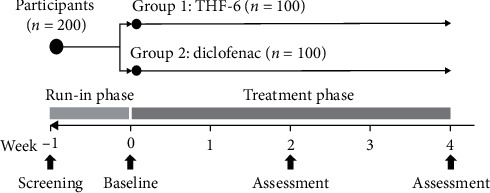
This randomized, double-blind, active-controlled, noninferiority trial randomly assigned patients with osteoarthritis of the knee to receive either THF-6 or diclofenac for four weeks. The primary outcome measure was the change from baseline in knee pain as measured by a 100 mm visual analog scale (VAS). Secondary outcome measures included knee stiffness, a stair climb test, the Knee Injury and Osteoarthritis Outcome Score, and safety parameters. Outcomes were assessed on a biweekly basis. Modified intention-to-treat (MITT) and perprotocol (PP) analyses were applied.
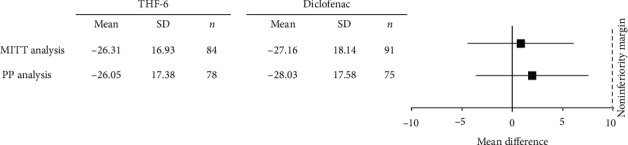
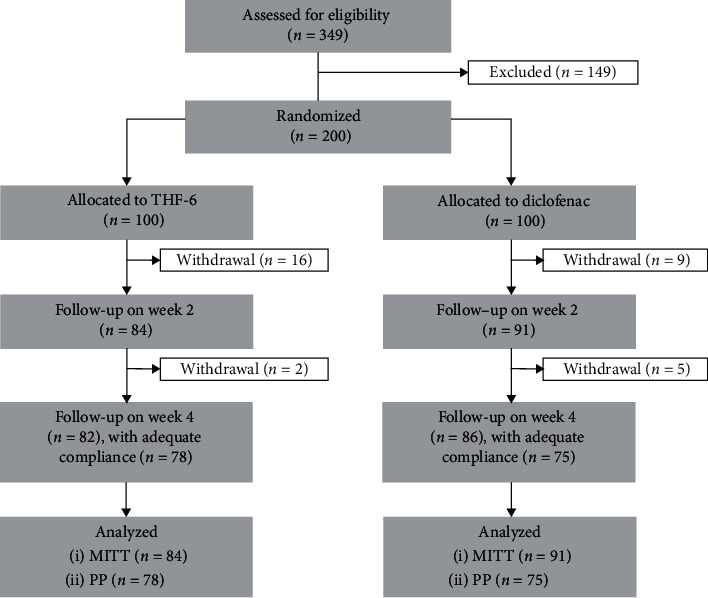
A total of 200 patients were enrolled of whom 175 (87.5%) were included in the MITT analysis and 153 (76.5%) in the PP analysis. The mean change in VAS pain did not differ between the two groups, and the upper limit of the two-sided 95% confidence interval (CI) for comparison between the two groups was within the prespecified margin of 10 mm for noninferiority (MITT analysis: mean difference = 0.86, 95% CI = -4.39 to 6.10, =0.748; PP analysis: mean difference = 1.98, 95% CI = -3.61 to 7.56, =0.486). Significant improvement was observed in all the efficacy parameters in both groups. Dyspepsia was the most common adverse event: 23 patients in the THF-6 group and 28 in the diclofenac group (=0.417).
THF-6 offers an alternative to oral diclofenac for the short-term treatment of osteoarthritis of the knee. It was shown to be noninferior to oral diclofenac in relieving knee pain. This trial is registered with ChiCTR-IPR-15007213.
膝关节骨关节炎是最常见的关节炎形式。确定当地可获得的有效且安全的草药配方被视为一个地区可持续发展的优先事项。本研究旨在评估泰国草药配方-6(THF-6)与口服双氯芬酸相比,对中重度膝关节骨关节炎患者的疗效和安全性。
这项随机、双盲、活性对照、非劣效性试验将膝关节骨关节炎患者随机分配接受THF-6或双氯芬酸治疗四周。主要结局指标是用100毫米视觉模拟量表(VAS)测量的膝关节疼痛较基线的变化。次要结局指标包括膝关节僵硬、爬楼梯试验、膝关节损伤和骨关节炎结局评分以及安全性参数。每两周评估一次结局。应用改良意向性治疗(MITT)和符合方案(PP)分析。
共纳入200例患者,其中175例(87.5%)纳入MITT分析,153例(76.5%)纳入PP分析。两组VAS疼痛的平均变化无差异,两组比较的双侧95%置信区间(CI)上限在预先设定的非劣效性10毫米范围内(MITT分析:平均差异=0.86,95%CI=-4.39至6.10,P=0.748;PP分析:平均差异=1.98,95%CI=-3.61至7.56,P=0.486)。两组所有疗效参数均有显著改善。消化不良是最常见的不良事件:THF-6组23例患者,双氯芬酸组28例患者(P=0.417)。
THF-6为膝关节骨关节炎的短期治疗提供了口服双氯芬酸的替代方案。在缓解膝关节疼痛方面,它被证明不劣于口服双氯芬酸。本试验已在ChiCTR-IPR-15007213注册。