Chawhuaveang Darren Dhananthat, Yu Ollie Yiru, Yin Iris Xiaoxue, Lam Walter Yu-Hang, Mei May Lei, Chu Chun-Hung
Faculty of Dentistry, The University of Hong Kong, Hong Kong SAR, China.
Faculty of Dentistry, The University of Otago, Dunedin, New Zealand.
J Dent Sci. 2021 Jan;16(1):523-529. doi: 10.1016/j.jds.2020.10.007. Epub 2020 Oct 24.
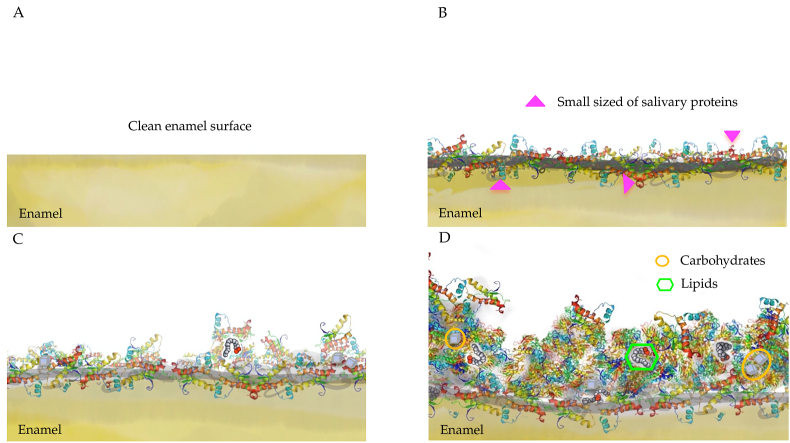
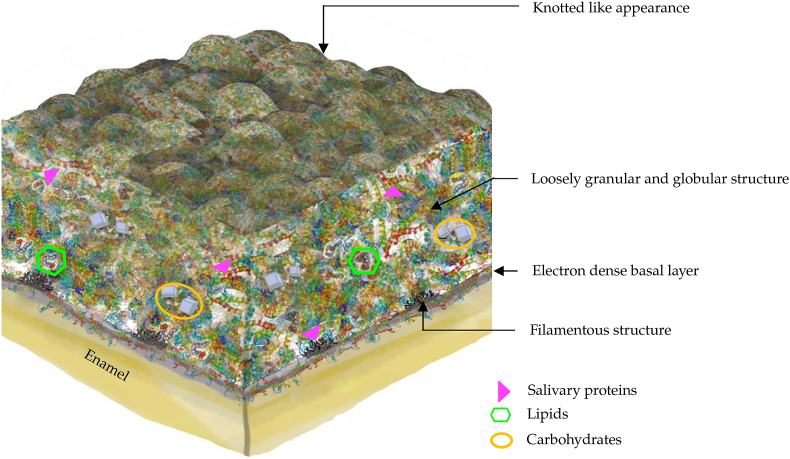
As soon as saliva contacts the teeth surface, salivary proteins adhere to the tooth surface to form acquired salivary pellicle. The formation of this acquired salivary pellicle is a dynamic and selective process of macromolecular adsorption and desorption. Although acquired salivary pellicle contains proteins and peptides, it also contains lipids, and other macro-molecules, all of which contribute to its protective properties. Acquired salivary pellicle is related to the development of common oral diseases, such as erosion, dental caries, and periodontal disease. Acquired salivary pellicle acts as a natural barrier to prevent a tooth's surface from making direct contact with acids and to protect it from erosive demineralization. It contributes to the control of dental erosion by modulating calcium and phosphate concentrations on the tooth surface. It also influences the initial colonizer of oral biofilm and affects the transportation pathway of the acidic products of cariogenic bacteria, which affects the development of dental caries. In addition, it influences periodontal disease by acting on the colonization of periodontal pathogens. This paper's aim is to provide an overview of the acquired salivary pellicle, highlighting its composition, structure, function, role in common oral diseases, and modification for the prevention of oral diseases.
唾液一旦接触牙齿表面,唾液蛋白就会附着在牙齿表面,形成获得性唾液薄膜。这种获得性唾液薄膜的形成是一个大分子吸附和解吸的动态且选择性的过程。尽管获得性唾液薄膜含有蛋白质和肽,但它也含有脂质及其他大分子,所有这些都有助于其保护特性。获得性唾液薄膜与常见口腔疾病如侵蚀、龋齿和牙周病的发展有关。获得性唾液薄膜作为一种天然屏障,可防止牙齿表面直接接触酸,并保护其免受侵蚀性脱矿质作用。它通过调节牙齿表面的钙和磷酸盐浓度来控制牙齿侵蚀。它还影响口腔生物膜的初始定植菌,并影响致龋菌酸性产物的运输途径,从而影响龋齿的发展。此外,它通过作用于牙周病原体的定植来影响牙周病。本文旨在概述获得性唾液薄膜,重点介绍其组成、结构、功能、在常见口腔疾病中的作用以及预防口腔疾病的改性方法。