Clinica Ortopedica E Traumatologica II, IRCCS Istituto Ortopedico Rizzoli, Via Pupilli 1, 40136, Bologna, BO, Italy.
Dipartimento Di Scienze Biomediche E Neuromotorie DIBINEM, Università Di Bologna, Via San Vitale, 40125, Bologna, BO, Italy.
Knee Surg Sports Traumatol Arthrosc. 2022 Feb;30(2):661-667. doi: 10.1007/s00167-020-06398-3. Epub 2021 Jan 2.
To investigate if postoperative clinical outcomes correlate with specific kinematic patterns after total knee arthroplasty (TKA) surgery. The hypothesis was that the group of patients with higher clinical outcomes would have shown postoperative medial pivot kinematics, while the group of patients with lower clinical outcomes would have not.
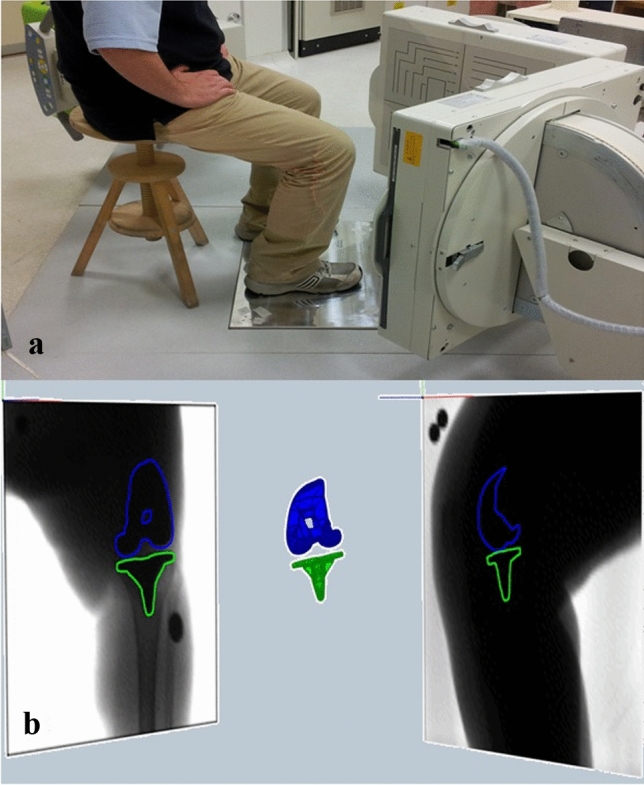
52 patients undergoing TKA surgery were prospectively evaluated at least a year of follow-up (13.5 ± 6.8 months) through clinical and functional Knee Society Score (KSS), and kinematically through dynamic radiostereometric analysis (RSA) during a sit-to-stand motor task. Patients received posterior-stabilized TKA design. Based on the result of the KSS, patients were divided into two groups: "KSS > 70 group", patients with a good-to-excellent score (93.1 ± 6.8 points, n = 44); "KSS < 70 group", patients with a fair-to-poor score (53.3 ± 18.3 points, n = 8). The anteroposterior (AP) low point (lowest femorotibial contact points) translation of medial and lateral femoral compartments was compared through Student's t test (p < 0.05).
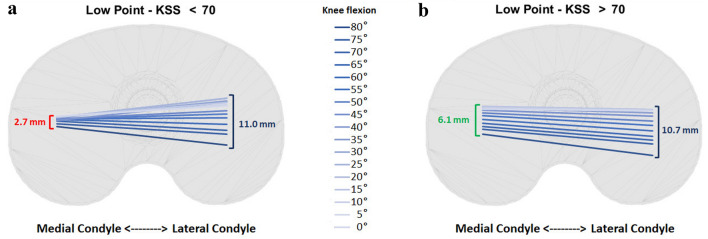
Low point AP translation of the medial compartment was significantly lower (p < 0.05) than the lateral one in both the KSS > 70 (6.1 mm ± 4.4 mm vs 10.7 mm ± 4.6 mm) and the KSS < 70 groups (2.7 mm ± 3.5 mm vs 11.0 mm ± 5.6 mm). Furthermore, the AP translation of the lateral femoral compartment was not significantly different (p > 0.05) between the two groups, while the AP translation of the medial femoral compartment was significantly higher for the KSS > 70 group (p = 0.0442).
In the group of patients with a postoperative KSS < 70, the medial compartment translation was almost one-fourth of the lateral one. Surgeons should be aware that an over-constrained kinematic of the medial compartment might lead to lower clinical outcomes.
II.
研究全膝关节置换(TKA)术后临床结果是否与特定的运动学模式相关。假设具有较高临床结果的患者组将表现出术后内侧枢轴运动学,而具有较低临床结果的患者组则不会。
前瞻性评估了 52 例接受 TKA 手术的患者,随访时间至少 1 年(13.5±6.8 个月),通过临床和功能膝关节协会评分(KSS)以及在坐站运动任务期间通过动态放射立体测量分析(RSA)进行运动学评估。患者接受后稳定型 TKA 设计。根据 KSS 的结果,患者分为两组:“KSS>70 组”,具有良好到优秀评分的患者(93.1±6.8 分,n=44);“KSS<70 组”,具有一般到较差评分的患者(53.3±18.3 分,n=8)。通过学生 t 检验比较内侧和外侧股骨间室的前后向(AP)低点(最低的股骨胫骨接触点)平移(p<0.05)。
在 KSS>70 组(6.1±4.4mm 对 10.7±4.6mm)和 KSS<70 组(2.7±3.5mm 对 11.0±5.6mm)中,内侧间室的低点 AP 平移明显低于外侧间室(p<0.05)。此外,两组间外侧股骨间室的 AP 平移无显著差异(p>0.05),而 KSS>70 组的内侧股骨间室的 AP 平移明显更高(p=0.0442)。
在 KSS<70 的术后患者组中,内侧间室的平移几乎是外侧间室的四分之一。外科医生应该意识到内侧间室的过度约束运动学可能导致较低的临床结果。
II 级。