
新型冠状病毒肺炎患者尿微量元素与疾病严重程度和结局的关系。
Urinary trace elements in association with disease severity and outcome in patients with COVID-19.
机构信息
Department of Laboratory Medicine, Tongji Hospital, Tongji Medical College, Huazhong University of Science and Technology, Wuhan, China.
Institute of Food Science and Engineering, Wuhan Polytechnic University, Wuhan, China.
出版信息
Environ Res. 2021 Mar;194:110670. doi: 10.1016/j.envres.2020.110670. Epub 2020 Dec 30.
BACKGROUND
The dynamics of urinary trace elements in patients with COVID-19 still remains to be investigated.
METHODS
A retrospective study was performed on a cohort of 138 confirmed COVID-19 patients for their urinary levels of essential and/or toxic metals including chromium, manganese, copper, arsenic, selenium, cadmium, mercury, thallium and lead according to the different disease severity (severe or non-severe) and outcome (recovered or deceased).
RESULTS
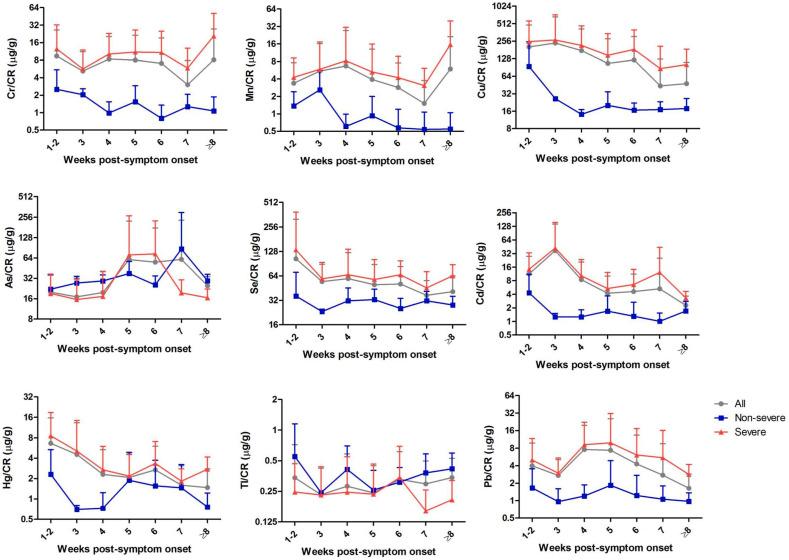
Urinary concentrations of chromium, manganese, copper, selenium, cadmium, mercury and lead after creatinine adjustment were found to be higher in severe patients than the non-severe cases with COVID-19. And among the severe cases, these elements were also higher in the deceased group than the recovered group. When the weeks of the post-symptom onset were taken in account, the changes of these urinary elements were existed across the clinical course since the disease onset. These urinary elements were found to be mostly positively inter-correlated, and further positively correlated with other laboratory inflammatory parameters including serum cytokines (IL-1B, IL2R, IL6, IL8, IL10, TNFα), ferritin, and neutrophil count and white blood cell count. As a independently predictive factor, urinary creatinine-adjusted copper of ≥25.57 μg/g and ≥99.32 μg/g were associated with significantly increased risk of severe illness and fatal outcome in COVID-19, respectively.
CONCLUSIONS
These results suggest abnormities in urinary levels of the trace metals were tightly associated with the severe illness and fatal outcome of COVID-19.
背景
COVID-19 患者尿液微量元素的动态变化仍有待研究。
方法
对 138 例确诊 COVID-19 患者进行回顾性研究,根据疾病严重程度(严重或非严重)和结局(康复或死亡),检测尿液中必需和/或有毒金属铬、锰、铜、砷、硒、镉、汞、铊和铅的水平。
结果
经肌酐校正后,严重 COVID-19 患者尿液中铬、锰、铜、硒、镉、汞和铅的浓度高于非严重 COVID-19 患者。在严重病例中,死亡组的这些元素也高于康复组。考虑到症状出现后的周数,这些尿液元素的变化自疾病发病以来贯穿整个临床病程。这些尿液元素大多呈正相关,且与其他实验室炎症参数(包括血清细胞因子[IL-1B、IL2R、IL6、IL8、IL10、TNFα]、铁蛋白和中性粒细胞计数、白细胞计数)呈进一步正相关。作为一个独立的预测因素,尿肌酐校正后铜≥25.57μg/g 和≥99.32μg/g 与 COVID-19 严重疾病和死亡结局的风险显著增加相关。
结论
这些结果表明,尿液中微量元素水平的异常与 COVID-19 的严重疾病和死亡结局密切相关。


 Zotero 插件