Stip Emmanuel, Rizvi Tahir A, Mustafa Farah, Javaid Syed, Aburuz Salahdein, Ahmed Nahida Nayaz, Abdel Aziz Karim, Arnone Danilo, Subbarayan Aravinthan, Al Mugaddam Fadwa, Khan Gulfaraz
Department of Psychiatry, University of Montréal, Montréal, QC, Canada.
Department of Psychiatry and Behavioral Science, College of Medicine and Health Science, United Arab Emirates University, Al Ain, United Arab Emirates.
Front Pharmacol. 2020 Dec 16;11:577678. doi: 10.3389/fphar.2020.577678. eCollection 2020.
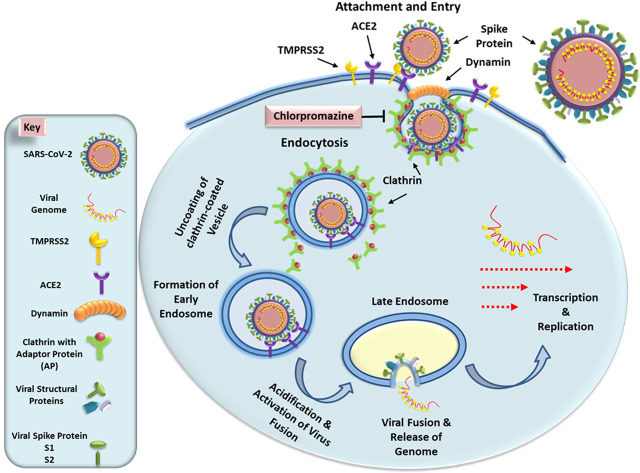
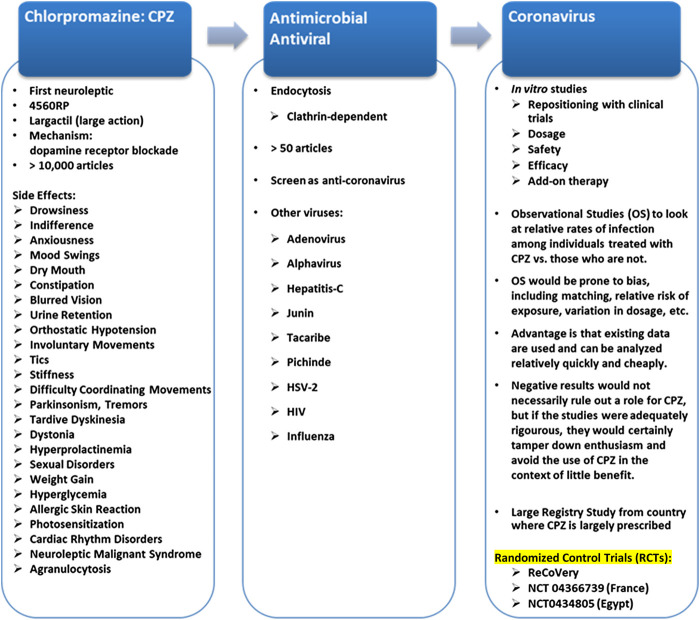
Coronavirus disease 2019 (COVID-19) is a severe acute respiratory syndrome (SARS) in humans that is caused by SARS-associated coronavirus type 2 (SARS-CoV-2). In the context of COVID-19, several aspects of the relations between psychiatry and the pandemic due to the coronavirus have been described. Some drugs used as antiviral medication have neuropsychiatric side effects, and conversely some psychotropic drugs have antiviral properties. Chlorpromazine (CPZ, Largactil) is a well-established antipsychotic medication that has recently been proposed to have antiviral activity against SARS-CoV-2. This review aims to 1) inform health care professionals and scientists about the history of CPZ use in psychiatry and its potential anti- SARS-CoV-2 activities 2) inform psychiatrists about its potential anti-SARS-CoV-2 activities, and 3) propose a research protocol for investigating the use of CPZ in the treatment of COVID-19 during the potential second wave. The history of CPZ's discovery and development is described in addition to the review of literature from published studies within the discipline of virology related to CPZ. The early stages of infection with coronavirus are critical events in the course of the viral cycle. In particular, viral entry is the first step in the interaction between the virus and the cell that can initiate, maintain, and spread the infection. The possible mechanism of action of CPZ is related to virus cell entry via clathrin-mediated endocytosis. Therefore, CPZ could be useful to treat COVID-19 patients provided that its efficacy is evaluated in adequate and well-conducted clinical trials. Interestingly, clinical trials of very good quality are in progress. However, more information is still needed about the appropriate dosage regimen. In short, CPZ repositioning is defined as a new use beyond the field of psychiatry.
2019冠状病毒病(COVID-19)是一种由严重急性呼吸综合征冠状病毒2型(SARS-CoV-2)引起的人类严重急性呼吸综合征。在COVID-19的背景下,已经描述了精神病学与冠状病毒大流行之间关系的几个方面。一些用作抗病毒药物的药物有神经精神方面的副作用,反之,一些精神药物具有抗病毒特性。氯丙嗪(CPZ,氯普马嗪)是一种成熟的抗精神病药物,最近有人提出它对SARS-CoV-2具有抗病毒活性。本综述旨在:1)向医疗保健专业人员和科学家介绍CPZ在精神病学中的使用历史及其潜在的抗SARS-CoV-2活性;2)向精神科医生介绍其潜在的抗SARS-CoV-2活性;3)提出一项研究方案,以调查在可能出现的第二波疫情期间使用CPZ治疗COVID-19的情况。除了回顾病毒学领域内已发表研究中与CPZ相关的文献外,还描述了CPZ的发现和发展历史。冠状病毒感染的早期阶段是病毒周期中的关键事件。特别是,病毒进入是病毒与细胞相互作用的第一步,可引发、维持和传播感染。CPZ可能的作用机制与通过网格蛋白介导的内吞作用进入病毒细胞有关。因此,如果在充分且开展良好的临床试验中评估其疗效,CPZ可能对治疗COVID-19患者有用。有趣的是,高质量的临床试验正在进行中。然而,关于合适的给药方案仍需要更多信息。简而言之,CPZ重新定位被定义为超出精神病学领域的新用途。