Delussi Marianna, Nazzaro Virgilio, Ricci Katia, de Tommaso Marina
Applied Neurophyiology and Pain Unit-AnpLab-SMBNOS Department, Bari Aldo Moro University, Bari, Italy.
Front Physiol. 2020 Dec 17;11:612325. doi: 10.3389/fphys.2020.612325. eCollection 2020.
Scientific literature does not offer sufficient data on electroencephalography (EEG) functional connectivity and its correlations with clinical and cognitive features in premanifest and manifest HD.
This study tries to identify abnormal EEG patterns of functional connectivity, in conditions of "brain resting state" and correlations with motor decline and cognitive variable in Huntington's disease (HD), in premanifest and manifest phase, looking for a reliable marker measuring disease progression.
This was an observational cross-sectional study; 105 subjects with age ≥18 years submitted to HD genetic test. Each subject underwent a neurological, psychiatric, and cognitive assessment, EEG recording and genetic investigation for detecting the expansion of the CAG trait. EEG connectivity analysis was performed by means of exact Low Resolution Electric Tomography (eLORETA) in 18 premanifest HD (pHD), 49 manifest HD (mHD), and 38 control (C) subjects.
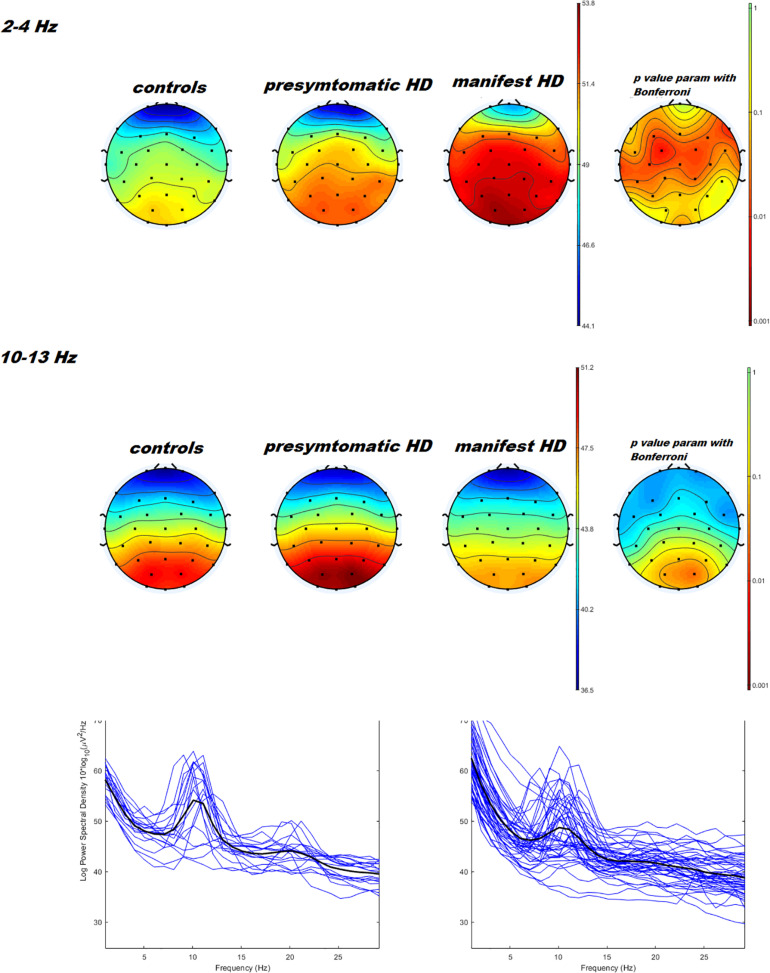
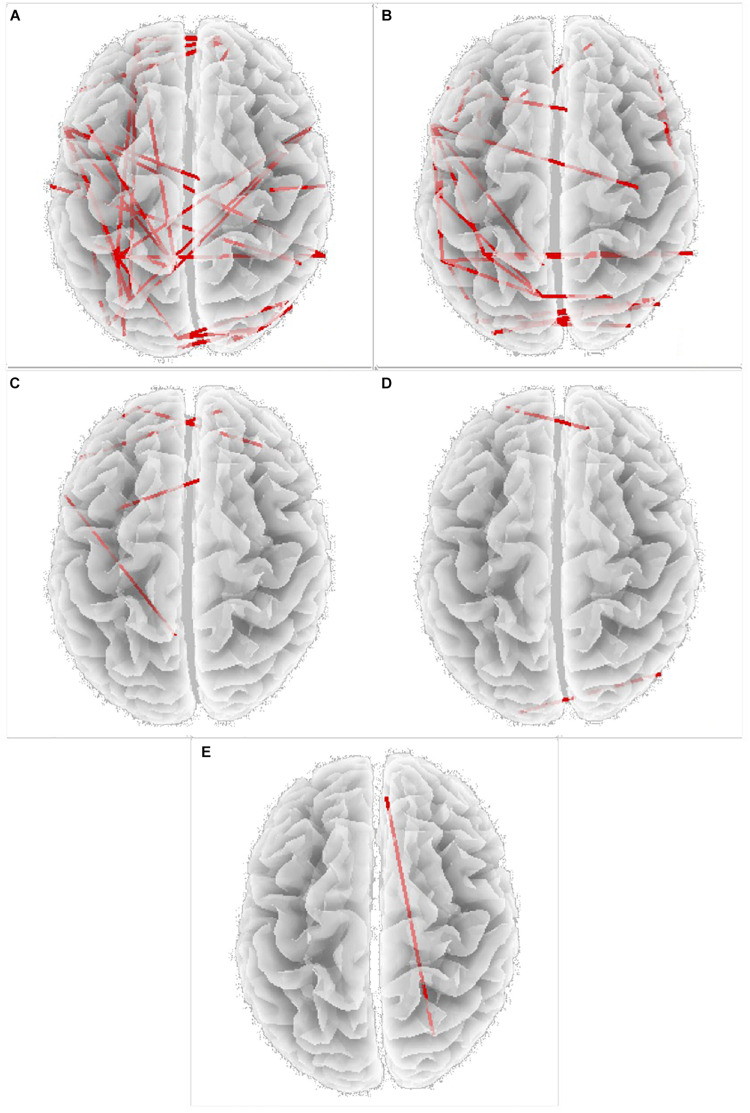
HD patients showed a Power Spectral Density reduced in the alpha range and increased in delta band compared to controls; no difference was detectable between pHD and mHD; the Global Connectivity in pHD revealed no significant differences if compared to mHD. The Current Source Density was similar among groups. No statistically significant results when comparing pHD with C group, even in comparison of mHD with Controls, and pHD with mHD. mHD compared to Controls showed a significant increase in delta, alpha1, alpha2, beta2, and beta3. Lagged Phase Synchronization in delta, alpha1, alpha2, beta2, and beta3 bands was increased in HD compared to controls ( = -3.921, < 0.05). A significant correlation was found in Regression Analysis: statistically significant results in pHD for the "Symbol Digit Modality Test and lagged phase synchronization" in the Beta1 ( = -0.806, < 0.05) in the prefrontal regions. The same correlation was found in mHD for the Stroop Word Reading Test (SWRT) in the Alpha2 band ( = -0.759, < 0.05).
Increased phase synchronization in main bands characterized EEG in HD patients, as compared to controls. pHD were not dissimilar from mHD as regard to this EEG pattern. Increased phase synchronization correlated to cognitive decline in HD patients, with a similar trend in pHD, suggesting that it would be a potential biomarker of early phenotypical expression.
科学文献中关于脑电图(EEG)功能连接及其与前驱期和显性亨廷顿舞蹈病(HD)临床及认知特征的相关性数据不足。
本研究试图确定在“大脑静息状态”下HD患者功能连接的异常EEG模式,以及其与前驱期和显性期HD患者运动功能衰退和认知变量的相关性,寻找一种可靠的测量疾病进展的标志物。
这是一项观察性横断面研究;105名年龄≥18岁的受试者接受了HD基因检测。每位受试者均接受了神经、精神和认知评估、EEG记录以及用于检测CAG性状扩增的基因调查。通过精确低分辨率脑电断层扫描(eLORETA)对18名前驱期HD(pHD)患者、49名显性期HD(mHD)患者和38名对照(C)受试者进行EEG连接性分析。
与对照组相比,HD患者在α频段的功率谱密度降低,在δ频段升高;pHD和mHD之间未检测到差异;与mHD相比,pHD的全局连接性无显著差异。各组间的电流源密度相似。比较pHD与C组、mHD与对照组以及pHD与mHD时,均未得出具有统计学意义的结果。与对照组相比,mHD在δ、α1、α2、β2和β3频段显著增加。与对照组相比,HD患者在δ、α1、α2、β2和β3频段的滞后相位同步增加(=-3.921,<0.05)。回归分析发现显著相关性:在前额叶区域,pHD中“符号数字模态测试与滞后相位同步”在β1频段具有统计学意义(=-0.806,<0.05)。在mHD中,α2频段的斯特鲁普单词阅读测试(SWRT)也发现了相同的相关性(=-0.759,<0.05)。
与对照组相比,HD患者EEG的主要频段相位同步增加。就这种EEG模式而言,pHD与mHD并无差异。HD患者相位同步增加与认知衰退相关,pHD也有类似趋势,提示其可能是早期表型表达的潜在生物标志物。