Facchin Federica, Leone Daniela, Tamanza Giancarlo, Costa Mauro, Sulpizio Patrizia, Canzi Elena, Vegni Elena
Department of Psychology, Università Cattolica del Sacro Cuore, Milan, Italy.
Unit of Clinical Psychology, San Paolo University Hospital, Asst-Santi Paolo e Carlo, Milan, Italy.
Front Psychol. 2020 Dec 17;11:586873. doi: 10.3389/fpsyg.2020.586873. eCollection 2020.
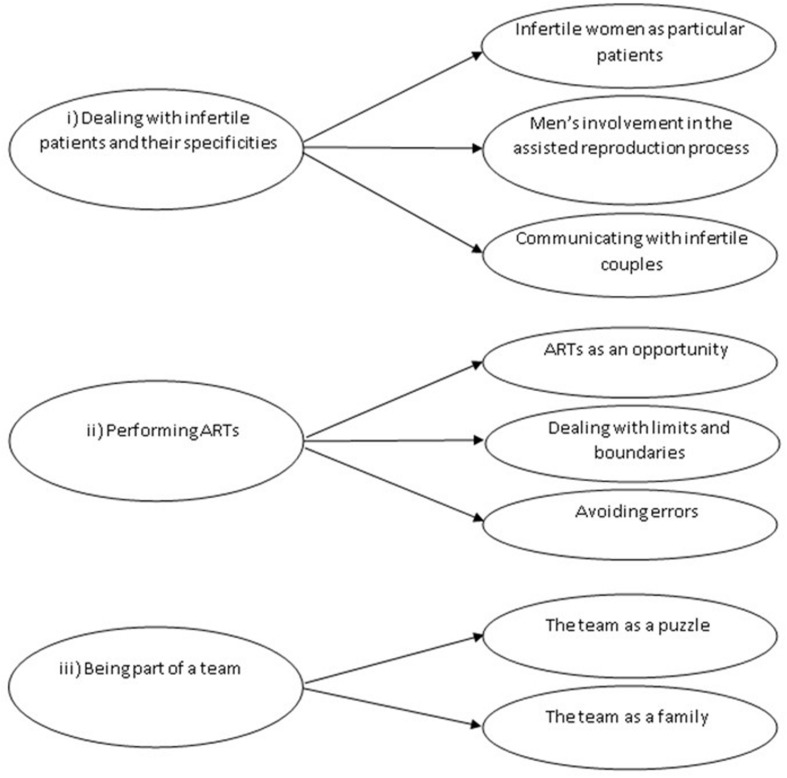
Although most studies investigated the impact of infertility and its treatment on the couple, a small body of evidence suggested that infertility care providers may experience different sources of stress related for instance to excessive workload, the complexity of the technique, and relational difficulties with patients. The current study aimed at providing further insight into the understanding of the subjective experience of infertility care providers by highlighting their feelings and emotions, personal meanings, challenges, and opportunities. Following the methodological guidelines of Interpretative Phenomenological Analysis, we conducted individual semi-structured interviews with 23 members of two different fertility units. Interviews were audiotaped and transcribed verbatim. Textual analysis was then conducted to identify emerging dominant themes and subthemes. Three main themes were extracted: (i) , (ii) , (iii) . These themes related to participants experiencing: (i) difficulties in establishing an empathic connection and communicating with couples, such that women were sometimes perceived as "particular patients" and men as poorly involved in the process; (ii) difficulties in dealing with a complex procedure in which errors are not allowed (as reported by embryologists), with a growing number of women aged > 40 seeking assisted reproduction, despite the risks for their health; (iii) being part of a team as a resource, although the huge amount of time spent together can involve conflicts and organizational problems. These findings suggested that patients' overpersistence (rather than just dropout) represents an important source of stress for infertility care providers. At the same time, the concept of particular or difficult patient derives from the combination of multiple factors, including providers' own history and subjective experience. The presence of mental health professionals in fertility units is essential to help providers improve the quality of doctor-patient communication and relieve the stress related to organizational issues and conflicts.
尽管大多数研究调查了不孕症及其治疗对夫妻的影响,但一小部分证据表明,不孕症护理提供者可能会经历不同的压力源,例如工作量过大、技术复杂性以及与患者的关系困难。本研究旨在通过突出不孕症护理提供者的感受和情绪、个人意义、挑战和机遇,进一步深入了解他们的主观体验。遵循解释性现象学分析的方法指南,我们对两个不同生育单位的23名成员进行了个人半结构化访谈。访谈进行了录音并逐字转录。然后进行文本分析以确定新出现的主导主题和子主题。提取了三个主要主题:(i) ,(ii) ,(iii) 。这些主题与参与者所经历的情况有关:(i)在与夫妻建立共情联系和沟通方面存在困难,以至于有时女性被视为“特殊患者”,而男性在这个过程中的参与度较低;(ii)在处理不允许出错的复杂程序时存在困难(胚胎学家报告),尽管健康存在风险,但40岁以上寻求辅助生殖的女性数量不断增加;(iii)作为团队的一员是一种资源,尽管在一起花费的大量时间可能会引发冲突和组织问题。这些发现表明,患者的过度坚持(而不仅仅是退出)是不孕症护理提供者压力的一个重要来源。同时,特殊或困难患者的概念源于多种因素的综合,包括提供者自身的经历和主观体验。生育单位配备心理健康专业人员对于帮助提供者提高医患沟通质量以及缓解与组织问题和冲突相关的压力至关重要。