Clark A E, Biffi B, Sivera R, Dall'Asta A, Fessey L, Wong T-L, Paramasivam G, Dunaway D, Schievano S, Lees C C
Queen Charlotte's and Chelsea Hospital, Imperial Healthcare NHS Trust, London, UK.
Imperial College London, London, UK.
R Soc Open Sci. 2020 Nov 25;7(11):201342. doi: 10.1098/rsos.201342. eCollection 2020 Nov.
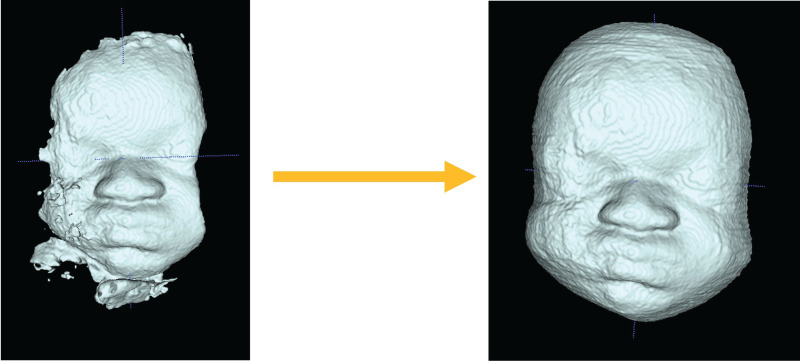
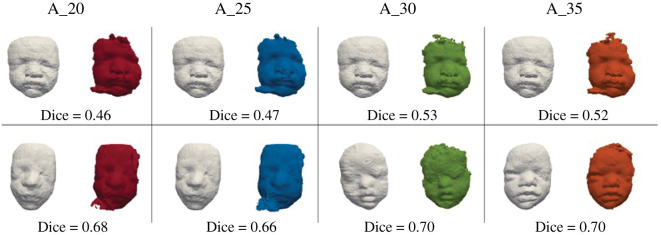
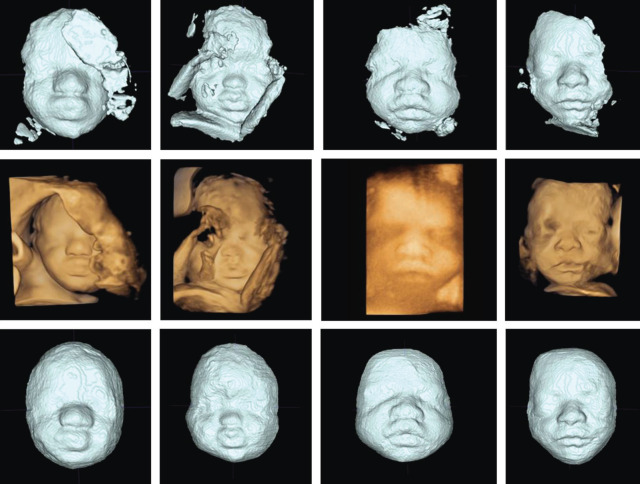
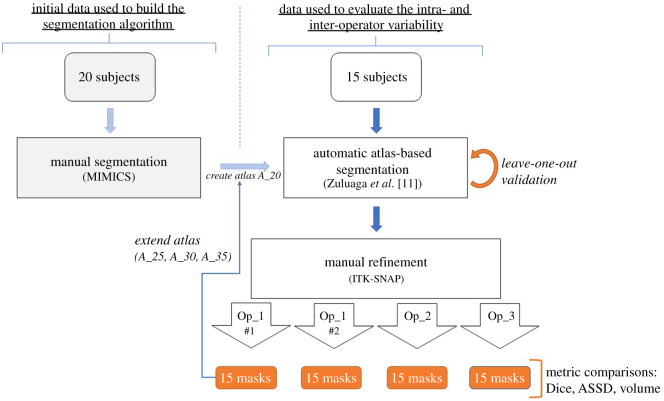
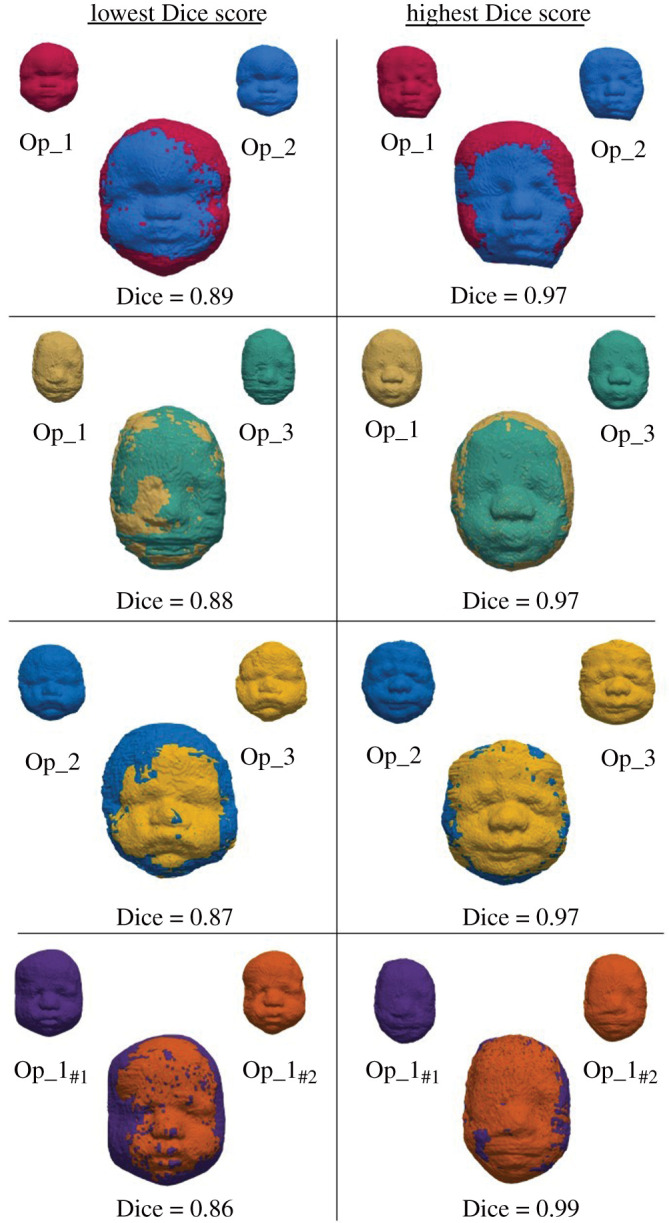
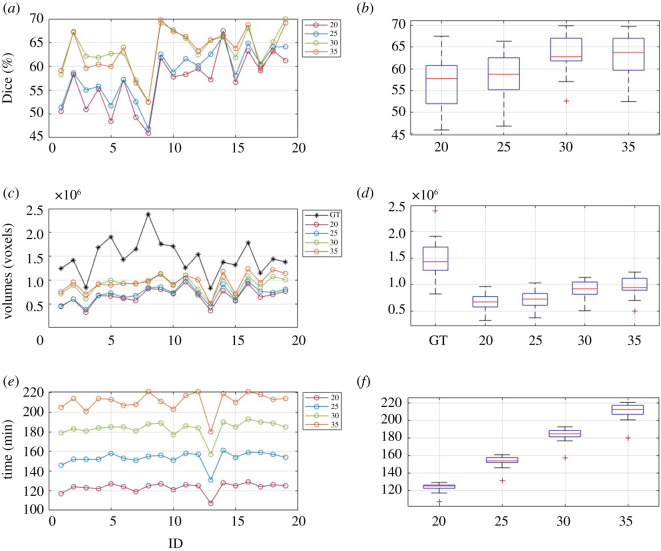
Fetal craniofacial abnormalities are challenging to detect and diagnose on prenatal ultrasound (US). Image segmentation and computer analysis of three-dimensional US volumes of the fetal face may provide an objective measure to quantify fetal facial features and identify abnormalities. We have developed and tested an atlas-based partially automated facial segmentation algorithm; however, the volumes require additional manual segmentation (MS), which is time and labour intensive and may preclude this method from clinical adoption. These manually refined segmentations can then be used as a reference (atlas) by the partially automated segmentation algorithm to improve algorithmic performance with the aim of eliminating the need for manual refinement and developing a fully automated system. This study assesses the inter- and intra-operator variability of MS and tests an optimized version of our automatic segmentation (AS) algorithm. The manual refinements of 15 fetal faces performed by three operators and repeated by one operator were assessed by Dice score, average symmetrical surface distance and volume difference. The performance of the partially automatic algorithm with difference size atlases was evaluated by Dice score and computational time. Assessment of the manual refinements showed low inter- and intra-operator variability demonstrating its suitability for optimizing the AS algorithm. The algorithm showed improved performance following an increase in the atlas size in turn reducing the need for manual refinement.
胎儿颅面部异常在产前超声检查中难以检测和诊断。对胎儿面部的三维超声容积进行图像分割和计算机分析,可能提供一种客观的方法来量化胎儿面部特征并识别异常。我们已经开发并测试了一种基于图谱的部分自动化面部分割算法;然而,这些容积需要额外的手动分割,这既耗时又费力,可能会阻碍该方法在临床上的应用。然后,这些经过手动优化的分割可以被部分自动化分割算法用作参考(图谱),以提高算法性能,目标是消除对手动优化的需求并开发出一个完全自动化的系统。本研究评估了手动分割的操作者间和操作者内变异性,并测试了我们自动分割(AS)算法的优化版本。通过Dice系数、平均对称表面距离和容积差异,评估了由三名操作者进行的15例胎儿面部手动优化以及一名操作者重复操作的情况。通过Dice系数和计算时间评估了使用不同大小图谱的部分自动算法的性能。对手动优化的评估显示操作者间和操作者内变异性较低,表明其适用于优化AS算法。随着图谱大小的增加,该算法性能有所改善,进而减少了对手动优化的需求。