Department of Magnetic Resonance Imaging, Qinhuangdao Municipal No. 1 Hospital, Qinhuangdao, People's Republic of China.
State Grid Information & Telecommunication Group Co., Ltd., Beijing, People's Republic of China.
Arch Gynecol Obstet. 2021 Mar;303(3):811-820. doi: 10.1007/s00404-020-05908-5. Epub 2021 Jan 4.
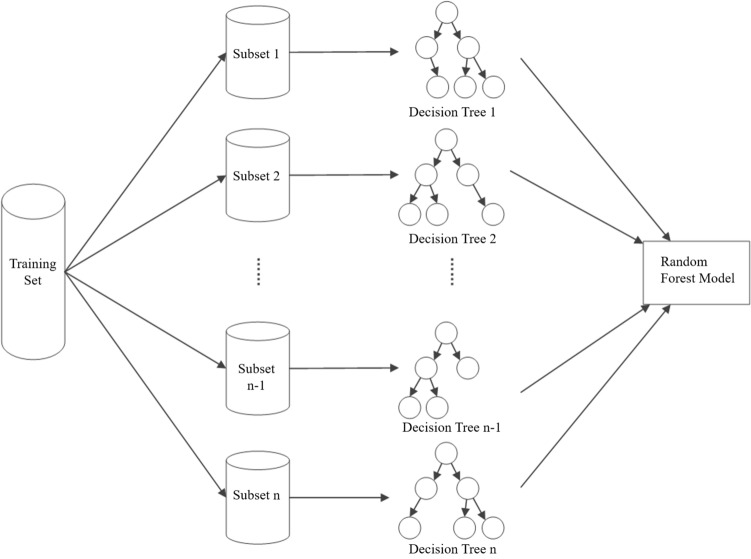
Our objective was to establish a random forest model and to evaluate its predictive capability of the treatment effect of neoadjuvant chemotherapy-radiation therapy.
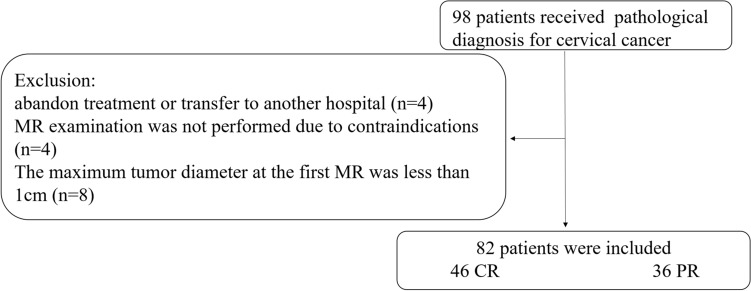
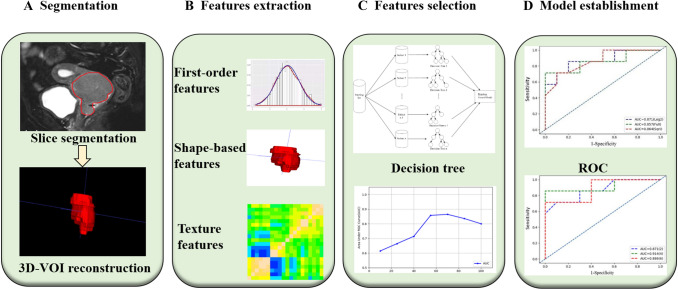
This retrospective study included 82 patients with locally advanced cervical cancer who underwent scanning from March 2013 to May 2018. The random forest model was established and optimised based on the open source toolkit scikit-learn. Byoptimising of the number of decision trees in the random forest, the criteria for selecting the final partition index and the minimum number of samples partitioned by each node, the performance of random forest in the prediction of the treatment effect of neoadjuvant chemotherapy-radiation therapy on advanced cervical cancer (> IIb) was evaluated.
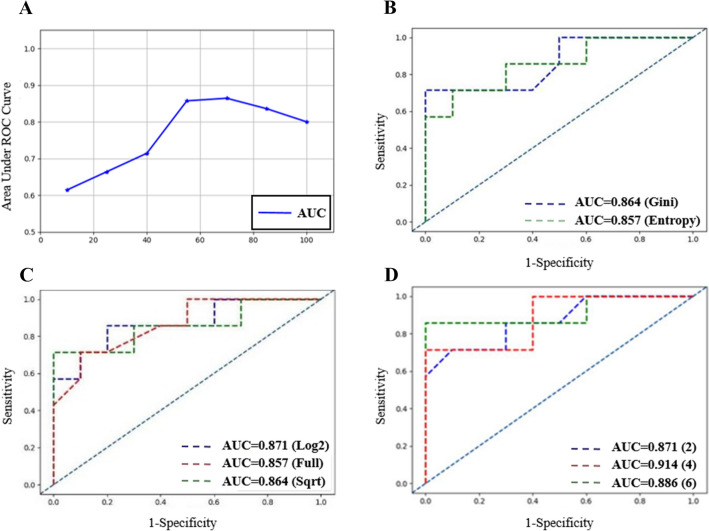
The number of decision trees in the random forests influenced the model performance. When the number of decision trees was set to 10, 25, 40, 55, 70, 85 and 100, the performance of random forest model exhibited an increasing trend first and then a decreasing one. The criteria for the selection of final partition index showed significant effects on the generation of decision trees. The Gini index demonstrated a better effect compared with information gain index. The area under the receiver operating curve for Gini index attained a value of 0.917.
The random forest model showed potential in predicting the treatment effect of neoadjuvant chemotherapy-radiation therapy based on high-resolution T2WIs for advanced cervical cancer (> IIb).
本研究旨在建立一个随机森林模型,并评估其预测新辅助化疗-放疗治疗效果的能力。
本回顾性研究纳入了 82 例局部晚期宫颈癌患者,这些患者于 2013 年 3 月至 2018 年 5 月接受了扫描。随机森林模型是基于开源工具包 scikit-learn 建立和优化的。通过优化随机森林中的决策树数量、选择最终分区指标的标准以及每个节点划分的最小样本数,评估随机森林在预测新辅助化疗-放疗治疗局部晚期宫颈癌(>IIb)的疗效中的性能。
随机森林中的决策树数量影响模型性能。当决策树数量设置为 10、25、40、55、70、85 和 100 时,随机森林模型的性能表现为先增加后减少的趋势。最终分区指标的选择标准对决策树的生成有显著影响。基尼指数与信息增益指数相比,效果更好。基尼指数的受试者工作特征曲线下面积达到 0.917。
基于高分辨率 T2WI,随机森林模型在预测局部晚期宫颈癌(>IIb)新辅助化疗-放疗治疗效果方面具有潜力。