• 文献检索
  • 文档翻译
  • 深度研究
  • 学术资讯
  • Suppr Zotero 插件Zotero 插件
  • 邀请有礼
  • 套餐&价格
  • 历史记录
应用&插件
Suppr Zotero 插件Zotero 插件浏览器插件Mac 客户端Windows 客户端微信小程序
定价
高级版会员购买积分包购买API积分包
服务
文献检索文档翻译深度研究API 文档MCP 服务
关于我们
关于 Suppr公司介绍联系我们用户协议隐私条款
关注我们

Suppr 超能文献

核心技术专利:CN118964589B侵权必究
粤ICP备2023148730 号-1Suppr @ 2026

文献检索

告别复杂PubMed语法,用中文像聊天一样搜索,搜遍4000万医学文献。AI智能推荐,让科研检索更轻松。

立即免费搜索

文件翻译

保留排版,准确专业,支持PDF/Word/PPT等文件格式,支持 12+语言互译。

免费翻译文档

深度研究

AI帮你快速写综述,25分钟生成高质量综述,智能提取关键信息,辅助科研写作。

立即免费体验

唾液成分和病毒传感器在 COVID-19 和传染病预防中的应用研究。

Survey of Saliva Components and Virus Sensors for Prevention of COVID-19 and Infectious Diseases.

机构信息

Networking Research Laboratory, Department of Electrical and Computer Engineering, New Jersey Institute of Technology, NJ 07102, USA.

Department of Electrical and Computer Engineering, New York Institute of Technology, New York, NY 10023, USA.

出版信息

Biosensors (Basel). 2020 Dec 31;11(1):14. doi: 10.3390/bios11010014.

DOI:10.3390/bios11010014
PMID:33396519
原文链接:https://pmc.ncbi.nlm.nih.gov/articles/PMC7824170/
Abstract

The United States Centers for Disease Control and Prevention considers saliva contact the lead transmission means of severe acute respiratory syndrome coronavirus 2 (SARS-CoV-2), which causes the coronavirus disease 2019 (COVID-19). Saliva droplets or aerosols expelled by heavy breathing, talking, sneezing, and coughing may carry this virus. People in close distance may be exposed directly or indirectly to these droplets, especially those droplets that fall on surrounding surfaces and people may end up contracting COVID-19 after touching the mucosa tissue on their faces. It is of great interest to quickly and effectively detect the presence of SARS-CoV-2 in an environment, but the existing methods only work in laboratory settings, to the best of our knowledge. However, it may be possible to detect the presence of saliva in the environment and proceed with prevention measures. However, detecting saliva itself has not been documented in the literature. On the other hand, many sensors that detect different organic components in saliva to monitor a person's health and diagnose different diseases that range from diabetes to dental health have been proposed and they may be used to detect the presence of saliva. This paper surveys sensors that detect organic and inorganic components of human saliva. Humidity sensors are also considered in the detection of saliva because a large portion of saliva is water. Moreover, sensors that detect infectious viruses are also included as they may also be embedded into saliva sensors for a confirmation of the virus' presence. A classification of sensors by their working principle and the substance they detect is presented. This comparison lists their specifications, sample size, and sensitivity. Indications of which sensors are portable and suitable for field application are presented. This paper also discusses future research and challenges that must be resolved to realize practical saliva sensors. Such sensors may help minimize the spread of not only COVID-19 but also other infectious diseases.

摘要

美国疾病控制与预防中心认为,唾液接触是严重急性呼吸系统综合征冠状病毒 2(SARS-CoV-2)的主要传播途径,该病毒可导致 2019 年冠状病毒病(COVID-19)。剧烈呼吸、说话、打喷嚏和咳嗽时呼出的唾液飞沫或气溶胶可能携带这种病毒。近距离的人可能会直接或间接暴露于这些飞沫中,尤其是落在周围表面的飞沫,人们在触摸面部黏膜组织后可能会感染 COVID-19。快速有效地检测环境中 SARS-CoV-2 的存在具有重要意义,但据我们所知,现有的方法仅在实验室环境中有效。然而,有可能检测环境中唾液的存在并采取预防措施。但是,在文献中尚未记录到检测唾液本身的方法。另一方面,已经提出了许多用于检测唾液中不同有机成分以监测人体健康和诊断从糖尿病到口腔健康等不同疾病的传感器,它们可能用于检测唾液的存在。本文调查了用于检测人唾液中有机和无机成分的传感器。由于唾液的大部分成分是水,因此也考虑了湿度传感器在唾液检测中的应用。此外,还包括了用于检测传染性病毒的传感器,因为它们也可能嵌入到唾液传感器中以确认病毒的存在。本文按工作原理和检测物质对传感器进行了分类。列出了它们的规格、样本量和灵敏度。还展示了哪些传感器是便携式的,适合现场应用的指示。本文还讨论了未来研究和必须解决的挑战,以实现实用的唾液传感器。这些传感器不仅有助于减少 COVID-19 等传染病的传播,还可能有助于减少其他传染病的传播。
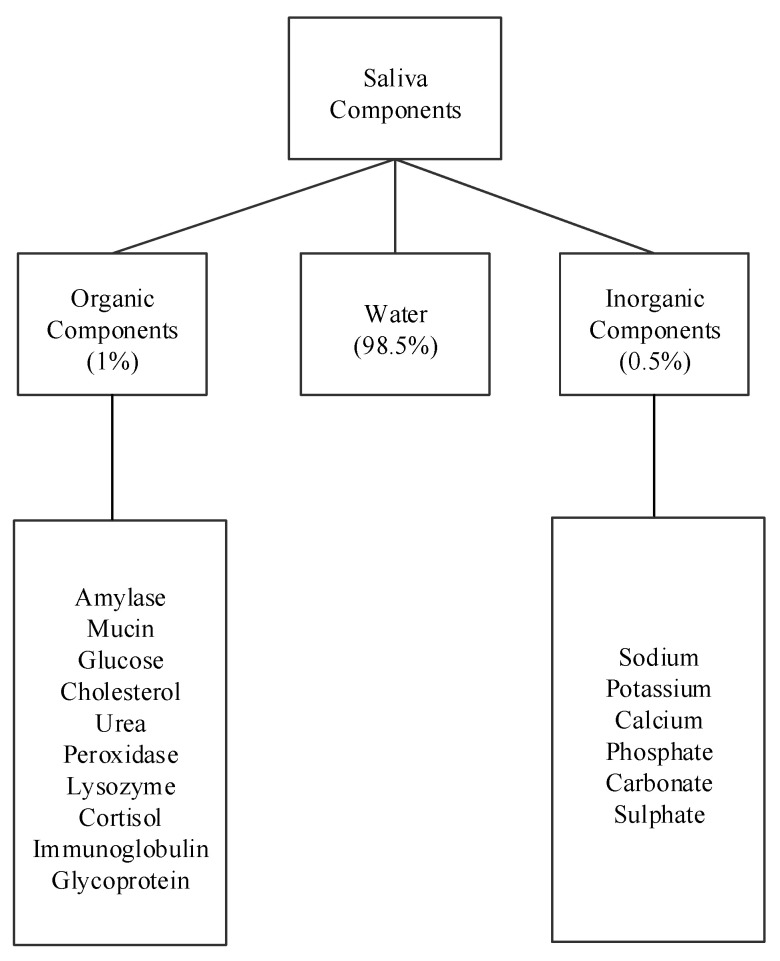
https://cdn.ncbi.nlm.nih.gov/pmc/blobs/1247/7824170/6f52ad427913/biosensors-11-00014-g025.jpg
https://cdn.ncbi.nlm.nih.gov/pmc/blobs/1247/7824170/b85ceaf5852e/biosensors-11-00014-g001.jpg
https://cdn.ncbi.nlm.nih.gov/pmc/blobs/1247/7824170/12b93108fec3/biosensors-11-00014-g002.jpg
https://cdn.ncbi.nlm.nih.gov/pmc/blobs/1247/7824170/addc8a830730/biosensors-11-00014-g003.jpg
https://cdn.ncbi.nlm.nih.gov/pmc/blobs/1247/7824170/5c5e63bc2292/biosensors-11-00014-g004.jpg
https://cdn.ncbi.nlm.nih.gov/pmc/blobs/1247/7824170/67a0bb4cf827/biosensors-11-00014-g005.jpg
https://cdn.ncbi.nlm.nih.gov/pmc/blobs/1247/7824170/ae709694302c/biosensors-11-00014-g006.jpg
https://cdn.ncbi.nlm.nih.gov/pmc/blobs/1247/7824170/2442b6866d3c/biosensors-11-00014-g007.jpg
https://cdn.ncbi.nlm.nih.gov/pmc/blobs/1247/7824170/eb1de1d32267/biosensors-11-00014-g008.jpg
https://cdn.ncbi.nlm.nih.gov/pmc/blobs/1247/7824170/88669ae31ebf/biosensors-11-00014-g009.jpg
https://cdn.ncbi.nlm.nih.gov/pmc/blobs/1247/7824170/5f304578d9bb/biosensors-11-00014-g010.jpg
https://cdn.ncbi.nlm.nih.gov/pmc/blobs/1247/7824170/ab9e664e1c30/biosensors-11-00014-g011.jpg
https://cdn.ncbi.nlm.nih.gov/pmc/blobs/1247/7824170/9759f1278613/biosensors-11-00014-g012.jpg
https://cdn.ncbi.nlm.nih.gov/pmc/blobs/1247/7824170/f86f15513615/biosensors-11-00014-g013.jpg
https://cdn.ncbi.nlm.nih.gov/pmc/blobs/1247/7824170/21d7e2950742/biosensors-11-00014-g014.jpg
https://cdn.ncbi.nlm.nih.gov/pmc/blobs/1247/7824170/e97b599f3c32/biosensors-11-00014-g015.jpg
https://cdn.ncbi.nlm.nih.gov/pmc/blobs/1247/7824170/506346ad7e1a/biosensors-11-00014-g016.jpg
https://cdn.ncbi.nlm.nih.gov/pmc/blobs/1247/7824170/d6fda21f51f7/biosensors-11-00014-g017.jpg
https://cdn.ncbi.nlm.nih.gov/pmc/blobs/1247/7824170/05babb25affe/biosensors-11-00014-g018.jpg
https://cdn.ncbi.nlm.nih.gov/pmc/blobs/1247/7824170/6b306209f198/biosensors-11-00014-g019.jpg
https://cdn.ncbi.nlm.nih.gov/pmc/blobs/1247/7824170/4af137819dba/biosensors-11-00014-g020.jpg
https://cdn.ncbi.nlm.nih.gov/pmc/blobs/1247/7824170/678722640d3f/biosensors-11-00014-g021.jpg
https://cdn.ncbi.nlm.nih.gov/pmc/blobs/1247/7824170/1ea26097b942/biosensors-11-00014-g022.jpg
https://cdn.ncbi.nlm.nih.gov/pmc/blobs/1247/7824170/902ac7eca671/biosensors-11-00014-g023.jpg
https://cdn.ncbi.nlm.nih.gov/pmc/blobs/1247/7824170/76acd5472a75/biosensors-11-00014-g024.jpg
https://cdn.ncbi.nlm.nih.gov/pmc/blobs/1247/7824170/6f52ad427913/biosensors-11-00014-g025.jpg
https://cdn.ncbi.nlm.nih.gov/pmc/blobs/1247/7824170/b85ceaf5852e/biosensors-11-00014-g001.jpg
https://cdn.ncbi.nlm.nih.gov/pmc/blobs/1247/7824170/12b93108fec3/biosensors-11-00014-g002.jpg
https://cdn.ncbi.nlm.nih.gov/pmc/blobs/1247/7824170/addc8a830730/biosensors-11-00014-g003.jpg
https://cdn.ncbi.nlm.nih.gov/pmc/blobs/1247/7824170/5c5e63bc2292/biosensors-11-00014-g004.jpg
https://cdn.ncbi.nlm.nih.gov/pmc/blobs/1247/7824170/67a0bb4cf827/biosensors-11-00014-g005.jpg
https://cdn.ncbi.nlm.nih.gov/pmc/blobs/1247/7824170/ae709694302c/biosensors-11-00014-g006.jpg
https://cdn.ncbi.nlm.nih.gov/pmc/blobs/1247/7824170/2442b6866d3c/biosensors-11-00014-g007.jpg
https://cdn.ncbi.nlm.nih.gov/pmc/blobs/1247/7824170/eb1de1d32267/biosensors-11-00014-g008.jpg
https://cdn.ncbi.nlm.nih.gov/pmc/blobs/1247/7824170/88669ae31ebf/biosensors-11-00014-g009.jpg
https://cdn.ncbi.nlm.nih.gov/pmc/blobs/1247/7824170/5f304578d9bb/biosensors-11-00014-g010.jpg
https://cdn.ncbi.nlm.nih.gov/pmc/blobs/1247/7824170/ab9e664e1c30/biosensors-11-00014-g011.jpg
https://cdn.ncbi.nlm.nih.gov/pmc/blobs/1247/7824170/9759f1278613/biosensors-11-00014-g012.jpg
https://cdn.ncbi.nlm.nih.gov/pmc/blobs/1247/7824170/f86f15513615/biosensors-11-00014-g013.jpg
https://cdn.ncbi.nlm.nih.gov/pmc/blobs/1247/7824170/21d7e2950742/biosensors-11-00014-g014.jpg
https://cdn.ncbi.nlm.nih.gov/pmc/blobs/1247/7824170/e97b599f3c32/biosensors-11-00014-g015.jpg
https://cdn.ncbi.nlm.nih.gov/pmc/blobs/1247/7824170/506346ad7e1a/biosensors-11-00014-g016.jpg
https://cdn.ncbi.nlm.nih.gov/pmc/blobs/1247/7824170/d6fda21f51f7/biosensors-11-00014-g017.jpg
https://cdn.ncbi.nlm.nih.gov/pmc/blobs/1247/7824170/05babb25affe/biosensors-11-00014-g018.jpg
https://cdn.ncbi.nlm.nih.gov/pmc/blobs/1247/7824170/6b306209f198/biosensors-11-00014-g019.jpg
https://cdn.ncbi.nlm.nih.gov/pmc/blobs/1247/7824170/4af137819dba/biosensors-11-00014-g020.jpg
https://cdn.ncbi.nlm.nih.gov/pmc/blobs/1247/7824170/678722640d3f/biosensors-11-00014-g021.jpg
https://cdn.ncbi.nlm.nih.gov/pmc/blobs/1247/7824170/1ea26097b942/biosensors-11-00014-g022.jpg
https://cdn.ncbi.nlm.nih.gov/pmc/blobs/1247/7824170/902ac7eca671/biosensors-11-00014-g023.jpg
https://cdn.ncbi.nlm.nih.gov/pmc/blobs/1247/7824170/76acd5472a75/biosensors-11-00014-g024.jpg
https://cdn.ncbi.nlm.nih.gov/pmc/blobs/1247/7824170/6f52ad427913/biosensors-11-00014-g025.jpg

相似文献

1
Survey of Saliva Components and Virus Sensors for Prevention of COVID-19 and Infectious Diseases.唾液成分和病毒传感器在 COVID-19 和传染病预防中的应用研究。
Biosensors (Basel). 2020 Dec 31;11(1):14. doi: 10.3390/bios11010014.
2
Heterogeneity in transmissibility and shedding SARS-CoV-2 via droplets and aerosols.飞沫和气溶胶传播 SARS-CoV-2 的传染性和脱落的异质性。
Elife. 2021 Apr 16;10:e65774. doi: 10.7554/eLife.65774.
3
Monitoring COVID-19 Transmission Risks by Quantitative Real-Time PCR Tracing of Droplets in Hospital and Living Environments.通过对医院和生活环境中飞沫进行定量实时 PCR 追踪监测 COVID-19 传播风险。
mSphere. 2021 Jan 6;6(1):e01070-20. doi: 10.1128/mSphere.01070-20.
4
Transmission risk of viruses in large mucosalivary droplets on the surface of objects: A time-based analysis.物体表面大黏液飞沫中的病毒传播风险:基于时间的分析。
Infect Dis Now. 2021 May;51(3):219-227. doi: 10.1016/j.idnow.2020.11.001. Epub 2020 Dec 30.
5
Seasonal influenza viruses decay more rapidly at intermediate humidity in droplets containing saliva compared to respiratory mucus.与呼吸道黏液相比,含唾液的飞沫中的季节性流感病毒在中等湿度下更快衰减。
Appl Environ Microbiol. 2024 Feb 21;90(2):e0201023. doi: 10.1128/aem.02010-23. Epub 2024 Jan 9.
6
Saliva is a non-negligible factor in the spread of COVID-19.唾液是 COVID-19 传播中不可忽视的因素。
Mol Oral Microbiol. 2020 Aug;35(4):141-145. doi: 10.1111/omi.12289. Epub 2020 May 31.
7
Effectiveness and cost-effectiveness of four different strategies for SARS-CoV-2 surveillance in the general population (CoV-Surv Study): a structured summary of a study protocol for a cluster-randomised, two-factorial controlled trial.在普通人群中进行 SARS-CoV-2 监测的四种不同策略的有效性和成本效益(CoV-Surv 研究):一项关于集群随机、双因素对照试验的研究方案的结构化总结。
Trials. 2021 Jan 8;22(1):39. doi: 10.1186/s13063-020-04982-z.
8
RNase in the saliva can affect the detection of severe acute respiratory syndrome coronavirus 2 by real-time one-step polymerase chain reaction using saliva samples.唾液中的核糖核酸酶会影响实时一步聚合酶链反应检测唾液样本中的严重急性呼吸综合征冠状病毒 2。
Pathol Res Pract. 2021 Apr;220:153381. doi: 10.1016/j.prp.2021.153381. Epub 2021 Feb 16.
9
Effect of saliva fluid properties on pathogen transmissibility.唾液流体特性对病原体传播性的影响。
Sci Rep. 2021 Aug 6;11(1):16051. doi: 10.1038/s41598-021-95559-6.
10
Saliva detection of SARS-CoV-2 for mitigating company outbreaks: a surveillance experience, Milan, Italy, March 2021.唾液中 SARS-CoV-2 的检测可减少公司疫情爆发:意大利米兰 2021 年 3 月的监测经验。
Epidemiol Infect. 2021 Jul 30;149:e171. doi: 10.1017/S0950268821001473.

引用本文的文献

1
Salivary biomarkers in diabetes mellitus diagnostics: A bibliometric analysis.糖尿病诊断中的唾液生物标志物:文献计量分析
Medicine (Baltimore). 2025 Aug 8;104(32):e43760. doi: 10.1097/MD.0000000000043760.
2
Saliva as a Diagnostic Tool for Systemic Diseases-A Narrative Review.唾液作为全身性疾病的诊断工具——一篇叙述性综述。
Medicina (Kaunas). 2025 Jan 30;61(2):243. doi: 10.3390/medicina61020243.
3
Reusable Biosensor for Easy RNA Detection from Unfiltered Saliva.用于从未过滤唾液中轻松检测RNA的可重复使用生物传感器。

本文引用的文献

1
Survival of the enveloped bacteriophage Phi6 (a surrogate for SARS-CoV-2) in evaporated saliva microdroplets deposited on glass surfaces.在玻璃表面上沉积的蒸发唾液微滴中包膜噬菌体 Phi6(SARS-CoV-2 的替代物)的存活情况。
Sci Rep. 2020 Dec 29;10(1):22419. doi: 10.1038/s41598-020-79625-z.
2
COVID-19 Pandemic and Role of Human Saliva as a Testing Biofluid in Point-of-Care Technology.新冠疫情与人类唾液作为即时检测技术中检测生物流体的作用
Eur J Dent. 2020 Dec;14(S 01):S123-S129. doi: 10.1055/s-0040-1713020. Epub 2020 Jun 3.
3
Rapid Detection of COVID-19 Causative Virus (SARS-CoV-2) in Human Nasopharyngeal Swab Specimens Using Field-Effect Transistor-Based Biosensor.
Sensors (Basel). 2025 Jan 9;25(2):360. doi: 10.3390/s25020360.
4
Aggregation-Induced Emission Luminogen: Role in Biopsy for Precision Medicine.聚集诱导发光团:精准医疗活检中的作用。
Chem Rev. 2024 Oct 23;124(20):11242-11347. doi: 10.1021/acs.chemrev.4c00244. Epub 2024 Oct 8.
5
Flexible Label-Free Platinum and Bio-PET-Based Immunosensor for the Detection of SARS-CoV-2.基于生物-PET 的灵活无标记铂免疫传感器用于检测 SARS-CoV-2。
Biosensors (Basel). 2023 Jan 26;13(2):190. doi: 10.3390/bios13020190.
6
Point-of-Care Diagnostic Biosensors to Monitor Anti-SARS-CoV-2 Neutralizing IgG/sIgA Antibodies and Antioxidant Activity in Saliva.即时诊断生物传感器监测唾液中抗 SARS-CoV-2 中和 IgG/sIgA 抗体和抗氧化活性。
Biosensors (Basel). 2023 Jan 20;13(2):167. doi: 10.3390/bios13020167.
7
Biosensors based detection of novel biomarkers associated with COVID-19: Current progress and future promise.基于生物传感器检测与新型冠状病毒肺炎相关的新型生物标志物:当前进展与未来前景。
Biosens Bioelectron X. 2022 Dec;12:100281. doi: 10.1016/j.biosx.2022.100281. Epub 2022 Nov 14.
8
Can periodontal pockets and caries lesions act as reservoirs for coronavirus?牙周袋和龋齿病变是否可作为冠状病毒的储库?
Mol Oral Microbiol. 2022 Apr;37(2):77-80. doi: 10.1111/omi.12362. Epub 2022 Feb 4.
9
Optimization and Standardization of Human Saliva Collection for MALDI-TOF MS.用于基质辅助激光解吸电离飞行时间质谱的人唾液采集的优化与标准化
Diagnostics (Basel). 2021 Jul 21;11(8):1304. doi: 10.3390/diagnostics11081304.
基于场效应晶体管的生物传感器快速检测人鼻咽拭子标本中的 COVID-19 病原体(SARS-CoV-2)。
ACS Nano. 2020 Apr 28;14(4):5135-5142. doi: 10.1021/acsnano.0c02823. Epub 2020 Apr 20.
4
Dual-Functional Plasmonic Photothermal Biosensors for Highly Accurate Severe Acute Respiratory Syndrome Coronavirus 2 Detection.用于高精准度严重急性呼吸综合征冠状病毒 2 检测的双功能等离子体光热生物传感器。
ACS Nano. 2020 May 26;14(5):5268-5277. doi: 10.1021/acsnano.0c02439. Epub 2020 Apr 13.
5
Sensitive and non-invasive cholesterol determination in saliva via optimization of enzyme loading and platinum nano-cluster composition.通过优化酶加载量和铂纳米簇组成,实现唾液中敏感且非侵入性的胆固醇测定。
Analyst. 2020 Feb 3;145(3):908-916. doi: 10.1039/c9an01679a.
6
Influence of Sampling Conditions, Salivary Flow, and Total Protein Content in Uric Acid Measurements in Saliva.采样条件、唾液流量和唾液中尿酸测量时总蛋白含量的影响
Antioxidants (Basel). 2019 Sep 11;8(9):389. doi: 10.3390/antiox8090389.
7
Acoustofluidic Micromixing Enabled Hybrid Integrated Colorimetric Sensing, for Rapid Point-of-Care Measurement of Salivary Potassium.声流微混合助力混合集成比色传感,用于快速现场检测唾液钾。
Biosensors (Basel). 2019 May 28;9(2):73. doi: 10.3390/bios9020073.
8
An Alternative Medical Diagnosis Method: Biosensors for Virus Detection.一种替代医学诊断方法:病毒检测生物传感器。
Biosensors (Basel). 2019 May 21;9(2):65. doi: 10.3390/bios9020065.
9
Recent Advances in Graphene-Based Humidity Sensors.基于石墨烯的湿度传感器的最新进展。
Nanomaterials (Basel). 2019 Mar 12;9(3):422. doi: 10.3390/nano9030422.
10
An electrochemical immunosensor for the corona virus associated with the Middle East respiratory syndrome using an array of gold nanoparticle-modified carbon electrodes.一种基于金纳米粒子修饰碳电极阵列的用于中东呼吸综合征相关冠状病毒的电化学免疫传感器。
Mikrochim Acta. 2019 Mar 7;186(4):224. doi: 10.1007/s00604-019-3345-5.