Department of Medical, Surgical and Experimental Sciences, University of Sassari, Sassari, Italy.
Department of Medicine and Surgery, University of Parma, Parma, Italy.
mSphere. 2021 Jan 6;6(1):e01070-20. doi: 10.1128/mSphere.01070-20.
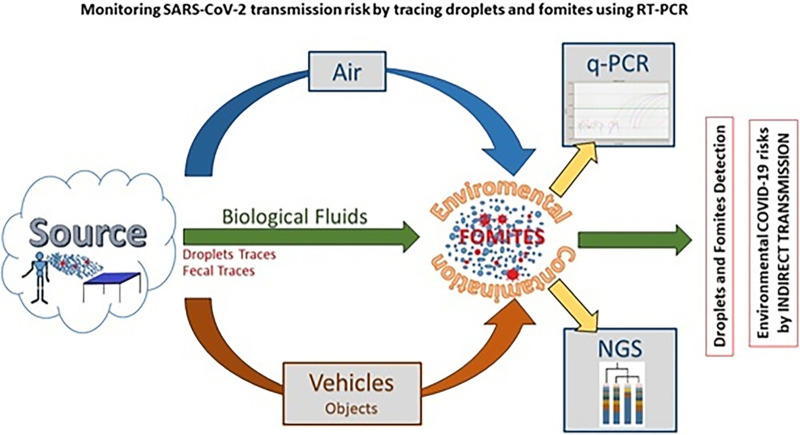
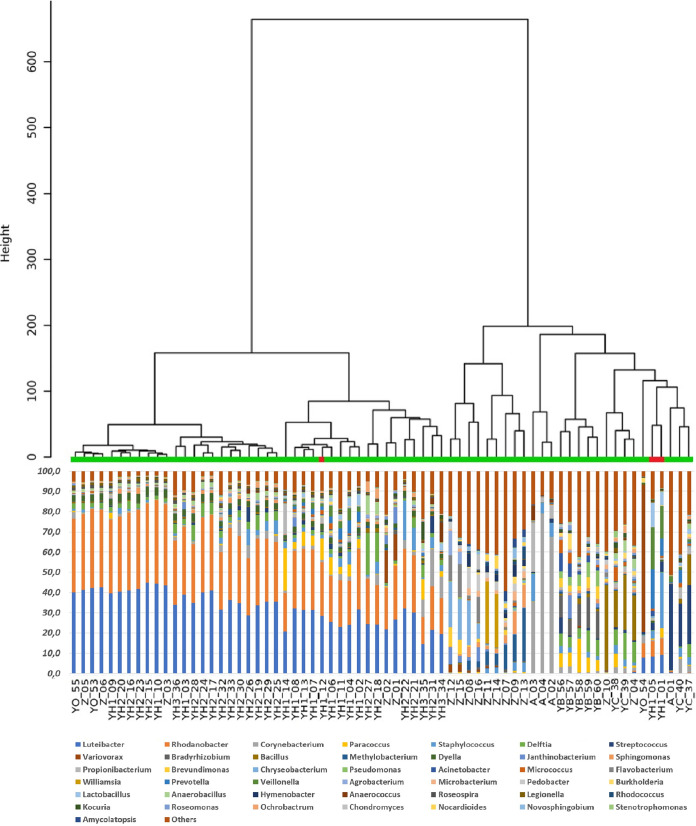
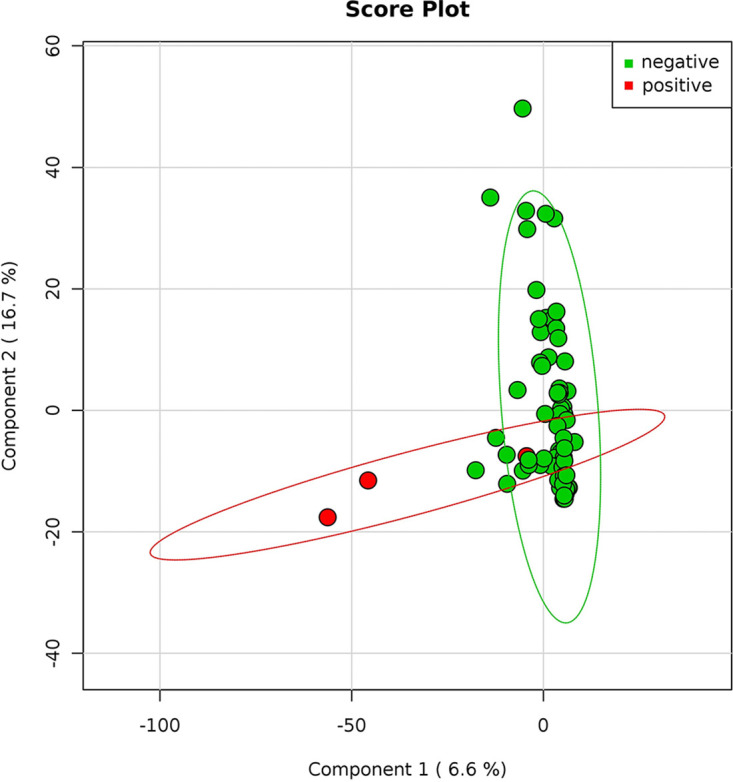
Severe acute respiratory syndrome coronavirus 2 (SARS-CoV-2) environmental contamination occurs through droplets and biological fluids released in the surroundings from patients or asymptomatic carriers. Surfaces and objects contaminated by saliva or nose secretions represent a risk for indirect transmission of coronavirus disease 2019 (COVID-19). We assayed surfaces from hospital and living spaces to identify the presence of viral RNA and the spread of fomites in the environment. Anthropic contamination by droplets and biological fluids was monitored by detecting the microbiota signature using multiplex quantitative real-time PCR (qPCR) on selected species and massive sequencing on 16S amplicons. A total of 92 samples (flocked swabs) were collected from critical areas during the pandemic, including indoor (three hospitals and three public buildings) and outdoor surfaces exposed to anthropic contamination (handles and handrails, playgrounds). Traces of biological fluids were frequently detected in spaces open to the public and on objects that are touched with the hands (>80%). However, viral RNA was not detected in hospital wards or other indoor and outdoor surfaces either in the air system of a COVID hospital but only in the surroundings of an infected patient, in consistent association with droplet traces and fomites. Handled objects accumulated the highest level of multiple contaminations by saliva, nose secretions, and fecal traces, further supporting the priority role of handwashing in prevention. In conclusion, anthropic contamination by droplets and biological fluids is widespread in spaces open to the public and can be traced by qPCR. Monitoring fomites can support evaluation of indirect transmission risks for coronavirus or other flu-like viruses in the environment. Several studies have evaluated the presence of SARS-CoV-2 in the environment. Saliva and nasopharyngeal droplets can land on objects and surfaces, creating fomites. A suitable indicator would allow the detection of droplets or biofluids carrying the virus. Therefore, we searched for viral RNA and droplets and fomites on at risk surfaces. We monitored by qPCR or next generation sequencing (NGS) droplets through their microbiota. Although the study was performed during the pandemic, SARS-CoV-2 was not significantly found on surfaces, with the only exception of environmental areas near infectious patients. Conversely, anthropic contamination was frequent, suggesting a role for biofluids as putative markers of indirect transmission and risk assessment. Moreover, all SARS-CoV-2-contaminated surfaces showed droplets' microbiota. Fomite monitoring by qPCR may have an impact on public health strategies, supporting prevention of indirect transmission similarly to what is done for other communicable diseases (e.g., influenza and influenza-like infections).
严重急性呼吸综合征冠状病毒 2 (SARS-CoV-2) 环境污染物是通过患者或无症状携带者在周围环境中释放的飞沫和生物体液传播的。被唾液或鼻分泌物污染的表面和物体代表了 2019 年冠状病毒病 (COVID-19) 间接传播的风险。我们对医院和生活空间的表面进行了检测,以确定病毒 RNA 的存在和环境中载体的传播。通过使用多重定量实时 PCR (qPCR) 对选定物种进行检测和对 16S 扩增子进行大规模测序,监测了飞沫和生物体液引起的人为污染。在大流行期间,从关键区域采集了 92 个样本( flock 拭子),包括室内(三所医院和三所公共建筑)和室外表面(手柄和扶手、操场),这些表面易受人为污染。在向公众开放的空间和经常用手触摸的物体上经常检测到生物体液的痕迹(>80%)。然而,无论是在 COVID 医院的空气系统中,还是在其他室内和室外表面,都没有检测到病毒 RNA,仅在感染患者的周围环境中检测到病毒 RNA,与飞沫痕迹和载体密切相关。处理过的物体积累了最高水平的唾液、鼻分泌物和粪便痕迹的多重污染,进一步支持了洗手在预防中的优先作用。总之,在向公众开放的空间中,飞沫和生物体液的人为污染非常普遍,可以通过 qPCR 进行追踪。监测载体可以支持评估环境中冠状病毒或其他类似流感病毒的间接传播风险。已经有几项研究评估了 SARS-CoV-2 在环境中的存在。唾液和鼻咽飞沫会落在物体和表面上,形成载体。合适的指标可以检测到携带病毒的飞沫或生物体液。因此,我们在有风险的表面上检测病毒 RNA 和飞沫及载体。我们通过 qPCR 或下一代测序 (NGS) 来监测通过其微生物群的飞沫。尽管这项研究是在大流行期间进行的,但 SARS-CoV-2 在表面上的检出率并不高,唯一的例外是感染患者周围的环境区域。相反,人为污染很普遍,这表明生物体液可能是间接传播和风险评估的潜在标志物。此外,所有受 SARS-CoV-2 污染的表面都显示出飞沫的微生物群。qPCR 监测载体可能会对公共卫生策略产生影响,支持间接传播的预防,类似于对其他传染病(如流感和流感样感染)所做的预防。