MRC-Versus Arthritis Centre for Musculoskeletal Ageing Research, National Institute for Health Research Nottingham Biomedical Research Centre, Clinical, Metabolic and Molecular Physiology, University of Nottingham, Royal Derby Hospital, Derby DE22 6DT, UK.
Nutrients. 2020 Dec 30;13(1):95. doi: 10.3390/nu13010095.
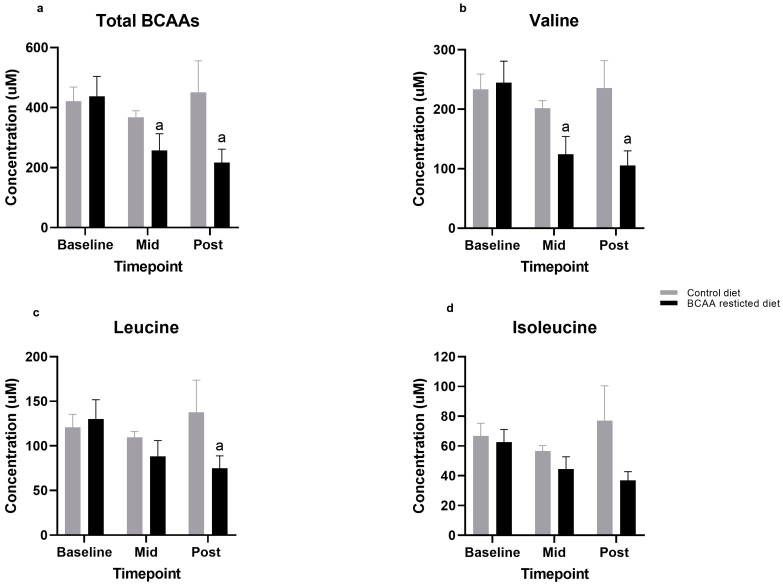
Elevated circulating branched-chain amino acids (BCAAs; isoleucine, leucine, and valine) are associated with obesity and type 2 diabetes (T2D). Reducing circulatory BCAAs by dietary restriction was suggested to mitigate these risks in rodent models, but this is a challenging paradigm to deliver in humans. We aimed to design and assess the feasibility of a diet aimed at reducing circulating BCAA concentrations in humans, while maintaining energy balance and overall energy/protein intake. Twelve healthy individuals were assigned to either a 7-day BCAA-restricted diet or a 7-day control diet. Diets were iso-nitrogenous and iso-caloric, with only BCAA levels differing between the two. The BCAA-restricted diet significantly reduced circulating BCAA concentrations by ~50% i.e., baseline 437 ± 60 to 217 ± 40 µmol/L ( < 0.005). Individually, both valine (245 ± 33 to 105 ± 23 µmol/L; < 0.0001), and leucine (130 ± 20 to 75 ± 13 µmol/L; < 0.05), decreased significantly in response to the BCAA-restricted diet. The BCAA-restricted diet marginally lowered Homeostatic Model Assessment of Insulin Resistance (HOMA-IR) levels: baseline 1.5 ± 0.2 to 1.0 ± 0.1; ( = 0.096). We successfully lowered circulating BCAAs by 50% while maintaining iso-nitrogenous, iso-caloric dietary intakes, and while meeting the recommended daily allowances (RDA) for protein requirements. The present pilot study represents a novel dietary means by which to reduce BCAA, and as such, provides a blueprint for a potential dietary therapeutic in obesity/diabetes.
循环中支链氨基酸(BCAA;异亮氨酸、亮氨酸和缬氨酸)水平升高与肥胖和 2 型糖尿病(T2D)有关。在啮齿动物模型中,通过饮食限制来减少循环 BCAA 被认为可以降低这些风险,但在人类中实施这一方案具有挑战性。我们旨在设计并评估一种旨在降低人类循环 BCAA 浓度的饮食方法的可行性,同时保持能量平衡和整体能量/蛋白质摄入。12 名健康个体被分配到 7 天 BCAA 限制饮食或 7 天对照饮食组。两种饮食的氮和热量均相同,仅 BCAA 水平在两组之间有所不同。BCAA 限制饮食可使循环 BCAA 浓度显著降低约 50%,即从基线的 437 ± 60 µmol/L 降至 217 ± 40 µmol/L(<0.005)。单独来看,缬氨酸(245 ± 33 至 105 ± 23 µmol/L;<0.0001)和亮氨酸(130 ± 20 至 75 ± 13 µmol/L;<0.05)的水平在对 BCAA 限制饮食的反应中均显著下降。BCAA 限制饮食使稳态模型评估的胰岛素抵抗(HOMA-IR)水平略有降低:从基线的 1.5 ± 0.2 降至 1.0 ± 0.1(=0.096)。我们成功地将循环 BCAA 降低了 50%,同时保持了氮和热量的摄入相同,并满足了蛋白质需求的推荐日摄入量(RDA)。本初步研究代表了一种通过饮食降低 BCAA 的新方法,为肥胖/糖尿病的潜在饮食治疗提供了蓝图。