Department of Environmental Health, College of Medicine & Health Sciences, School of Public Health, Bahir Dar University, Bahir Dar, Ethiopia.
Department of Epidemiology and Biostatistics, College of Medicine & Health Sciences, School of Public Health, Bahir Dar University, Bahir Dar, Ethiopia.
Environ Health Prev Med. 2021 Jan 4;26(1):1. doi: 10.1186/s12199-020-00923-z.
Household air pollution from biomass fuels burning in traditional cookstoves currently appeared as one of the most serious threats to public health with a recent burden estimate of 2.6 million premature deaths every year worldwide, ranking highest among environmental risk factors and one of the major risk factors of any type globally. Improved cookstove interventions have been widely practiced as potential solutions. However, studies on the effect of improved cookstove interventions are limited and heterogeneous which suggested the need for further research.
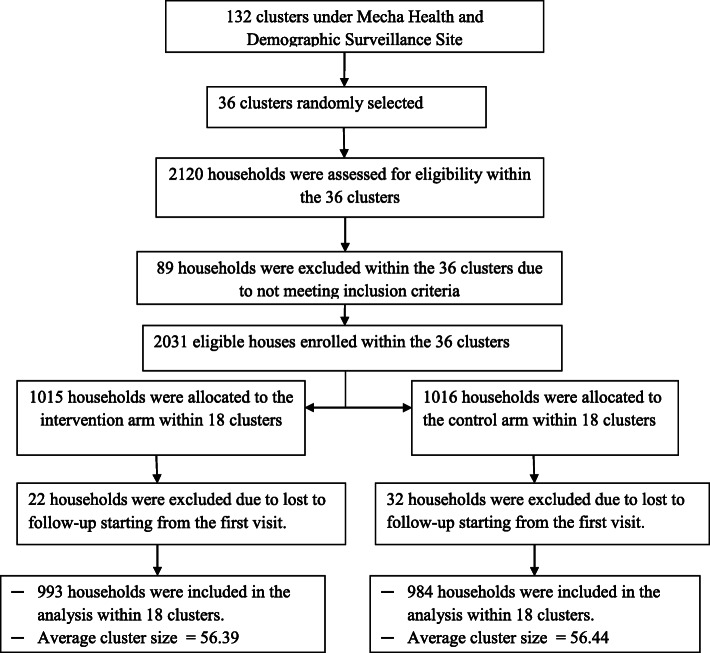
A cluster randomized controlled trial study was conducted to assess the effect of biomass-fuelled improved cookstove intervention on the concentration of household air pollution compared with the continuation of an open burning traditional cookstove. A total of 36 clusters were randomly allocated to both arms at a 1:1 ratio, and improved cookstove intervention was delivered to all households allocated into the treatment arm. All households in the included clusters were biomass fuel users and relatively homogenous in terms of basic socio-demographic and cooking-related characteristics. Household air pollution was determined by measuring the concentration of indoor fine particulate, and the effect of the intervention was estimated using the Generalized Estimating Equation.
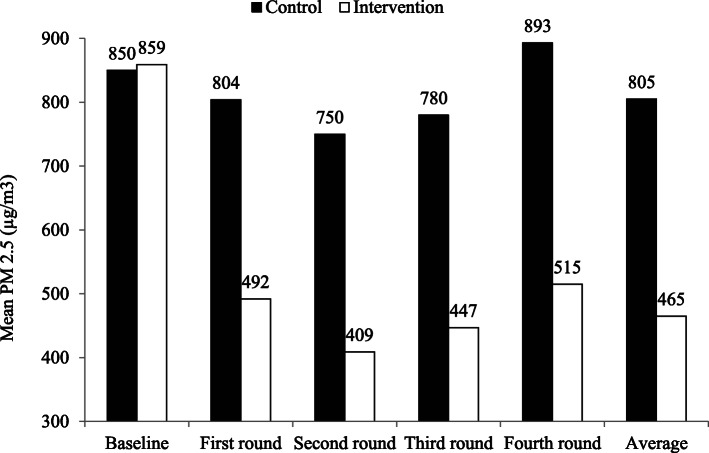
A total of 2031 household was enrolled in the study across 36 randomly selected clusters in both arms, among which data were obtained from a total of 1977 households for at least one follow-up visit which establishes the intention-to-treat population dataset for analysis. The improved cookstove intervention significantly reduces the concentration of household air pollution by about 343 μg/m (Ḃ = - 343, 95% CI - 350, - 336) compared to the traditional cookstove method. The overall reduction was found to be about 46% from the baseline value of 859 (95% CI 837-881) to 465 (95% CI 458-472) in the intervention arm compared to only about 5% reduction from 850 (95% CI 828-872) to 805 (95% CI 794-817) in the control arm.
The biomass-fuelled improved cookstove intervention significantly reduces the concentration of household air pollution compared to the traditional method. This suggests that the implementation of these cookstove technologies may be necessary to achieve household air pollution exposure reductions.
The trial project was retrospectively registered on August 2, 2018, at the clinical trials.gov registry database ( https://clinicaltrials.gov/ ) with the NCT03612362 registration identifier number.
来自传统炉灶燃烧生物质燃料的家庭空气污染目前被认为是对公众健康最严重的威胁之一,全球每年有 260 万人因此过早死亡,这一数字在环境风险因素中排名最高,也是任何类型的主要风险因素之一。改良炉灶干预措施已被广泛应用作为潜在的解决方案。然而,关于改良炉灶干预措施效果的研究有限且存在异质性,这表明需要进一步研究。
本研究采用了一项集群随机对照试验,旨在评估与继续使用开放式燃烧传统炉灶相比,生物质燃料改良炉灶干预对家庭空气污染浓度的影响。共有 36 个集群以 1:1 的比例随机分配到两个治疗组,所有分配到治疗组的家庭都接受了改良炉灶干预。所有纳入的家庭都使用生物质燃料,并且在基本社会人口学和烹饪相关特征方面相对同质。通过测量室内细颗粒物浓度来确定家庭空气污染程度,使用广义估计方程来估计干预效果。
共有 2031 户家庭参加了这项研究,涉及 36 个随机选择的对照组和治疗组集群,其中至少有一个随访的家庭共有 1977 户,这为分析建立了意向治疗人群数据集。与传统炉灶方法相比,改良炉灶干预可显著降低约 343μg/m³的家庭空气污染浓度(B = -343,95%置信区间 -350,-336)。与对照组相比,干预组的总体降幅约为 46%,从基线值 859(95%置信区间 837-881)降至 465(95%置信区间 458-472),而对照组仅从 850(95%置信区间 828-872)降至 805(95%置信区间 794-817),降幅约为 5%。
与传统方法相比,生物质燃料改良炉灶干预可显著降低家庭空气污染浓度。这表明,为了实现家庭空气污染暴露量的降低,可能有必要实施这些炉灶技术。
该试验项目于 2018 年 8 月 2 日在临床试验注册数据库(https://clinicaltrials.gov/)进行了回顾性注册,注册标识符为 NCT03612362。