
加纳改善婴幼儿健康的炊具干预措施的整群随机试验。
A cluster randomised trial of cookstove interventions to improve infant health in Ghana.
机构信息
Department of Environmental Health Sciences, Columbia University, New York, New York, USA
Kintampo Health Research Centre, Research and Development Division, Ghana Health Service, Kintampo North Municipality, Ghana.
出版信息
BMJ Glob Health. 2021 Aug;6(8). doi: 10.1136/bmjgh-2021-005599.
INTRODUCTION
Household air pollution from solid fuel combustion for cooking and heating is a leading cause of childhood morbidity and mortality worldwide. We hypothesised that clean cooking interventions delivered during pregnancy would improve child health.
METHODS
We conducted a cluster randomised trial in rural Ghana to test whether providing pregnant women liquefied petroleum gas (LPG) cookstoves or improved biomass cookstoves would reduce personal carbon monoxide and fine particulate pollution exposure, increase birth weight and reduce physician-assessed severe pneumonia in the first 12 months of life, compared with control participants who continued to cook with traditional stoves. Primary analyses were intention-to-treat. The trial was registered with ClinicalTrials.gov and follow-up is complete.
RESULTS
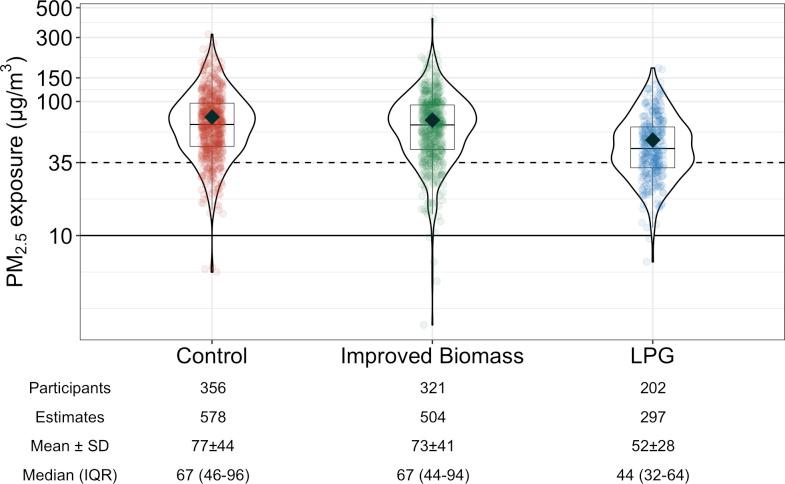
Enrolment began on 14 April 2014, and ended on 20 August 2015. We enrolled 1414 pregnant women; 361 in the LPG arm, 527 in the improved biomass cookstove arm and 526 controls. We saw no improvement in birth weight (the difference in mean birth weight for LPG arm births was 29 g lighter (95% CI -113 to 56, p=0.51) and for improved biomass arm births was 9 g heavier (95% CI -64 to 82, p=0.81), compared with control newborns) nor severe child pneumonia (the rate ratio for pneumonia in the LPG arm was 0.98 (95% CI 0.58 to 1.70; p=0.95) and for the improved biomass arm was 1.21 (95% CI 0.78 to 1.90; p=0.52), compared with the control arm). Air pollution exposures in the LPG arm remained above WHO health-based targets (LPG median particulate matter less than 2.5 microns in diameter (PM) 45 µg/m³; IQR 32-65 vs control median PM 67 µg/m³, IQR 46-97).
CONCLUSIONS
Neither prenatally-introduced LPG nor improved biomass cookstoves improved birth weight or reduced severe pneumonia risk in the first 12 months of life. We hypothesise that this is due to lower-than-expected exposure reductions in the intervention arms.
TRIAL REGISTRATION NUMBER
NCT01335490.
简介
家庭烹饪和取暖用固体燃料造成的空气污染是导致全球儿童发病率和死亡率的主要原因。我们假设,在怀孕期间进行清洁烹饪干预将改善儿童健康。
方法
我们在加纳农村进行了一项整群随机试验,以测试为孕妇提供液化石油气(LPG)炊具或改进的生物质炊具是否会减少个人接触一氧化碳和细颗粒物污染,增加出生体重,并减少 12 个月内医生评估的严重肺炎,与继续使用传统炉灶烹饪的对照组相比。主要分析是意向治疗。该试验在 ClinicalTrials.gov 上注册,随访已完成。
结果
招募工作于 2014 年 4 月 14 日开始,于 2015 年 8 月 20 日结束。我们共招募了 1414 名孕妇;LPG 组 361 名,改进的生物质炊具组 527 名,对照组 526 名。我们没有看到出生体重的改善(LPG 组出生体重的平均差异轻 29 克(95%CI-113 至 56,p=0.51),改进的生物质组出生体重重 9 克(95%CI-64 至 82,p=0.81),与对照组新生儿相比),也没有严重的儿童肺炎(LPG 组肺炎的发生率比为 0.98(95%CI0.58 至 1.70;p=0.95),改进的生物质组为 1.21(95%CI0.78 至 1.90;p=0.52),与对照组相比)。LPG 组的空气污染暴露仍然高于世界卫生组织基于健康的目标(LPG 中小于 2.5 微米的颗粒物(PM)45μg/m³;IQR32-65 与对照组 PM67μg/m³,IQR46-97)。
结论
无论是产前引入的 LPG 还是改进的生物质炊具都没有改善出生体重或降低 12 个月内严重肺炎的风险。我们假设这是由于干预组的暴露减少低于预期。
试验注册号
NCT01335490。


 Zotero 插件