Department of Pathophysiology, Key Lab of Neurological Disorder of Education Ministry, School of Basic Medicine, Tongji Medical College, Huazhong University of Science and Technology, Wuhan, 430030, PR China.
The Institute of Brain Research, Collaborative Innovation Center for Brain Science, Huazhong University of Science and Technology, Wuhan, 430030, PR China.
Cell Death Differ. 2021 May;28(5):1548-1562. doi: 10.1038/s41418-020-00685-9. Epub 2021 Jan 4.
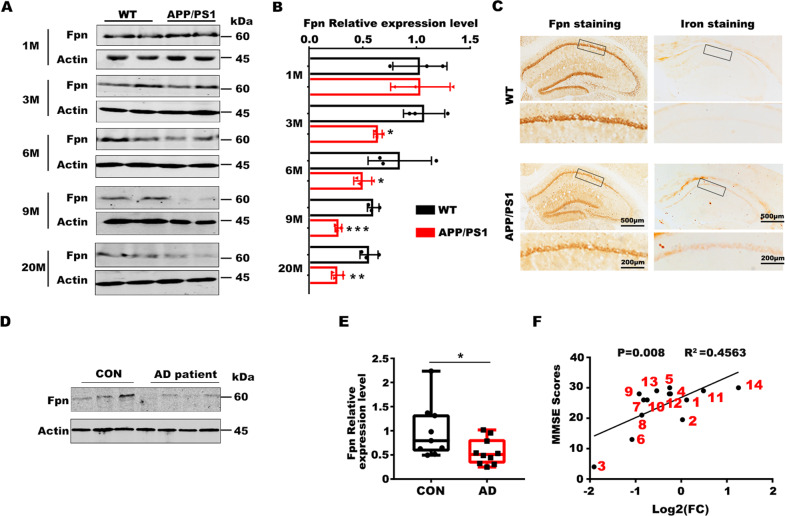
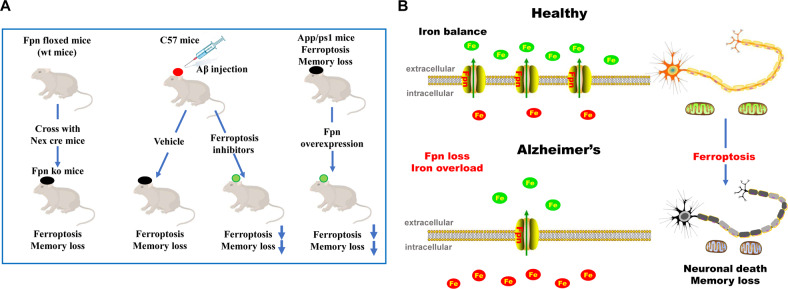
Iron homeostasis disturbance has been implicated in Alzheimer's disease (AD), and excess iron exacerbates oxidative damage and cognitive defects. Ferroptosis is a nonapoptotic form of cell death dependent upon intracellular iron. However, the involvement of ferroptosis in the pathogenesis of AD remains elusive. Here, we report that ferroportin1 (Fpn), the only identified mammalian nonheme iron exporter, was downregulated in the brains of APPswe/PS1dE9 mice as an Alzheimer's mouse model and Alzheimer's patients. Genetic deletion of Fpn in principal neurons of the neocortex and hippocampus by breeding Fpn mice with NEX-Cre mice led to AD-like hippocampal atrophy and memory deficits. Interestingly, the canonical morphological and molecular characteristics of ferroptosis were observed in both Fpn and AD mice. Gene set enrichment analysis (GSEA) of ferroptosis-related RNA-seq data showed that the differentially expressed genes were highly enriched in gene sets associated with AD. Furthermore, administration of specific inhibitors of ferroptosis effectively reduced the neuronal death and memory impairments induced by Aβ aggregation in vitro and in vivo. In addition, restoring Fpn ameliorated ferroptosis and memory impairment in APPswe/PS1dE9 mice. Our study demonstrates the critical role of Fpn and ferroptosis in the progression of AD, thus provides promising therapeutic approaches for this disease.
铁稳态失调与阿尔茨海默病(AD)有关,过量的铁会加剧氧化损伤和认知缺陷。铁死亡是一种依赖于细胞内铁的非细胞凋亡形式的细胞死亡。然而,铁死亡在 AD 发病机制中的作用仍不清楚。在这里,我们报告铁蛋白(Fpn),即唯一被鉴定的哺乳动物非血红素铁输出蛋白,在 APPswe/PS1dE9 小鼠(一种 AD 小鼠模型)和 AD 患者的大脑中下调。通过将 Fpn 小鼠与 NEX-Cre 小鼠杂交,在大脑新皮层和海马体的主要神经元中敲除 Fpn,导致类似 AD 的海马体萎缩和记忆缺陷。有趣的是,在 Fpn 和 AD 小鼠中都观察到了铁死亡的典型形态和分子特征。铁死亡相关 RNA-seq 数据的基因集富集分析(GSEA)表明,差异表达基因高度富集在与 AD 相关的基因集上。此外,特异性铁死亡抑制剂的给药可有效减少体外和体内 Aβ 聚集诱导的神经元死亡和记忆损伤。此外,恢复 Fpn 可改善 APPswe/PS1dE9 小鼠的铁死亡和记忆障碍。我们的研究表明 Fpn 和铁死亡在 AD 进展中的关键作用,因此为这种疾病提供了有前途的治疗方法。